The Catholic Church needs an “independent ecclesiastical commission” to evaluate bishops’ ad limina visits.
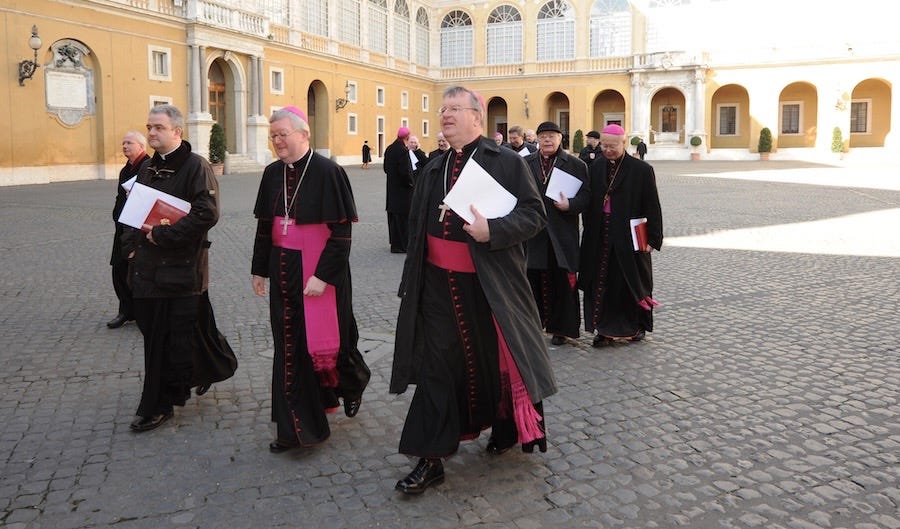
That is one of the conclusions of a nine-page document released Sept. 8 by the Vatican’s General Secretariat of the Synod on the visits that regional groupings of bishops are required to make roughly every five years to Rome.
The text also calls for online follow-up meetings between bishops and officials of the Roman curia to address issues raised during what are formally known as visits ad limina apostolorum (“to the threshold of the apostles”).
But the document acknowledges that sweeping changes to the ad limina visit process requested by bishops might not be feasible because they could add significantly to the workload of an already stretched Roman curia.
“The Ad Limina Visits in a Missionary Synodal Perspective” is the second text prepared by Study Group 7, one of 10 groups established by Pope Francis in 2024 after the synod on synodality’s first session in Rome.
Study Group 7, which was led by the German Bishop Felix Genn, issued its first document, on the selection of bishops, May 5. Other members of the group included Cardinal Robert Francis Prevost, before his election as Pope Leo XIV, Cardinal Luis Antonio Tagle, Cardinal Mario Grech, Cardinal Claudio Gugerotti, and Cardinal Jean-Claude Hollerich, the synod on synodality’s relator general.
The final reports of the 10 study groups are defined as “working documents.” When a study group submits its final report to the General Secretariat of the Synod, it has completed its mandate and is dissolved.
Vatican officials will go through each of the final reports, looking for “operative proposals” that will be presented to Pope Leo XIV, who will decide whether they should be enacted.
The new document, written in Italian and available in an English working translation, responds to a request in the synod on synodality’s 2024 final document for a review of how ad limina visits can become “more and more an opportunity for open exchange and mutual listening.”
The text explores the ecclesial and theological significance of ad limina visits, which the final document described as “the apex of the relation between the bishops of local Churches and the Bishop of Rome and his closest collaborators in the Roman Curia.”
The visits currently follow the procedure set out in the 1988 Directory for the Ad Limina Visit, which notes that the two main purposes of ad limina trips are for bishops to venerate the tombs of Sts. Peter and Paul and to meet with the pope. Bishops are expected to prepare reports on their dioceses ahead of the visits, with the help of a Vatican questionnaire.
The document calls for the creation of a new interdicasterial body at the Vatican under the coordination of the Prefecture of the Papal Household, which oversees the pope’s daily schedule. It says the new body should receive input from the Vatican Secretariat of State, as well as from the General Secretariat of the Synod, to “ensure the synodal quality of its work.”
The text says the new body is necessary to oversee the logistical aspects of ad limina visits and oversee the implementation of proposals to reform the process.
The document suggests that bishops should take a synodal approach to preparing for their ad limina visits, encouraging them to “convoke the People of God so that they may engage co-responsibly in the preparation of the preliminary report.”
The text also calls for an overhaul of the Vatican questionnaire, so that it focuses less on statistics, is better tailored to each local Church, and gives more space for bishops to say what they expect from an ad limina visit.
The document notes that, “because of the pope’s increased commitments and the growth in the number of local Churches throughout the world,” it is no longer possible for ad limina visits to take place every five years. It expresses hope that the trips will take place “at least every eight years.”
It also appeals for an assessment of safeguarding procedures to be an integral part of ad limina visits, recommending that bishops “submit a specific report to be discussed in Rome also with the Pontifical Commission for the Protection of Minors.”
The document urges bishops to report back to the local Church on the outcome of their ad limina visits “through one or more public meetings.”
“In the meantime, where the ad limina visit has brought to light matters requiring further dialogue between the local Churches and the Roman bodies, online meetings or even visits to the local Churches by representatives of the Curia may be arranged in order to foster ongoing accompaniment, monitoring, and mutual learning,” the text says.
It adds: “In any event, provision should be made, between one ad limina visit and the next, for a mid-term online meeting between the bishops and representatives of the curia, during which a discernment may be made concerning the fruits that the visit is bearing and any difficulties that continue to persist.”
The document says that at regular intervals, “an independent ecclesiastical commission should be established to evaluate the entire process.”
“Its evaluation should also include the work of the coordinating body and of the competent curial institutions, with the aim of ensuring that the ad limina visit becomes ever more fully suited to its purpose.”
The General Secretariat of the Synod released one other study group report Sept. 8. The final report of Study Group 6 addresses relations between bishops, consecrated life, and ecclesial associations.
The document proposes the development of new criteria for approving the creation of new institutes of consecrated life and the appointment of a delegate for consecrated life in every diocese.
As of Sept. 8, seven of the 10 original study groups have issued a final report. The three that have yet to report are Study Group 1, on relations between the Eastern Catholic Churches and the Latin Church, Study Group 8, on the role of papal representatives, and Study Group 10, on ecumenism.
Final reports are also expected from two additional groups, on “The Liturgy in a Synodal Perspective” and “The Statute of Episcopal Conferences, Ecclesial Assemblies and Particular Councils” respectively. The two groups were added by Pope Leo XIV.
The study groups are accompanied by three commissions, the Canonical Commission, the Eastern Canonical Commission, and the SECAM Commission on Polygamy, which issued its final report in March. The final reports of the other two commissions are pending.
The General Secretariat of the Synod said Sept. 8 that Study Group 7 would continue to work on a third topic assigned to it, on the judicial function of the bishop. The text “will be published upon completion of the work.”

Vatican committee on topic proposes new committee on same topic. Tale as old as time.
One more layer of bureaucracy to add to the curia, giving the appearance of synodaling synodality...glad it's just a working document.