Syro-Malabar bishops avoid flashpoints at Modi meeting
While avoiding specific recent cases, the bishops did discuss minority rights and the role of religious minorities
Bishops of the Syro-Malabar Catholic Church reportedly avoided controversial topics during a Tuesday meeting with India’s Prime Minister Narendra Modi.
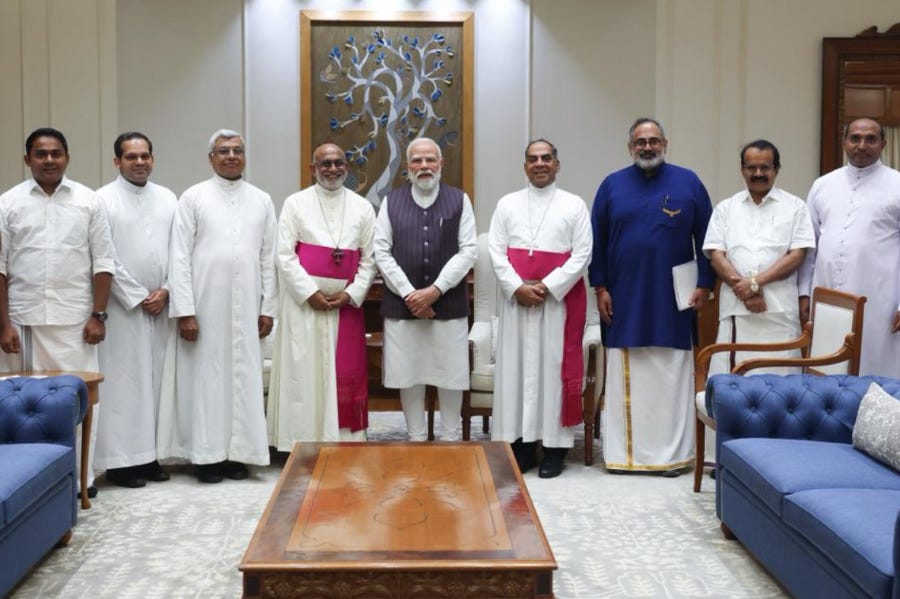
Indian Catholic media said the Nov. 4 discussion at the prime minister’s residence in New Delhi did not address the controversial July arrest of two nuns in Chhattisgarh state or recent attacks on religious minorities.
But Modi and the delegation of senior Syro-Malabar bishops led by Major Archbishop Raphael Thattil, the head of the Kerala-based Eastern Catholic Church, did touch on minority rights and the role of religious minorities in nation-building.
Thattil described the Nov. 4 meeting as a courtesy visit, while Modi called the gathering a “wonderful interaction.”
Rajeev Chandrasekhar, the state president of Modi’s Bharatiya Janata Party in Kerala, said that at the end of the gathering, the prime minister told the bishops: “I am always there to serve you.”
“A general discussion about minority rights took place, and the PM emphasized that it is a party and government which works for everyone. He added that we will be there for them and are ready to help,” Chandrasekhar said.
The meeting was notable because the Hindu nationalist BJP has been seeking to cultivate ties with India’s Catholic minority, especially in Kerala, where the party has struggled to gain traction but secured an electoral breakthrough in 2024.
Modi, who has led India since 2014, has increased his meetings with Christian leaders in recent years. He visited New Delhi’s Sacred Heart Cathedral in April 2023 and received Christian leaders at his residence on Christmas Day that year. He became the first Indian prime minister to visit the Catholic Bishops’ Conference of India’s headquarters in New Delhi in December 2024.
But despite Modi’s outreach, many Indian Catholics remain concerned at widespread violations of religious freedom, which are often reported in BJP-run states.
The bishops’ meeting with Modi came shortly after the Syro-Malabar Church criticized the posting of hoardings in eight villages in the BJP-led Chhattisgarh state forbidding entry to Christian pastors.
The Church lamented an Oct. 28 ruling by the Chhattisgarh High Court that the signs did not violate India’s constitution.
“By putting up these boards banning pastors and converted Christians in certain villages of Chhattisgarh, a new chariot march of institutionalized communalism has been set in motion,” it said Nov. 3.
Communalism in India refers to the advancing of one religious group’s interests over those of others.
The Indian news site Onmanorama reported that the Syro-Malabar bishops submitted a request to Modi to invite Pope Leo XIV to India.
Modi invited Leo XIV’s predecessor, Pope Francis, to visit the country in 2021 and again in 2024. The last papal trip to India took place in 1999, when Pope John Paul II visited New Delhi.
Around 80% of India’s roughly 1.4 billion population are Hindus. Roughly 14% are Muslim and 2% Christian.
India’s more than 20 million Catholics generally belong to the Latin Church, Syro-Malabar Church, or Syro-Malankara Church.
The Syro-Malabar Church has around five million members, concentrated in Kerala state, but is also present around the world, including in the U.S., U.K., and Australia.


I once read that more people worship in a church in India on a Sunday morning than across all of Western Europe. I wonder if that’s true.
When I was last in India I visited Kerala and was told moved by the faith and beauty of the Christians that live there. Let’s pray for all Christians in India, and for the continual Catholic revival in showing our Hindu friends the light of Christ.