Hey everybody,
Today’s the feast of St. John Vianney, and you’re reading The Tuesday Pillar Post.
If you’re a parish priest, today’s your day. If you’re not, today’s the day for your parish priest.
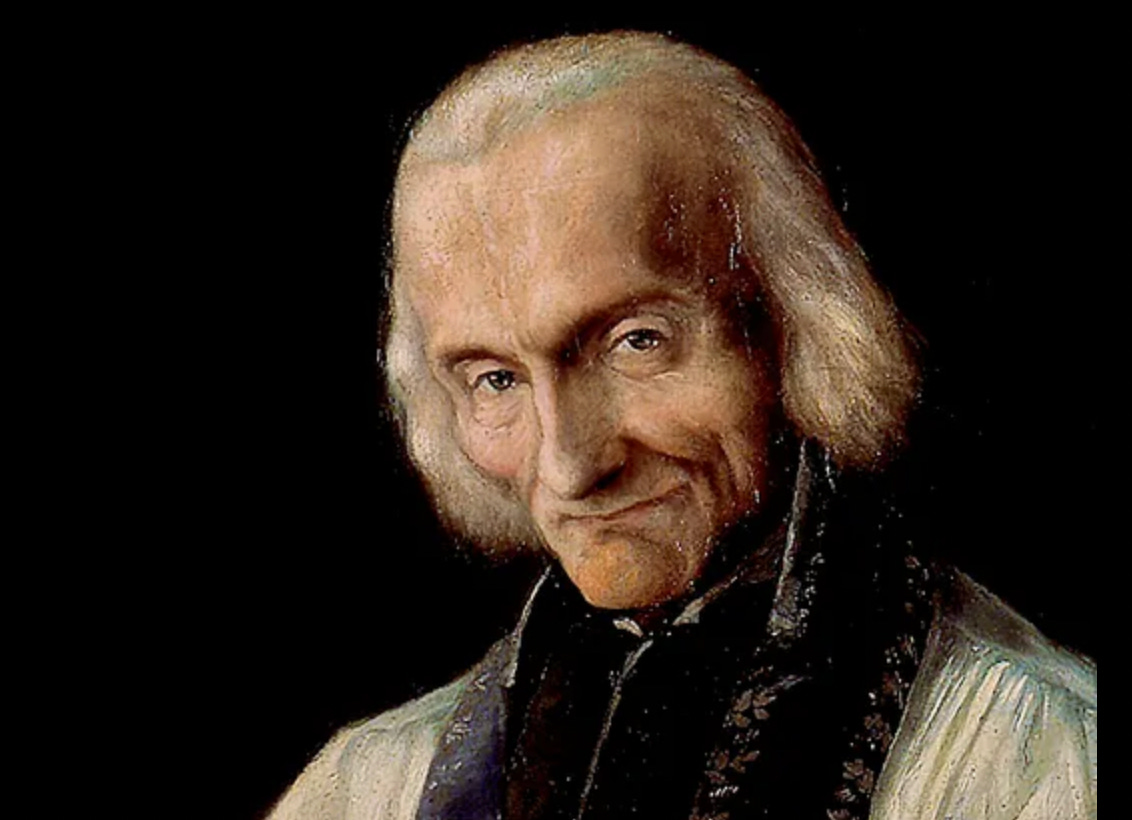
Most of you know something about his story: He was born in the French Revolution’s reign of anticlericalism, in which priests either swore loyalty to the regime and its philosophy, or found themselves going underground, and offering sacraments was for them illegal.
His devout farming parents traveled to Masses in homes and on farms; insofar as I can tell, his first communion was in a barn.
The witness of those priests made him want to be one, but the path was twisted and rocky: His father would not at first assent, and by the time he did, John had almost no education and struggled in every part of his academic formation. He was poor and ill-prepared, and people thought he was foolish.
But he was persistently faithful.
Through a forced and unexpected military conscription, through illness, through an accidental military desertion that came when he couldn’t find his unit, and that put him on the wrong side of the law, he was faithful. And then, having endured all that, he was faithful through skepticism in his diocese about whether he should be ordained at all.
He was ordained, and after he was a parochial vicar, he was sent to a peasant parish of 230 people. There he stayed for the rest of his life: A little parish in a little village in a little corner of France.
But he wanted to be a good priest. He got people to start going to Mass on Sundays. He got them to come to confession. He fixed with his own hands their ugly and badly maintained church. He got to know them, and he preached to them, and he offered them God’s mercy. He did most of that by living faithfully, with such earnestness that people were convicted.
In all of that, his interior life grew, so that as he offered up a lot of suffering, God seemed to give him the opportunity for more: People gossipped about him, priests didn’t always like him, he seems to have battled the devil, night after night. I think there were consolations which went along with that — deep, mystical insights into the goodness and love of God. But they were hard won.
For me, the story of John Vianney is one of those near-mythical saint tales that can feel far from my own reality. He exercised heroic patience, I exercise almost none. He was unflappably penitent, while I am dispositionally permissive with myself. He had love for souls where I have often love of self.
But it seems romantic because we tell it with gauzy piety. It was actually hard, each part of his life, and likely discouraging, and he doubtlessly had the temptations to comfort, and self-pity, and self-indulgence. He was a person, not a cartoon character, nor a SuperPriests mascot.
But if he wanted us to know something, it was a lesson to which he would not have become so zealously committed if he didn’t actually know how much it mattered: That in the sacrament of penance, to which he gave his life, is the chance to start again, and then to let God build on small beginnings, by the patient persistence of mercy.
I’ll text my pastor today, and tell him I appreciate him, sure. But I think the real lesson is that Christ is waiting for me in the confessional, through the ministry of his priests, to build something good from the most unlikely of beginnings.
—
The news
Officials have said it is the most destructive wildfire situation in the state’s history, largely because of the fires’ vicinity to residential neighborhoods.
The Pillar spoke with Bishop Thomas Daly about the fires, and about the challenges of a pastoral response.
The appointments come after Pope Leo has had more than a year in office, and seen a modest slate of Chinese episcopal appointments pass across his desk. This means the pontiff has had time to gauge the internal workings of the Holy See’s deal with the Chinese Communist Party.
With that under his belt, what could be the scope of the pope’s ambitions for improving the Church’s lot in China?
Ed Condon takes a good look at the state of affairs.
—
Religious freedom activists say that the first step of such persecution is the passage of “anti-conversion” laws, whose stated aim is to prevent coerced conversion. Such laws, they say, where they exist, are often weaponized against Christians, who face accusations of proselytization even for such offenses as performing works of mercy or acts of worship.
Which is why the Archdiocese of Bombay is pushing back over the Maharashtra Freedom of Religion Act of 2026, which according to the archdiocese, “creates scope for undue scrutiny or surveillance of prayer meetings, schools, hospitals and social-service centres run by minority institutions.”
—
I call your attention to a special episode of The Pillar Podcast.
I sat down recently with Bishop Andrew Cozzens to talk about the National Eucharistic Congress — how it happened, what it meant for him personally, and what lessons were learned.
“It’s happened to me a couple times in my life where you get caught up in something the Holy Spirit is doing,” Bishop Cozzens told me.
He’s worth listening to. Do that here.
—
But more than a month later, that expected papal action has not come.
In an analysis on the subject, Edgar Beltran asks whether the pontiff intends a kind of soft reform — keeping existing liturgical policies on the books, while moving toward a more generous application.
—
Pope Leo XIV issued a new Fundamental Law of Vatican City State last week, replacing a previous version adopted in 2023.
Prepare your diocese for 2027’s Education Freedom Tax Credits with the Catholic Education Fund. Our turnkey SGO solution provides shared infrastructure, compliance, fundraising, and distribution at scale—delivering national reach with local impact. Don’t navigate this alone. Join our national network of dioceses as a Partner. Let’s grow Catholic education, together.
I am in Houston, Texas today, to give some talks at the Leadership Summit of Amazing Parish, which is a non-profit that gives coaching to parish pastors and the people who work with them.
(They didn’t pay me to say that or anything, I just know a bunch of Pillar reader pastors who use their services and are happy with them.)
Last night, when I should have gone to the opening address, I instead walked three blocks to take in a Houston Astros game, but the truth is that I found the Field-Formerly-Known-As-Enron to be so soulless and arid that I’m now certain I made a mistake.
If I weren’t going to listen to the talk, I ought instead to have gone to see some of the historic churches of this city, whose mixture of mission and French influence make them well-reflective of the fascinating history of Catholicism in Texas.
That history can’t be told without the story of Bishop Claude Dubuis, who left France for Texas on February 19, 1846, while St. John Vianney was serving in the parish of Ars, and on the very day the Republic of Texas joined these United States.
Dubuis is a fascinating guy.
He came, like a lot of French missionaries, as a part of a trend that began during the Republic of Texas days, and largely because the republic was supported diplomatically by the French — in some ways at the behest of the Vatican, which had hoped that French recognition of the Texas republic would help encourage Protestant and somewhat-anti-Catholic Texas public officials to tolerate the Church and her people.
By the time Dubuis arrived as a young Holy Cross priest on Texas soil, the circumstances had changed considerably, and Texas was American. But the Church was very French, at least in her clerical classes.
Dubuis was tough. He was pastor to German farm and ranching settlers who provided him a hut to live in at the beginning. He traveled the vast territory of his parish on horseback; he slept in trees to avoid both snakes and floodwaters. He was captured four times by the Comanche, before he began learning their language and inviting them into his church.
In 1850, he traveled to France to bring back more priests, regaling seminarians with stories of frontier priestly life, and signing them up in droves. Then, as he became vicar general of the Galveston diocese, he started bringing sisters to staff schools.
He learned Spanish, English, German, Alsatian, and the aforementioned Comanche. He learned to eat cornbread and salt bacon, and to endure the noonday heat.
In 1862, frontier-hardened and with dirt under his nails, he became the second bishop of Galveston. He was consecrated a bishop in France, where he’d traveled to make a vocations visit and to stop in at the Apostolic See for some business.
To come back — with the Civil War raging — he had to be ferried through a Union blockade, along with 60 priests, sisters, and seminarians he had brought with him from France.
He buried people during a cholera outbreak, and he went to Vatican Council I with dust in his hat.
He had more than 150,000 Catholics, over a vast Texas territory, and fewer than 90 priests, most of whom were French. Some of those priests flirted with French-ish Jansenism, and Dubuis had to help them find a path that would work on the frontier, while they also adapted to a very different status for the Church than they had enjoyed in France. He also had to deal with priests who couldn’t adapt and returned to France, and a small number who disappeared out onto the plains, some for marriage, some just walking off without so much as a letter.
But Dubuis was committed, he became a Texan, and he loved his people.
In 1881, at 64, he was traveling to France for vocations work when he began taking ill. He had terrible arthritis, and a lot of miles on his body. He stayed to recover in his family home. So far as I can tell, as a year or so passed, he was asked to resign, but he didn’t. It seems he expected to go back to Texas.
He didn’t make it. In fact for the next 12 years, he remained bishop of Galveston, but living in France.
In those days, before the great centralization of the 20th century, a diocesan bishop wasn’t easily or often removed. And Dubuis wasn’t. I don’t really understand why he didn’t resign. I think, as best as I can tell, he really hoped to get back. He was a Texan, and a missionary.
For the diocese, that was a hardship. Bishop Nicolaus Gallagher — himself an Ohio boy — became coadjutor in 1882, but he had to run the diocese as apostolic administrator for the next decade. He opened schools and encouraged religious orders, but he had to do all of that in the strange liminal period of a protracted episcopal absence, in which the see wasn’t impeded, but the bishop wasn’t there, either.
I don’t know if Gallagher looked north for wisdom on that subject, but he could have.
See, in 1859 — the year Vianney died, as it happens — a man named Bishop James Duggan became the fourth bishop of Chicago. Irish-born and with a basically broke diocese, Duggan had faced his own problems. He did his best to work through them, but by 1869, he was suffering from a collapse in mental health, and at the encouragement of other American bishops, Pius IX sent him to a sanatorium in Missouri, where his mental health continued to decline.
For the next decade, Bishop Tom Foley ran the Chicago diocese as a coadjutor — Duggan was apparently not fit mentally to resign, or not willing — and yet Pius IX was disinclined to remove him either. That situation lasted all the way until Foley’s death in 1879, and Duggan’s apparently lucid resignation soon thereafter, which paved the way for Chicago to become an archdiocese, and a new bishop to take the reins.
For his part, Dubuis didn’t resign from office until 1892, whereupon Leo XIII was so grateful to have the situation clarified that he made him a titular archbishop, and saw to it that he could help with confirmation across the city of Lyon.
Reverend Fathers, I’m not sure where your bishop is today. But if he’s not on extended leave in France, or in a sanatorium in Missouri, you probably have something to thank God for.
Please be assured of our prayers, and please pray for us.
Yours in Christ,
JD Flynn
editor-in-chief
The Pillar


