The German Church’s AfD nightmare scenario
Poised to win a state election in Saxony, the controversial party is threatening the church tax system
Germany’s bishops are months away from a potential showdown with a surging political party they have urged Catholics not to vote for because of its “racial-nationalist” attitudes.
The looming confrontation could take place in the state of Saxony-Anhalt, in the former communist East Germany, where voters go to the polls Sept. 6 to elect new representatives to the state parliament.
The Alternative for Germany party — unanimously condemned by the German bishops in 2024 — is projected to win the most seats. The latest poll puts it in first place with 42%, well ahead of the center-right Christian Democratic Union with 24%. If its support continues to grow, the AfD could even approach an outright majority in the Saxony-Anhalt parliament.
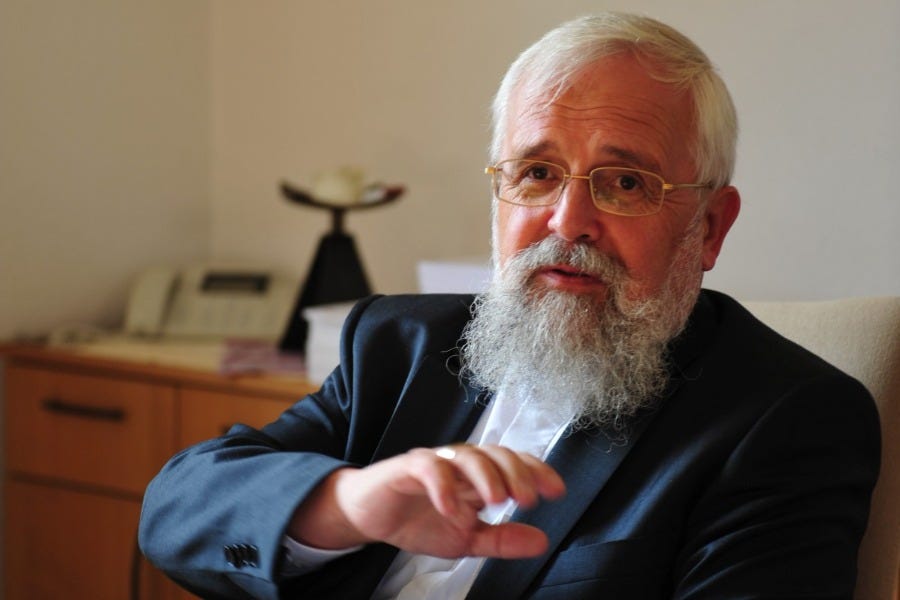
Local Bishop Gerhard Feige has described the possibility that Saxony-Anhalt will become the first of Germany’s 16 states to be controlled by the AfD as an “existential” challenge to the Church as the party has proposed eliminating the German church tax system.
Why are tensions between the bishops and the AfD coming to a head in Saxony-Anhalt? What is the exact nature of the perceived threat? How is the Church responding? And what’s the likely outcome?
Why Saxony-Anhalt?
The state of Saxony-Anhalt is not well known outside of Germany. There are good reasons for that. It was only formed in 1945, then swiftly dissolved after it was incorporated into East Germany, and re-established in 1990, after the fall of the Berlin Wall.
With around 2.2 million people, it is one of the smallest German states in terms of population. It is also one of the poorest, with the second-lowest GDP per capita of the 16 states.
Saxony-Anhalt could be considered the birthplace of the Protestant Reformation because it includes Wittenberg, the town associated with Martin Luther’s 95 Theses. Yet after 40 years of state atheism, it is one of Germany’s most secular regions.
Roughly 235,000 people in the state belong to the Protestant Church of Germany, a federation of 20 Lutheran, Reformed, and United regional churches. Around 66,000 are Catholics, but only 7,000 are Mass-goers. The vast majority of the population is religiously unaffiliated.
The state has proven a fertile ground for the AfD, a party founded in 2013 by disillusioned members of the Christian Democratic Union, with a platform of abolishing the euro, the currency of 20 European Union member states.
Following the arrival of a record 1.1 million asylum seekers in 2015, the COVID pandemic, the Ukraine war, and a cost-of-living crisis, the AfD evolved into what many commentators describe as a far-right party — though many supporters reject the label.
This development violated Germany’s post-war consensus that no party should be formed to the right of the CDU. But while the political establishment deplored the AfD’s metamorphosis, voters rewarded it, especially in the former East Germany. The party came second to the CDU in the 2016 and 2021 Saxony-Anhalt state elections.
In 2024, the German bishops declared that Catholics could not vote for the AfD as it had undergone “several waves of radicalization” and was now “dominated by a racial-nationalist attitude.”
Among the declaration’s most vocal supporters was Bishop Gerhard Feige, head of the Diocese of Magdeburg, which covers most of Saxony-Anhalt. Magdeburg is the second-smallest of Germany’s 27 Catholic dioceses in terms of population. It has long relied on subsidies from the richer western dioceses, subsidies which are decreasing and scheduled to expire.
The Magdeburg diocese is therefore economically fragile. Like other German dioceses, it is seeing a long-term decline in membership, making it doubly vulnerable to outside shocks.
What’s the perceived threat?
The AfD in Saxony-Anhalt released a manifesto in January that promised to support the state’s smaller Christian communities, while cutting financial subsidies to the two biggest communities, the Catholic Church and the Protestant Church in Germany.
The manifesto said: “Our desire to abolish the privileges of churches that levy church taxes does not mean that we reject the Christian faith — on the contrary. It is precisely because we recognize the importance of Christianity that we are targeting churches that levy church taxes, because the large churches are damaging the faith.”
“It is not without reason that they are losing more and more members, while many small churches and religious communities are experiencing a true renaissance of Christianity. We will develop instruments to promote these small churches.”
It added: “Free churches, Baptist congregations, and Orthodox Churches practice an authentic and vital faith that supports the cultural change we are striving for in many ways.”
The manifesto stirred controversy because it threatened two long-established mechanisms by which German states provide financial support to the country’s recognized churches.
The first mechanism is state subsidies. These originated as compensation for the seizure of Church land, property, and assets in the early 1800s. They are paid and administered by individual states, rather than the federal government, but are covered by Germany’s Basic Law, the equivalent of its constitution. The Basic Law foresees the eventual abolition of the payments, but so far no state has attempted to cut them, because doing so would require a substantial one-off payment to the churches.
The second funding mechanism is the church tax. In Germany, religious communities that are corporations under public law have a right to levy taxes on their members. Every person in Germany who declares a Catholic identity on an official registration form is required to pay an 8-9% surcharge on top of their income tax liability, depending on the region in which they live. The sum is collected directly from employees’ paychecks on the Church’s behalf by the state, which claims roughly 3% of the total revenue.
Church tax revenues help keep the German Church’s vast, complex machinery running. They pay the salaries of staff working in pastoral care, schools, and social institutions, and go toward pensions, the upkeep of church buildings, and aid projects abroad.
German state governments do not levy the church tax. They merely collect it. In principle, they could withdraw from the arrangement, but there are practical obstacles. They would need to change state law, which mandates the collections, and renegotiate existing contracts with churches.
What are the possible consequences?
Bishop Feige said in January that if the AfD won the state election and carried out its threat to end state subsidies and the state collection of church tax, the impact would be “dramatic.”
“We don’t have large reserves,” he noted. “Should this happen, we would no longer be able to operate parishes, educational centers, and social services in the same way.”
According to the Magdeburg diocese’s most recently available full financial report, from 2023, it had an annual income of 38.21 million euros (around $44 million), of which 16.08 million euros (42%) came from the church tax and 15.81 million euros (41%) from state subsidies and other grants. Evidently, the AfD manifesto proposal would plunge the diocese into deep financial crisis.
Feige’s Protestant counterpart said his community would suffer the same fate. Karsten Wolkenhauer, head of the Protestant Church of Anhalt, said: “If a new state government stops paying state subsidies and church tax revenue also dries up, we would be bankrupt in less than a year.”
Legal experts have argued that the doomsday scenario set out by Feige and Wolkenhauer cannot be realized because of constitutional safeguards. But the two leaders have insisted that they are not being alarmist.
“Trump is currently demonstrating how it’s done,” Feige argued. “Facts are being created, and we could litigate for years, but the money would be gone.”
Wolkenhauer said that a constitutional challenge would take two or three years, during which the local Church would be insolvent. He argued that even if the Federal Constitutional Court ruled in favor of the churches, an AfD state government could declare a budget emergency and still refuse to pay out.
How is the Church responding?
Bishop Feige took his concerns to the German bishops’ February plenary meeting in Würzburg.
At the end of the gathering, Beate Gilles, the bishops’ conference general secretary, said dioceses were preparing collectively for the possibility of an AfD breakthrough at the state level.
Since 2024, dioceses have contributed to a common fund in case individual dioceses face financial peril. But the procedure for filing a claim needed to be reevaluated because of the new scenario in which a state government could withdraw subsidies without compensation.
The most troubling scenario for German Catholic leaders would be if the threat to state subsidies and state collection of church tax spread beyond Saxony-Anhalt to other parts of the country.
In April, the AfD bloc in Germany’s national parliament submitted a draft bill to abolish state subsidies to churches. The bill has little chance of advancing, but it serves as a symbolic warning that the AfD is prepared to make state funding of churches into a national issue.
Saxony-Anhalt is not the only state heading to the polls in September. The nearby states of Mecklenburg-Vorpommern and Berlin will hold ballots Sept. 20. The AfD is leading in Mecklenburg-Vorpommern and polling in second place in Berlin.
Unlike in Saxony-Anhalt, the AfD in Mecklenburg-Vorpommern hasn’t promised to end state funding of churches in its manifesto. But given the national party’s support for cuts, the churches in Mecklenburg-Vorpommern are preparing for the worst-case scenario anyway.
What’s the likely outcome?
If the latest polls are accurate, the AfD will win the most seats in Saxony-Anhalt and Mecklenburg-Vorpommern, but fall short of the outright majorities that would enable it to govern the states.
Even with a very strong showing, the AfD will be unable to form the state governments because of other parties’ long-standing refusal to enter into a coalition with it — a strategy known as the Brandmauer (firewall).
The only thing that could change this is a huge late surge in support for the AfD. Feige and local Protestant leaders are doing their best to avert that by appealing directly to voters to shun the party.
In April, they issued a joint statement condemning the AfD in Saxony-Anhalt’s manifesto. The local AfD did not appear to respond publicly to the declaration. But individual AfD supporters accused the churchmen of playing politics and engaging in left-wing activism while enjoying state subsidies.
Feige returned to the topic at last week’s Catholic Day, a biannual showcase for the Catholic Church in Germany, held this year in Würzburg. In an interview with Vatican Radio, he argued it was impossible to engage directly with the AfD in Saxony-Anhalt.
“We will try to engage in dialogue with the public, including with people who might vote for them. But we will not have any direct contact with representatives of this party in Saxony-Anhalt,” he said.
“We’ll have to see how the elections turn out, what position we as churches will take, and what challenges we can expect. In any case, the AfD’s government platform — which has already been adopted — is a clear declaration of intent to fight the churches.”
The refusal to engage directly with the AfD was also evident at the Catholic Day as a whole. More than 250 organizations had stalls at the May 13-17 festival, including such diverse bodies as the Society of St. Pius X’s youth wing and an ecumenical group on “BDSM and Christianity.” But the AfD was officially excluded.
The decision not to invite AfD figures to the Catholic Day was likely taken primarily by the lay Central Committee of German Catholics, which organized the event in collaboration with the German bishops’ conference and local diocese. The lay body is a long-standing opponent of the AfD and pushed successfully for a nationwide ban on party members holding Church posts.
While the Vatican has upheld the prohibition, it does not seem to be shunning the AfD to the same extent as the German Church leadership. On May 15, with the Catholic Day in full swing, an AfD representative in Germany’s parliament briefly met with Pope Leo XIV at the Vatican.
Malte Kaufmann said he told the pope “that the AfD fights for the family and Christian values,” adding: “He was pleased to hear this and thanked me for it.”
Although Germany’s bishops and lay leaders have maintained a united front against the party, they remain worried. A new poll suggests their opposition has had only a moderate impact on Catholic opinion.
The survey concluded that 26% of Catholics would vote for the party, compared to 27% of Protestants, 30% of people with no religious affiliation, and 29% of the general population.
This implies that the bishops’ 2024 declaration may have dented Catholic support for the AfD, but by no means destroyed it.
The prospect of an AfD government at the national level remains far off. A federal election is unlikely to be held before 2029. Unless the AfD can somehow build a massive nationwide majority, it won’t be able to win power, given the Brandmauer.
But a state-level breakthrough is a possibility — if not now, then sometime in the next decade. By refusing to engage directly with the AfD, the German Church could be leaving itself with little leverage if its nightmare scenario does come to pass. Meanwhile, the absence of dialogue almost guarantees further escalation.
In Saxony-Anhalt, the AfD has identified the Church’s weak spot. Ironically, given the German Church’s reputation for riches, it turns out to be money.

Could AfD get themselves voted in to the Synodal Way? Would be hilarious.
‘An ecumenical group on “BDSM and Christianity.”’
…Wait what?
Then again maybe it’s just Irme Stetter-Karp in dominatrix mode forcing (most of) the German episcopate clad in gimp suits to lick her stiletto boots while she holds them on a leash. Also known as the Synodal Way…
But seriously, what?