
When a group of U.S. bishops visited the White House last Thursday for a meeting they were told would include Secretary of State Marco Rubio and Vice President JD Vance, it’s not clear what they were expecting.
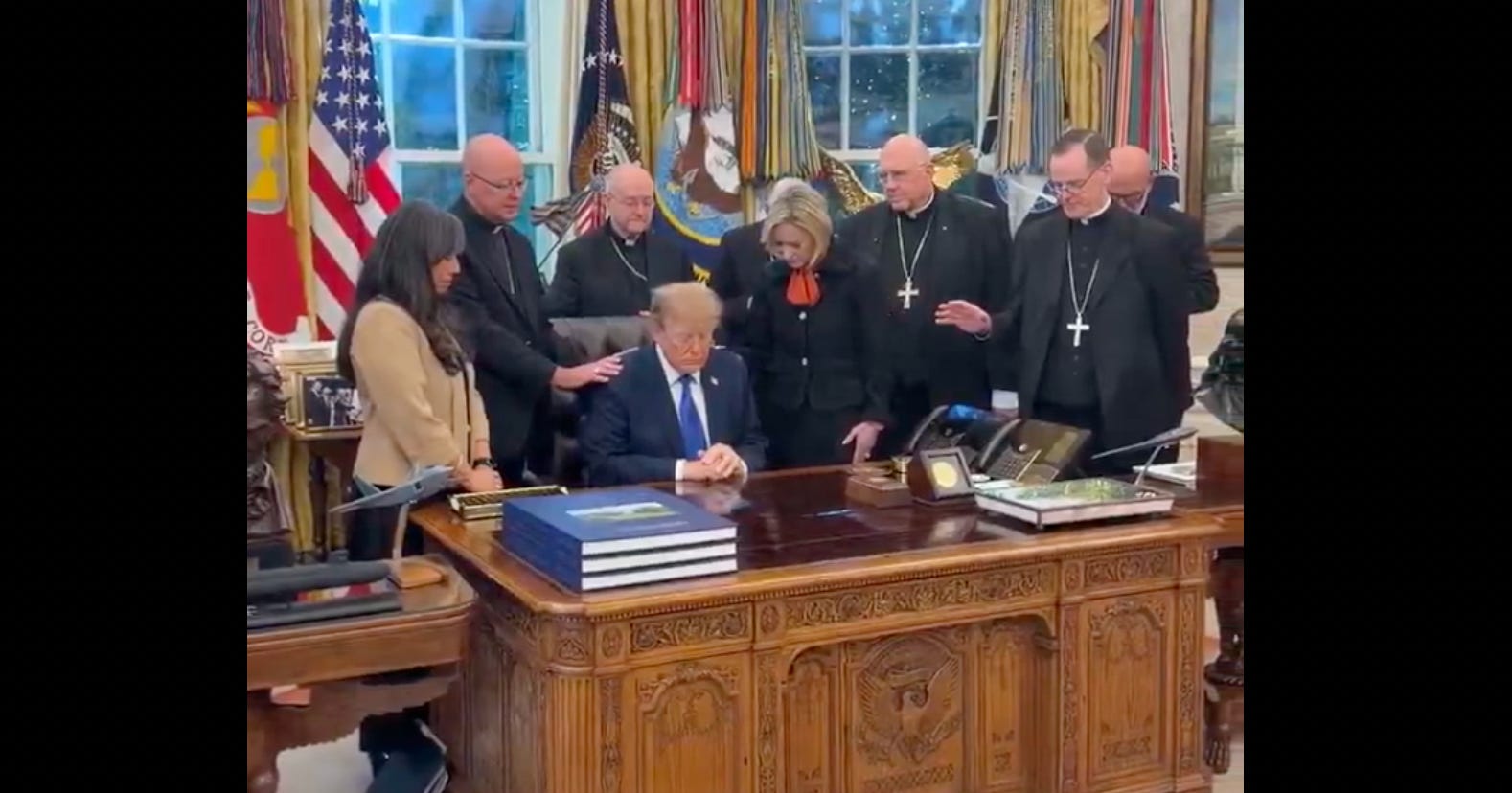
Few, it seems, expected that the meeting would become the subject of widespread media attention, or that at least one of their number would be apologizing for even attending in the first place. In fact it’s not even clear how many of them were expecting to meet the President of the United States, or to pray over him in the White House.
But the propriety of the meeting has become the subject of fierce debate among some Catholics. And even what exactly happened is still up for debate, with the bishops themselves offering somewhat conflicting accounts of how they got in the room in the first place.
Discussion of the gathering is not on the agenda for next month’s fall plenary meeting of the United States Conference of Catholic Bishops. But it does seem certain to be discussed in hallways and behind closed doors — with at least some questions raised about the bishops’ conference itself. And the bishops’ conference also seems the most likely forum at which Pope Leo’s views on the matter will be expressed.
—
Video of a group of bishops praying over President Donald Trump emerged on social media Thursday afternoon, published first by communications personnel in the White House.
The prayer offered by Archbishop James Golka of Denver was not specific to Trump. It prayed in general for the United States and its government, and for national protection against evil, without offering any kind of endorsement for Trump personally.
In fact, the words appeared to be carefully chosen to avoid the appearance of partisanship or endorsement of the president as a political candidate. And clerics watching the video probably had a sense of what was going on — that the bishops suddenly found themselves asked to offer a public prayer in a potentially volatile situation, and were aiming to do so without offering words that might be misinterpreted or misunderstood.
On the whole, that seems to track with the most likely account of what happened on Oct. 22: A group of bishops went to the Executive Office Building for a meeting with high-level administration officials. At the end of the meeting, they were invited to meet with Trump in the Oval Office. From there, the idea of some prayer seemingly emerged, and then camera phones came out. And while the bishops were still probably being ushered through the de facto Oval Office gift shop, the video was cut and posted on social media by Trump staffers.
But the question being asked is whether the bishops should have been in the room in the first place.
And however much the assembled bishops wanted to avoid controversy, they didn’t. The video was posted and promoted by members of the Trump administration, two weeks ahead of a midterm election that does not look likely to go well for Trump’s party. It came out the same day that JD Vance appeared on the Raymond Arroyo television program — a moment when the Trump administration was apparently aiming to reactivate Catholic support for the president’s party.
And indeed, it was taken in some corners as at least an implicit endorsement of Trump’s GOP. Some Catholics asked online whether bishops would have allowed themselves to be similarly filmed surrounding Biden with prayer two weeks before a major party election. Some strong Trump critics said that the bishops simply allowed Trump within the Overton window of acceptable political choices, a move they felt inappropriate for a political leader they oppose strongly. And some Catholics from the MAGA side of the aisle took the opposite tack, arguing that the bishops were — of course — meeting with Trump because his agenda most aligns with Catholic social teaching.
It seemed soon apparent that near everyone would have an opinion on that particular nexus of Church and state.
Some Catholics — and indeed, at least one bishop in attendance — emphasized that praying with people is good, and that a cleric should choose an opportunity to pray with a national leader whenever he’s offered it.
“I knew that it could be shared and that some might use it for political purposes,” Denver’s Golka said recently. “But as I prayed about it, I thought that this is what Catholics do. We pray for people. No matter whether we agree or disagree on anything, we always pray for our country and leaders.”
“I was being a Catholic priest,” Golka said. “We pray for people.”
But others — including at least one bishop in attendance who apologized for going — have said that the prelates at the meeting were “manipulated” into giving a “political photo opportunity” that might imply endorsement.
The prudence of the meeting itself might be debated ad nauseam.
So might be the provenance of the meeting. The Pillar confirmed, with bishops in attendance and others close to the meeting, that invitations for prelates came from Mario Enzler, a former Swiss Guard and disgraced former academic who is now an official at the pro-Trump Heritage Foundation.
After The Pillar broke the news of Enzler’s involvement, the Heritage Foundation denied that Enzler organized the meeting, and one bishop-attendee offered that his invitation came from (unnamed) “officials connected with the White House Faith Office.”
After that denial, The Pillar again confirmed that several attendee bishops were invited to the gathering directly by Enzler.
Indeed, however it’s finessed or framed by Heritage, some — if not all — bishops were invited to the White House meeting by Enzler, a high-ranking staffer from a political think tank.
And to some observers, that ought to have increased the bishops’ awareness that the meeting would be politicized, and was not only a synodal conversation with administration officials.
Still, while bishops are Americans — and offer plenty of commentary on the world of American electoral politics — they don’t live entirely in that world either, and most don’t see the world through its lens. Some attendees were doubtlessly warned that the meeting could be an attempt to politicize them, and seemingly felt the presence of prayer in the White House was worth that possibility, or decided not to allow the risk of being politicized to deter them from an opportunity to raise issues of concern to the Church, to find areas of common ground with the administration, or to spread the Gospel.
It is obvious that some of the debate on the subject is obvious posturing, including a great deal of opportunistic faux outrage from commentators with clearly stated political priorities. Some defenses of the bishops have been no less nakedly partisan, often breathlessly so.
In short, the internet’s gonna internet.
But whether the meeting was imprudent, two weeks ahead of an election, is actually a matter for legitimate conversation. But debating it intelligently does require understanding that many bishops are less actually focused on the political process, and the way the game is played, than they’re usually presumed to be. Whether that’s a signigicant liability on their part, however, and what could be done about it, is again a reasonable subject for discussion.
—
In short, the meeting has become the subject of some debate among Catholics, and of international media coverage, but agreement on its meaning, and on whether bishops should have attended, seems unlikely.
Amid that speculation are questions about how Pope Leo, who has had sharp exchanges through the media with the Trump administration, might perceive the meeting.
That topic will likely generate questions among closed-door episcopal conversations next month, and is likely to see questions put to the bishop-attendees about why they chose to attend the meeting.
It is likely to be especially noted that as a matter of protocol, bishops ordinarily engage with the federal executive through the government affairs office of the bishops’ conference, which was not in attendance at the meeting, and not involved in its planning.
But The Pillar has confirmed that at least some senior officials of the conference were aware of the meeting with administration officials before it took place, and some had concerns about how it might be used politically. And in November, at least some prelates are likely to ask conference leadership whether they could, or should, have intervened to dissuade bishops from attending.
All of that is laden with long-standing disagreement among the U.S. bishops about how to engage with recent presidential administrations — how bishops should engage with the pro-abortion Biden White House, and how they should engage with a Trump White House that has been critical of Pope Leo and the USCCB itself on immigration, and at odds with the bishops on the death penalty, in vitro fertilization, marriage, and several other issues.
Any criticism about whether prelates ought to have attended last week’s meeting is likely to draw comparison with the calls from corners of the episcopate to “dialogue” and finding “common ground” with the Biden administration — especially if the bishops criticizing attendance at the Trump meeting are the same ones who called for that dialogue in the last administration.
Still, it seems almost certain that questions will be raised about whether there were internal USCCB staff discussions about their approach to the Oct. 22 White House meeting. Staffers will likely emphasize that the USCCB is not an authoritative body, staffers do not tell bishops what to do, and that its protocol for engaging with civic officials is at the level of an implied moral agreement, at best, between American bishops.
And actually, most bishops in the room will know that whatever the views of USCCB staffers, there is little power at the conference to dissuade bishops from doing what they choose to do. If there is discussion about whether conference staffers ought to have intervened in some way, it is most likely best understood as a polite proxy pretext by which to have disagreement about whether bishops should have gone to the meeting in the first place.
To the extent it happens, that discussion will shake out behind closed doors. But far more public will be the second address to the bishops of new apostolic nuncio Archbishop Gabriele Caccia, whose very job at these meetings is to communicate to the bishops the pope’s priorities and the manner in which he’d like to see them addressed.
When Caccia takes the microphone, Pope Leo XIV’s views on the meeting could well be spoken or implied. And on all sides of the issue, U.S. bishops will certainly be listening.
Why is Enzler a “disgraced” former something or other? How is it relevant to the story?