‘There is plenty of life’: Bishop Lopes on the Australian ordinariate’s future
On Monday the bishop was named the new administrator of Australia’s ordinariate for former Anglicans.
Pope Leo XIV named Monday a new apostolic administrator to oversee Australia’s ordinariate for groups of former Anglicans, amid questions about its long-term future.
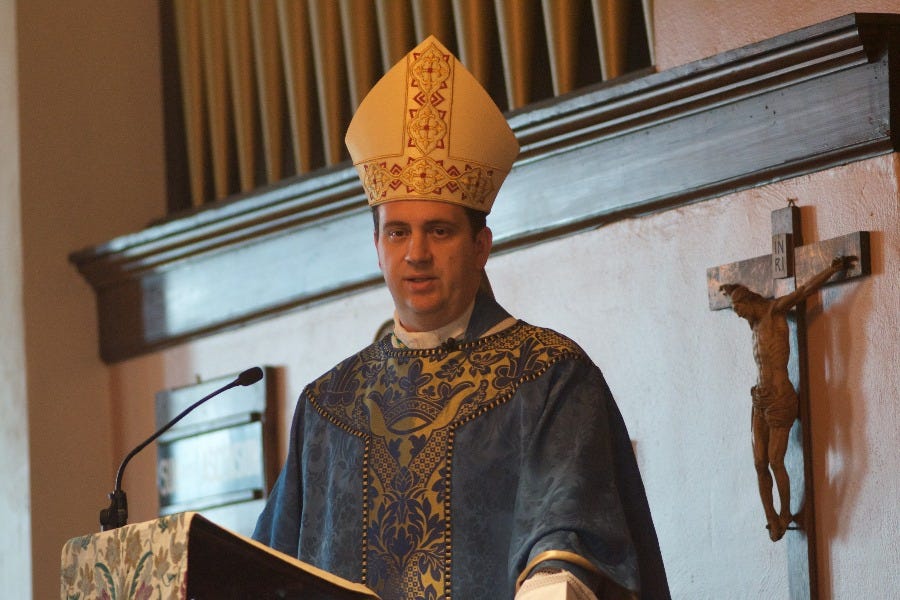
The Vatican announced May 11 that the pope had named Bishop Steven Lopes, the head of North America’s Personal Ordinariate of the Chair of Saint Peter, as apostolic administrator of the Personal Ordinariate of Our Lady of the Southern Cross.
Observers had expected a leadership transition at the Australian ordinariate since March, when Leo XIV named its previous apostolic administrator, Bishop Anthony Randazzo, as prefect of the Vatican’s Dicastery for Legislative Texts.
Randazzo, the bishop of Australia’s Broken Bay diocese, had overseen the local ordinariate since July 2023. The Vatican confirmed May 11 that the pope had concluded Randazzo’s mandate following his Rome appointment.
Lopes discussed the significance of his nomination in a May 11 interview with The Pillar.
To put his comments in context, it’s worth recalling the background of the Australian ordinariate, which was founded in June 2012, following the creation of the U.K. Ordinariate of Our Lady of Walsingham in January 2011 and the Ordinariate of the Chair of Saint Peter in January 2012.
The Ordinariate of Our Lady of the Southern Cross is the smallest of the three in terms of the number of laity, priests, and parishes. But it also covers the widest geographical area, serving Japan, New Zealand, and other parts of Oceania, in addition to Australia. This helps to explain why its 13-year existence has been marked by struggle.
The Australian ordinariate was led initially by the English-born Msgr. Harry Entwistle until his retirement in 2019. He was succeeded by the Canadian Msgr. Carl Reid, who resigned in 2023, paving the way for Randazzo’s appointment.
Some ordinariate members have questioned why the new apostolic administrator isn’t another Australian bishop. But the Texas-based Lopes is already familiar with the Antipodean ordinariate because he conducted an apostolic visitation in 2022, coinciding with its 10th anniversary.
The Pillar understands that following the visitation, Rome expressed a strong commitment to the Australian ordinariate and sought ways to strengthen it. This included the appointment of Randazzo, who had also participated in the visitation.
Ordinariate members credit Randazzo with building up the organization. On April 21, he ordained two new deacons for the body.
In a May 11 message to ordinariate members, Randazzo said that Lopes was “a man of the Church and will strongly encourage the continued growth and mission of the Ordinariate of Our Lady of the Southern Cross.”
In one of his first moves, Lopes reappointed Fr. Stephen Hill, a liturgical expert ordained as an ordinariate priest in 2013, as the Australian ordinariate’s vicar general.
In his Pillar interview, Lopes addressed the debate about the Australian ordinariate’s viability, his hopes for the body, and the obstacles to realizing them.
People have questioned the viability of the Personal Ordinariate of Our Lady of the Southern Cross since it was established in 2012.
Does the appointment of a second apostolic administrator in succession suggest it may not be viable in the long term?
Or does it show, on the contrary, that the Church as a whole is committed to its future?
I certainly understand some of the impressions that one can have looking at the relatively small Ordinariate of Our Lady of the Southern Cross from the outside. After all, I participated in the apostolic visitation several years ago that came about precisely because of some of these impressions. But what we found, even in that process, was that impressions do not tell the full story. Or even part of it. Actually, there is plenty of life and robust faith in this ordinariate.
I recall a lecture I attended several years ago by a great Australian, Professor Tracy Rowland. She described the realized ecumenism of the ordinariate as “reweaving the ecumenical tapestry.” The face of a tapestry is a thing of great intricacy and beauty. But the back is a mess, with threads going every which direction and little discernible pattern. The early years of the ordinariate have felt and looked a bit like that!
Just this past March, the Holy See published a reflection on ordinariate patrimony. It affirmed that the things that make the ordinariate distinctive, which we call patrimony, “is a way of receiving and living out the faith … it is a living reality, which looks to the future in the transmission of the faith to future generations. [It] not only equips the ordinariates to welcome communities and individuals into full communion, but also continues to shape their distinctive participation in the Church’s mission well into the future.”
So this transition of leadership is to be seen in precisely that context. This is another step in the Church’s commitment to foster the patrimony and draw out the mission of the Ordinariate of Our Lady of the Southern Cross. The ordinariate has been given unique tools for evangelization, and I have no doubt that these tools can and will bear great fruit for the Church in Australia and Oceania. Because it already is.
And for some inside baseball, notice that my official appointment is “sede vacante et ad nutum Sanctae Sedis.”
The “ad nutum” part is pretty standard in the appointment of an apostolic administrator. It simply means I’m going to work with the Holy See until such time as the Holy Father decides on the next, permanent provision of leadership.
But the “sede vacante” part is new, as this was not the case under Archbishop Randazzo. In declaring that the see of the ordinariate is vacant, the first thing I observe is that the Holy See is recognizing that it is, in fact, a see. It is a true Particular Church juridically configured to a diocese.
My role is therefore that of a custodian. I am there to offer pastoral support and governance until such time as the ordinariate receives its own bishop, as has happened in North America and in the United Kingdom.
New dioceses are not simply created out of nothing. They grow and mature over time as the parishes that constitute them grow and mature, until such time as the Church recognizes they have the ecclesial elements that call for the apostolic ministry of a bishop. I see hints of that even in how my appointment is structured.
What are your greatest hopes for the Ordinariate of Our Lady of the Southern Cross?
I simply want more people to see the vitality that I see in the Ordinariate of Our Lady of the Southern Cross. If you look beyond the seeming smallness of our parish communities, you will see the Church at its best. There are priests in their 70s and 80s working harder than men half their age and covering great distances for the good of souls. There are young parents finding new ways to draw on the rich English patrimony to transmit the faith to their children in a highly secular environment. There are young men and women discerning vocations and finding courage to pursue them. There are liturgies celebrated beautifully and reverently, thanking God for these blessings.
Happily, some of these things will become apparent rather quickly. Later this year, the ordinariate will celebrate the ordination of two men to the priesthood.. We will also see the dedication of a new parish church in Perth, which is the first church construction project undertaken by the ordinariate in Australia.
Vocations and parish growth do not just happen. This is grace at work, and real people faithfully receiving that grace and allowing it to bear fruit in tangible ways. That gives me hope. Real hope, which is not just a feeling but a deep trust in the Lord’s promises and not just in our own strength and ingenuity.
What do you think are the biggest obstacles to realizing these hopes?
A common challenge for the ordinariate in Australia, as well as North America, is what I have begun to call the “tyranny of distance.” Our parish communities are so far apart from one another. It becomes very difficult to gather the clergy together, let alone any of the lay faithful.
Forming a lively sense of our identity and mission in the Church is complicated enough, but when you feel isolated — that your own parish is an island — it’s all the more difficult.
Another challenge that will simply take time to overcome is that the narrative about the ordinariate is often created by people with very little actual experience of it. Simply stated, our fellow Catholics often don’t know how to describe us and so the Ordinariate gets painted with all sorts of different brushes. We are often called the “Anglican Ordinariate” … which is ecumenically insensitive to actual Anglicans and can be downright offensive to ordinariate members, many of whom entered into full communion with the Catholic Church at great personal cost.
In North America, several of our parishes from the Pastoral Provision have been in existence nearly 50 years. That means we have generations of our faithful who have grown up with our distinctive form of liturgy and parish life as simply their expression of what it means to be Catholic.
Distinctions imposed from the outside — like convert or cradle Catholic — are meaningless in the actual context of our parish life. This will be all the more true as our parishes continue to mature and grow.

