
The organizers of the Vatican’s Amoris laetitia meeting announced Friday the names of the members of the committee charged with reviewing the gathering’s concluding report before publication
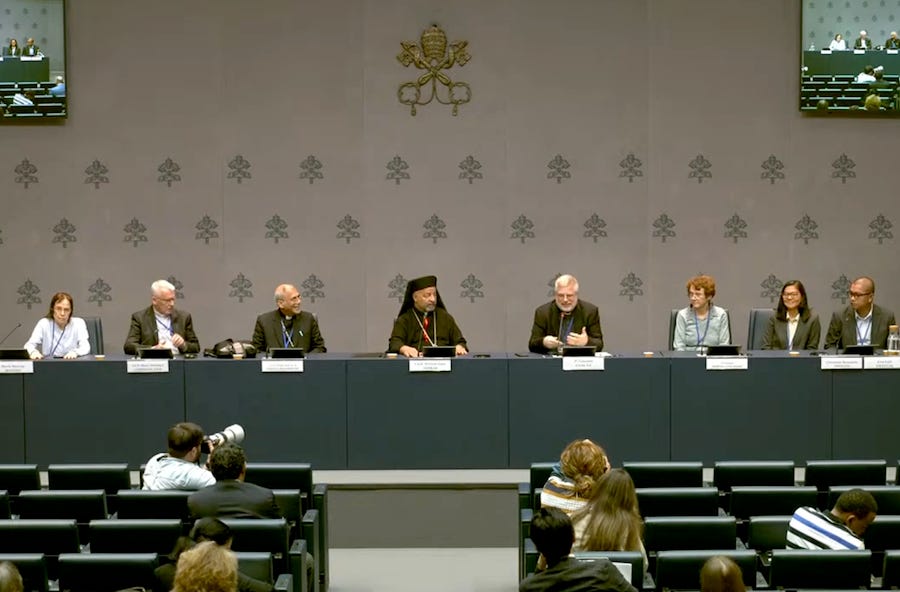
The 11-member committee will consider a draft of a “synthesis report” that sums up what has emerged during the Oct. 7-14 meeting called by Pope Leo XIV to discuss developments 10 years after the publication of Pope Francis’ apostolic exhortation on love in the family.
Who are the members? And what will happen next?
Who are the members?
A total of 187 people are taking part in the Amoris meeting. They include representatives from all 115 of the world’s episcopal conferences and all 15 sui iuris (self-governing) Eastern Catholic Churches led by a patriarch, major archbishop, or metropolitan. There are also two representatives of bishops who do not belong to episcopal conferences.
There are also 22 Invitati — prelates personally invited to attend the Amoris meeting who are neither presidents of bishops’ conferences nor heads of Eastern Catholic Churches.
There are 11 members of the organizing team, and 22 people from 11 couples and families, who are described by the Vatican as Ospiti-Famiglie, or guest families.
Fr. Giacomo Costa, S.J., consultor of the General Secretariat of the Synod, said at an Oct. 9 Vatican press conference that five members of the 11-strong report committee were chosen from among the 16 speakers on the meeting’s first day.
He said the criteria were to select one representative per continent and ensure the inclusion of a member of one of the guest families.
The first six members of the report committee belong to the meeting’s organizing team.
Cardinal Kevin Farrell, the Irish-born prefect of the Dicastery for Laity, Family, and Life, will serve as president of the committee. His dicastery is responsible for organizing the Amoris meeting, alongside the General Secretariat of the Synod of Bishops. Farrell is the meeting’s Presidente Delegato, or presiding delegate, and plays a prominent role in daily proceedings.
Other committee members include Cardinal Mario Grech, the Maltese general secretary of the Synod of Bishops, who is the Moderatore (moderator) of the gathering.
Another member is Gabriella Gambino, the lay Italian undersecretary of the Dicastery for the Laity, Family, and Life, who is coordinator for the guest families present at the meeting.
She is joined by Msgr. Philippe Bordeyne, the French president of the Pontifical John Paul II Theological Institute for Marriage and Family Sciences in Rome. He serves as coordinator of the team of “experts” assisting participants.
Also on the committee is the deputy coordinator of the experts, Orietta Rachele Grazioli, an Italian canon lawyer and lecturer at the Pontifical John Paul II Theological Institute for Marriage and Family Sciences.
The final member of the organizing team on the report committee is Fr. Giacomo Costa, S.J., who is responsible for the Amoris meeting’s methodology.
The final five members of the committee are those selected from among the speakers on the first day.
Audrey Boucher is the committee member chosen from among the 22 representatives of guest families. She is the diocesan pastoral coordinator for the Diocese of Sainte-Anne-de-la-Pocatière in Quebec, Canada, and the only committee member from North America.
One of the Asian representatives is Cardinal Pablo Virgilio David, the outspoken Bishop of Kalookan. The former president of the Catholic Bishops’ Conference of the Philippines is one of 22 people designated as Invitati.
Also representing Asia is Cardinal Anthony Poola, the Archbishop of Hyderabad, India. Poola is the president of the Catholic Bishops’ Conference of India, which serves as a coordinating body for the bishops of the country’s three sui iuris Churches. He became the world’s first Dalit cardinal in 2022.
Representing Africa is Archbishop José Manuel Imbamba of Saurimo, Angola, and the president of the Episcopal Conference of Angola and São Tomé.
The final member of the review committee is Cardinal Matteo Zuppi, the president of the Italian bishops’ conference and papal peace envoy to Ukraine and Russia. He is presumably the committee’s representative for Europe, though seven of the committee’s 11 members — roughly two-thirds — have European origins. None of the committee members is from South America or Oceania.
What happens next?
The Amoris meeting resembles an extraordinary general assembly of the synod of bishops, in that it gathers the presidents of bishops’ conferences and heads of Eastern Churches to discuss a pressing global Church topic, in this case the most effective ways of “proclaiming the Gospel with families today.”
But Vatican officials have been at pains to emphasize that the gathering is not a synod. While an extraordinary synod typically produces a “final report,” officials have stressed that the Amoris meeting will instead end with a “synthesis report” that seeks to summarize the weeklong discussions.
The role of the newly named committee is to check that the draft synthesis report accurately reflects what emerged during the gathering.
The full assembly of participants will discuss the synthesis report on the meeting’s final day, Oct. 14, before entrusting it to the pope. The synthesis will be made public with the proviso that it is a working document and not a text intended to replace Amoris laetitia.
Oh, not looking forward to this report or this committees activities…
"They include representatives from all 115 of the world’s episcopal conferences and all 15 sui iuris (self-governing) Eastern Catholic Churches."
I believe this statement may be inaccurate as presented.
Although there may be 15 Eastern Catholic churches represented at the current meeting the count most often accepted is that there are 24 total Catholic Churches sui iuris. Ergo, it would appear that they are not all present.
Unless I am missing some nuance.
Source: Wikipedia https://en.wikipedia.org/wiki/Eastern_Catholic_Churches