
Four of the 22 people personally invited by Pope Leo XIV to attend a major week-long Vatican meeting on Amoris laetitia are from the United States.
The four who will join U.S. bishops’ conference president Archbishop Paul Coakley at the Oct. 7-14 event called “Ten years after Amoris laetitia: proclaiming the Gospel with families today” are Cardinal Blase Cupich, Cardinal Robert McElroy, Cardinal Joseph Tobin, and Bishop Daniel Flores.
The U.S. is the only country with four participants personally selected by the pope. Canada, China, Italy, and Vatican City each have two, while 10 other countries have a single personally chosen participant, including Brazil, Mexico, and the Philippines, which are respectively the first, second, and third countries by Catholic population.
All 115 episcopal conferences worldwide will be represented at the event, in all but a few cases by the president of the respective bishops’ conference. Bishop Erik Varden, for example, will represent the Nordic bishops’ conference, and Archbishop Richard Moth, the bishops’ conference of England and Wales.
All 15 sui iuris (self-governing) Eastern Catholic Churches will also be represented, with the heads of 14 of the Churches present, alongside a delegate from the Armenian Catholic Patriarchate of Cilicia. Major Archbishop Sviatoslav Shevchuk will represent the war-ravaged Ukrainian Greek Catholic Church and Patriarch Ignace Youssif III Younan is also scheduled to attend amid upheaval in the Syriac Catholic Church.
They will also be joined by 11 couples or families, as well as 26 “experts” and 16 “facilitators.”
What’s the background to the meeting? And what will happen?
For the best experience, open in a new window.
What’s the background?
In April 2016, Pope Francis published Amoris laetitia (The Joy of Love), an apostolic exhortation “on love in the family.” It instantly became one of the most controversial texts of his pontificate thanks to footnote 351, which touched on the reception of sacraments by divorced and remarried Catholics.
The document covered an immense amount of ground beyond this neuralgic topic, from preparing engaged couples for marriage to child rearing to the spirituality of marriage. Indeed, at more than 50,000 words it was one of the longest papal texts in history.
In March 2026, Pope Leo XIV published a message marking the exhortation’s 10th anniversary. He announced that he had decided to gather the presidents of the world’s bishops’ conferences in October 2026, “in an effort to proceed, in mutual listening, to a synodal discernment on the steps to be taken in order to proclaim the Gospel to families today, in light of Amoris laetitia and taking into account what is currently being done in the local Churches.”
In July 2026, the Vatican published the preparatory document for the meeting, which identified five themes for discussion at the meeting:
1) Families today: reality, beauty and challenges.
2) Young people and the discovery of the vocation to marriage.
3) Married life. The first years of marriage: a decisive time.
4) In the difficulties of life: accompanying and supporting.
5) Christian families as subjects of the Church’s mission.
What will happen?
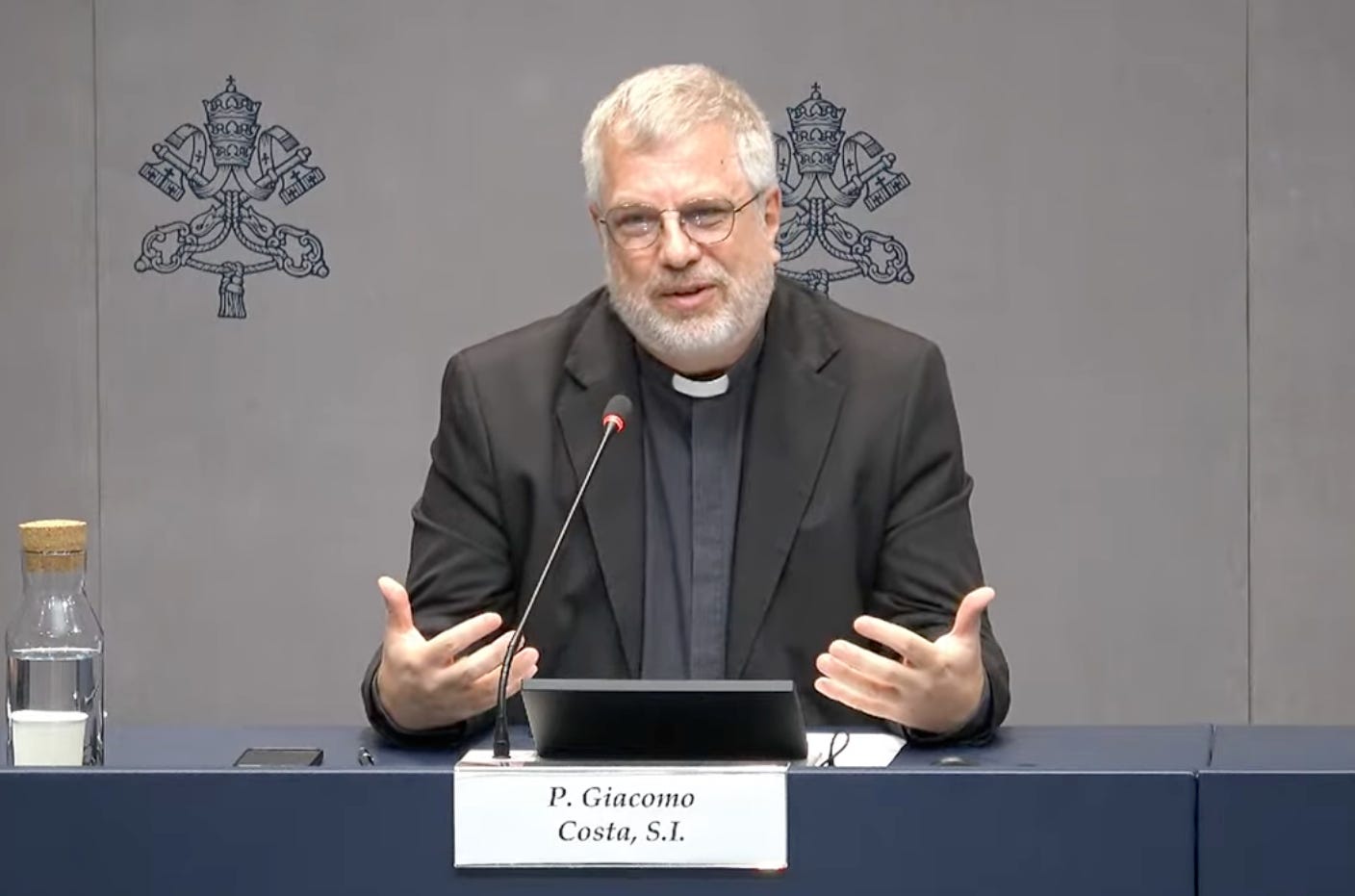
At an Oct. 2 Vatican press conference presenting the meeting, Fr. Giacomo Costa, S.J., consultor of the General Secretariat of the Synod, shed light on its purpose and methodology.
Costa described the gathering as “a kind of evaluation assembly,” similar to those taking place around the world ahead of the 2028 ecclesial assembly in Rome.
He said: “A synodal process, in fact, does not conclude with the approval of a document. A document is not the end point: it must enter into the life of the Church and allow itself to be put to the test by experience. The Churches are called to translate its orientations into their different contexts, to experiment with different paths, to assess their fruits and difficulties, and then to come together again to reflect on what has been experienced.”
“From this perspective, evaluating does not mean passing judgment on the text, either to praise it or to criticize it, but learning from the experience gained after its publication, in order to recognize where the Spirit is leading the Church and what new steps the Spirit is asking it to take.”
Costa added: “Ten years later, the question is not what Amoris laetitia says, but what we have learned by trying to live it. The objective indicated by Pope Leo XIV is to move forward, through mutual listening, toward a synodal discernment of the steps that need to be taken today to proclaim the Gospel with families.”
Costa stressed that the meeting won’t be a synod, though it will use the synodal methodology known as “Conversation in the Spirit,” in which an assembly forms small groups in which each participant shares their own experience, reflects on what they hear from others, then seeks to discern with others what has emerged.
The meeting will kick off on Wednesday, Oct. 7 with greetings by Cardinal Kevin Farrell, the prefect of the Dicastery for Laity, Family, and Life, and Cardinal Mario Grech, the secretary general of the synod. They are the heads of the two Vatican offices responsible for organizing the event.
Following an introductory address by Pope Leo XIV, there will be a meditation by Sr. Helen Alford, president of the Pontifical Academy of Social Sciences. Participants will will break into smaller groups.
The meeting will take place in the Vatican’s Paul VI Hall, where the 2023-2024 synod on synodality took place. It’s not yet clear whether the synod’s famous round tables and iPads will be brought out of storage for the Amoris meeting.
For the next six days (including a rest day on Sunday, Oct. 11), participants will work their way through the five themes. Each group will offer a brief report back to the assembly, followed by a time for further interventions in a plenary setting.
The discussions during the five thematic days will be boiled down into a summary report. A commission including representatives of the assembly will check that the report faithfully reflects what emerged.
On the final day, Wednesday, Oct. 14, Pope Leo XIV will celebrate a Mass in St. Peter’s Square. The assembly will then discuss the summary report before entrusting it to the pope, who will offer a concluding address. The summary will be made public as a working document, rather than a text that is intended to replace Amoris laetitia.