Venezuelan cardinals urge bishops to speak out
Ahead of the Venezuelan bishops' meeting, two cardinals are urging a strong and unified episcopal voice
Two Venezuelan cardinals and an archbishop have called on the Catholic Church to demand the release of all political prisoners, an end to repression of free speech, and respect for the results of Venezuela’s disputed 2024 presidential election.
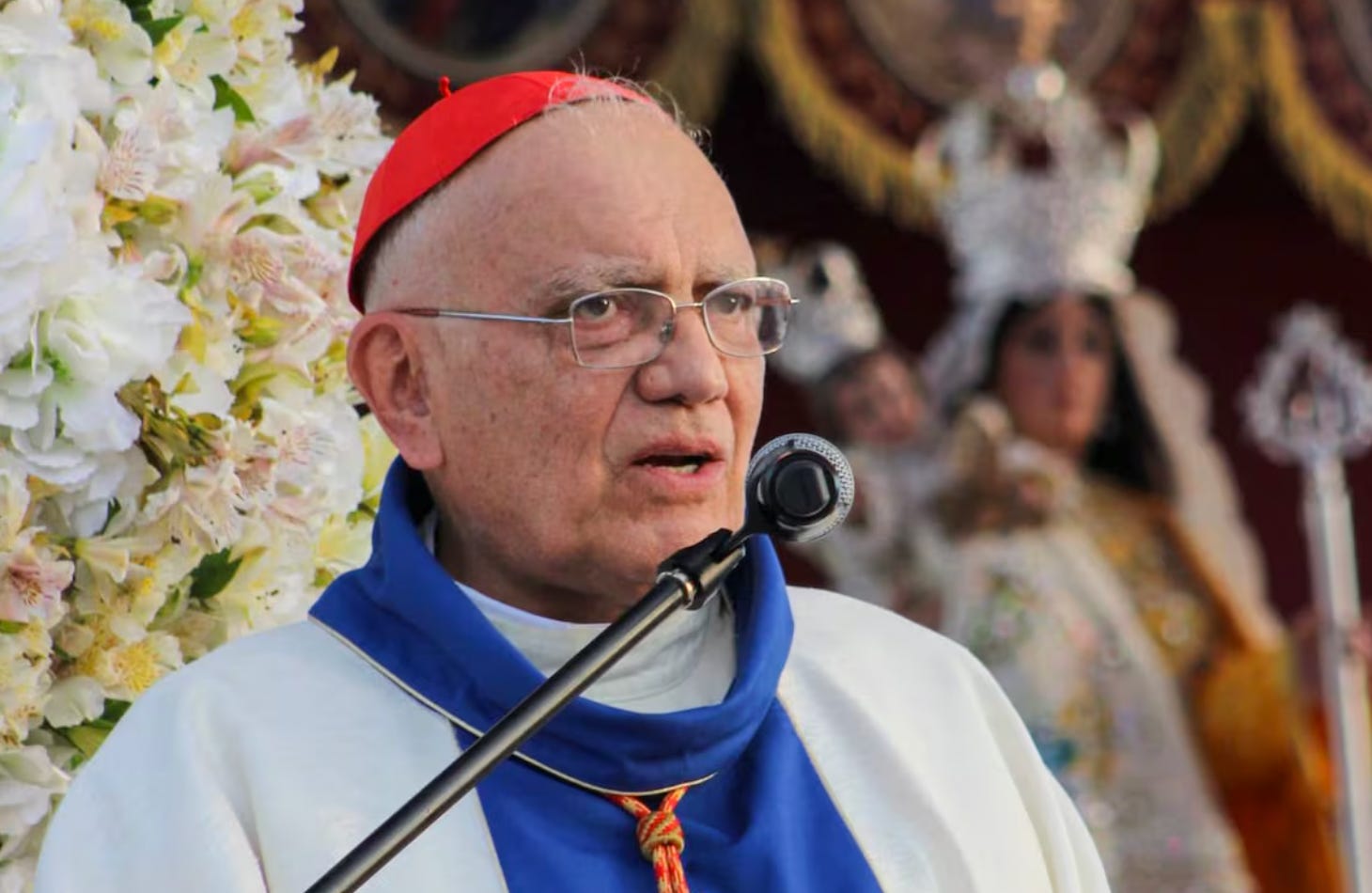
Cardinals Baltazar Porras and Diego Padrón, and retired Archbishop Ovidio Pérez Morales published a letter Jan. 31 urging the Church to speak boldly amid the country’s ongoing political uncertainty.
“The Church, despite the shortcomings and difficulties inherent to human beings, is, by God’s will, a sign and instrument of unity and communion among all Venezuelans,” the letter said.
The letter was released just days before the Venezuelan bishops are scheduled to gather for their plenary assembly, which starts Wednesday. Local observers say the timing suggests an effort to influence discussions among the bishops, after a month of institutional prudence following the Jan. 3 capture of former dictator Nicolás Maduro.
The letter’s authors urged fellow bishops to reiterate three non-negotiable principles, “the dignity of the human person, the validity of the Constitution, and full popular sovereignty as the base of any path of peace.”
—
Since Maduro’s capture, the bishops’ conference has issued only a brief, two-paragraph statement on the day of the arrest, and has otherwise remained silent, while only a handful of bishops have publicly spoken of the country’s situation. Local observers say that restraint reflects uncertainty about the country’s political direction, which the letter acknowledged.
“We are in a period of transition, still awaiting an uncertain transition to what the country desires and needs: the restoration of the rule of law within an effective constitutional framework that guarantees the nation’s future progress in democratic pluralism, economic and political development, peaceful coexistence among citizens, and an ethical and cultural environment of respect and promotion of human rights.”
“This will make visible and dynamic, therefore, our fidelity to our best republican heritage and to the values of a predominantly Christian and religious people,” the letter adds.
The Venezuelan Church has largely been seen as one of the few free institutions in the country, able to assert itself against the Maduro government.
But after a post-election crackdown on dissent after the 2024 presidential contest — which was widely criticized as fraudulent — the bishops’ conference adopted a more cautious tone, while many bishops have refrained from public comment on the country’s crisis and the regime.
Meanwhile, a month after Maduro’s capture, other institutions long silenced by the regime have begun to speak out. University students have resumed protests, and some television stations have cautiously reduced self-censorship. But the Church hasn’t spoken yet.
As the bishops prepare for their plenary assembly, the letter seems intended to frame the Church’s response to the political moment.
“It is necessary to set positive, achievable goals that promote the common good, combine freedom and responsibility, and ensure stability and shared development in justice and solidarity, within a constitutional framework, responding to the will of the sovereign people, who deserve greater attention in terms of health, education, and fair wages,” the letter says.
The letter established three proposals for bishops to address.
“First, immediate, total, and comprehensive release of each and every political prisoner. Release that implies not only imprisonment, but also the elimination of any subsequent precautionary measures (police, judicial, or any other kind) that could mean the continuation of the current repression.”
“Second, the immediate liberation from the current communication hegemony in the hands of the government, based on the aforementioned and invoked rights. Freedom of communication stems directly from the right to life,” the letter says.
Last, the letter emphasized a call to “obey the majority will of the sovereign people, freely decided and expressed on July 28, 2024,” referring to that year’s presidential elections, in which the opposition and most of the international community claim that Maduro committed fraud.
The political opposition claimed that its candidate, Edmundo González, won the election with 68% of the vote - and published more than 80% of the country’s voting station tally sheets on a website to back its claims. The regime did not publish full voting station results.
“The long-awaited transition is urgent and must be worked on immediately, without further delays that prolong the current confusing and uncertain situation.”
The letter concluded with a call that the Church should “seek to serve the national reunification and the moral and material reconstruction of the country. Consequently, the Church wishes to seriously commit at all levels to the reconciliation, freedom, and human and spiritual development of the nation.”
In July 31, 2024, just three days after Venezuela’s contested presidential elections, Porras and Padrón sent a letter to the Venezuelan bishops, which was later leaked, in which they said that the Church has “the moral duty to support and sustain just initiatives against abuses with civic disobedience and resistance.”
The letter warned of the possibility of a “Nicaraguan-style government” in the future. Nonetheless, the cardinals said, the Church cannot be silent in the face of injustice.
“We are not and we should not be neutral,” they said, speaking of a duty to “prophetically denounce, even if it’s a risk, the injustices, and proclaim our principles and values, pastorally being together with the people with solidarity.”

