
Scotland’s bishops presented seven options this week for the future of the country’s eight dioceses.
The bishops outlined the possible scenarios for changes to Scotland’s diocesan structures Sept. 20, following a consultation process announced in March.
The bishops launched the consultation following a request from the Vatican to explore whether the current situation of eight dioceses is still suited to the Church’s needs.
In their introduction to the seven options, the bishops wrote: “This is not simply a question of boundaries, administrative adjustments or the sharing of resources more effectively.”
“Primarily it is about how we can better proclaim the Gospel, support our clergy, religious and lay people, and strengthen our parishes and communities for evangelization.”
Here are the seven possibilities suggested by the bishops and what they would mean for Scotland’s Catholics.
1. Maintain the current structures
This is actually the seventh and final option presented by the bishops. But it’s worth considering it first, since it offers a useful baseline for understanding the other options.
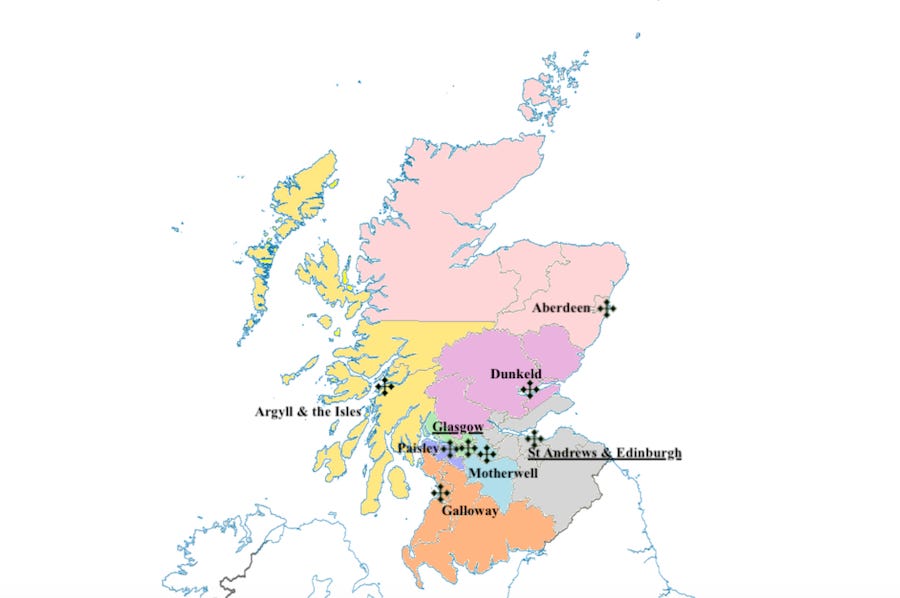
As can be seen from the map above and the graphic below, Scotland’s eight dioceses vary considerably in terms of geographical size and Catholic population.
It’s worth specifying that we are speaking here solely about the Latin Catholic dioceses. Scotland is also served by Eastern Catholic jurisdictions (the Ukrainian Catholic Eparchy of the Holy Family of London and the Syro-Malabar Catholic Eparchy of Great Britain) as well as personal jurisdictions (the Bishopric of the Forces and the Personal Ordinariate of Our Lady of Walsingham.)
Of Scotland’s eight dioceses, the Diocese of Argyll and the Isles covers the largest geographical area (12,004 square miles) but also has the smallest Catholic population (9,990 in 2023, according to the website catholic-hierarchy.org).
Conversely, the Archdiocese of Glasgow (318 square miles) covers the smallest geographical area and has the largest Catholic population (223,270 in 2023).
The present configuration of dioceses dates to 1947. That was when two more dioceses (Motherwell and Paisley) were added to the original six associated with the restoration of the Scottish Catholic hierarchy in 1878 (Aberdeen, Argyll and the Isles, Dunkeld, Galloway, Glasgow, and St. Andrews and Edinburgh).
The eight dioceses are currently organized into two ecclesiastical provinces: Glasgow (including Motherwell and Paisley) and St. Andrews and Edinburgh (including Aberdeen, Argyll and the Isles, Dunkeld, and Galloway).
2. Argyll and the Isles and Paisley merge
The first proposed change is a merger of Argyll and the Isles, Scotland’s largest diocese by geographical area, with Paisley, which was created in 1947 from the Archdiocese of Glasgow.
Paisley served 88,970 Catholics in 2023, making it Scotland’s fourth most populous diocese. A merger with Argyll and the Isles would increase the Catholic population to 98,960, still comfortably leaving the diocese in fourth place.
3. Argyll and the Isles and Glasgow merge
In this scenario, Scotland’s largest diocese by geographical area is merged with the diocese with the largest Catholic population. This would, of course, create Scotland’s geographically largest and most populous diocese.
The head of a hypothetical Archdiocese of Glasgow and Argyll and the Isles would be responsible not only for large urban parishes, but also for far-flung communities, such as the parish on the Isle of Barra in the Outer Hebrides, about an hour’s flight from Glasgow.
4. Paisley and Galloway merge
Combining these two dioceses would essentially expand the southern Diocese of Galloway northwards.
The merged diocese would have a total Catholic population of 131,786, using the 2023 figures. This would make it Scotland’s third-largest diocese by Catholic population, ahead of the Archdiocese of St. Andrews and Edinburgh.
5. Galloway and Motherwell merge
A merger of Galloway and Motherwell — which was created from the Glasgow archdiocese in 1947 — would create an even larger southernmost diocese, both in terms of geographical area and population.
A hypothetical Diocese of Galloway and Motherwell would serve 197,008 people, according to 2023 figures, taking it closer to parity with the Archdiocese of Glasgow.
6. St. Andrews and Edinburgh and Dunkeld merge
This merger would create a large diocese spanning much of central and eastern Scotland.
The combined diocese would leapfrog Motherwell to become the second-most populous in Scotland.
7. Motherwell, Paisley, and Galloway merge
A triple merger would arguably be the boldest of the seven options. The hypothetical diocese of Motherwell, Paisley, and Galloway would cover a swathe of southern Scotland and comprise almost 286,000 Catholics, putting it well ahead of the Archdiocese of Glasgow.
It would, in a sense, reverse the creation of Motherwell and Paisley in 1947, when Scotland’s diocesan structure expanded from six dioceses to eight.
But instead of restoring the Motherwell and Paisley dioceses to the Glasgow archdiocese, the change would incorporate the newer dioceses into the Galloway diocese, creating a new configuration for the Catholic Church in Scotland.
The seven options seem to form a spectrum, with preserving the status quo at one end and introducing a triple merger at the other.
In a perhaps surprisingly transparent move, the Scottish bishops also named eight proposals that they considered but decided not to pursue.
The first, and perhaps the most complex, was to split and absorb the Aberdeen diocese. The idea was to divide Aberdeen diocese at the Great Glen, which runs diagonally across the Highlands, incorporating the northern part into Argyll and the Isles and the southern part into Dunkeld.
The other seven rejected ideas were more straightforward: merging Dunkeld and Aberdeen; merging Argyll and the Isles and Aberdeen; merging Argyll and the Isles and Dunkeld; merging Glasgow, Motherwell, and Paisley; merging Glasgow and Paisley; merging St. Andrews and Edinburgh and Galloway; and merging Glasgow, Paisley, and Argyll and the Isles.
Referring to the seven options that they are committed to pursuing, the Scottish bishops stressed that they are “possibilities for further discernment, not decisions or an agreed map for the future.”
“As your bishops, we recognize that dioceses are communities of faith with their own histories, relationships and traditions. Any change must therefore be approached with prayer, sensitivity and care for the people and communities involved,” they wrote.
“Synodal discernment also asks each of us to look beyond our own self-interests and to consider what will best serve the Catholic Church in Scotland as a whole.”
The bishops added: “Everyone in every parish is encouraged to make their voice heard when opportunities for consultation are announced locally by their diocesan bishop.”
Don't disregard the Shetland islands, cropped off the map!