What does Leo think about lay governance?
His most notable curial moves so far seem to point in different directions.
Pope Leo last week made his largest slate of curial appointments to-date. Coming a little more than a year since his election, the pope reshuffled the senior positions of four dicasteries and most notably, named his second female prefect to lead a Vatican department.
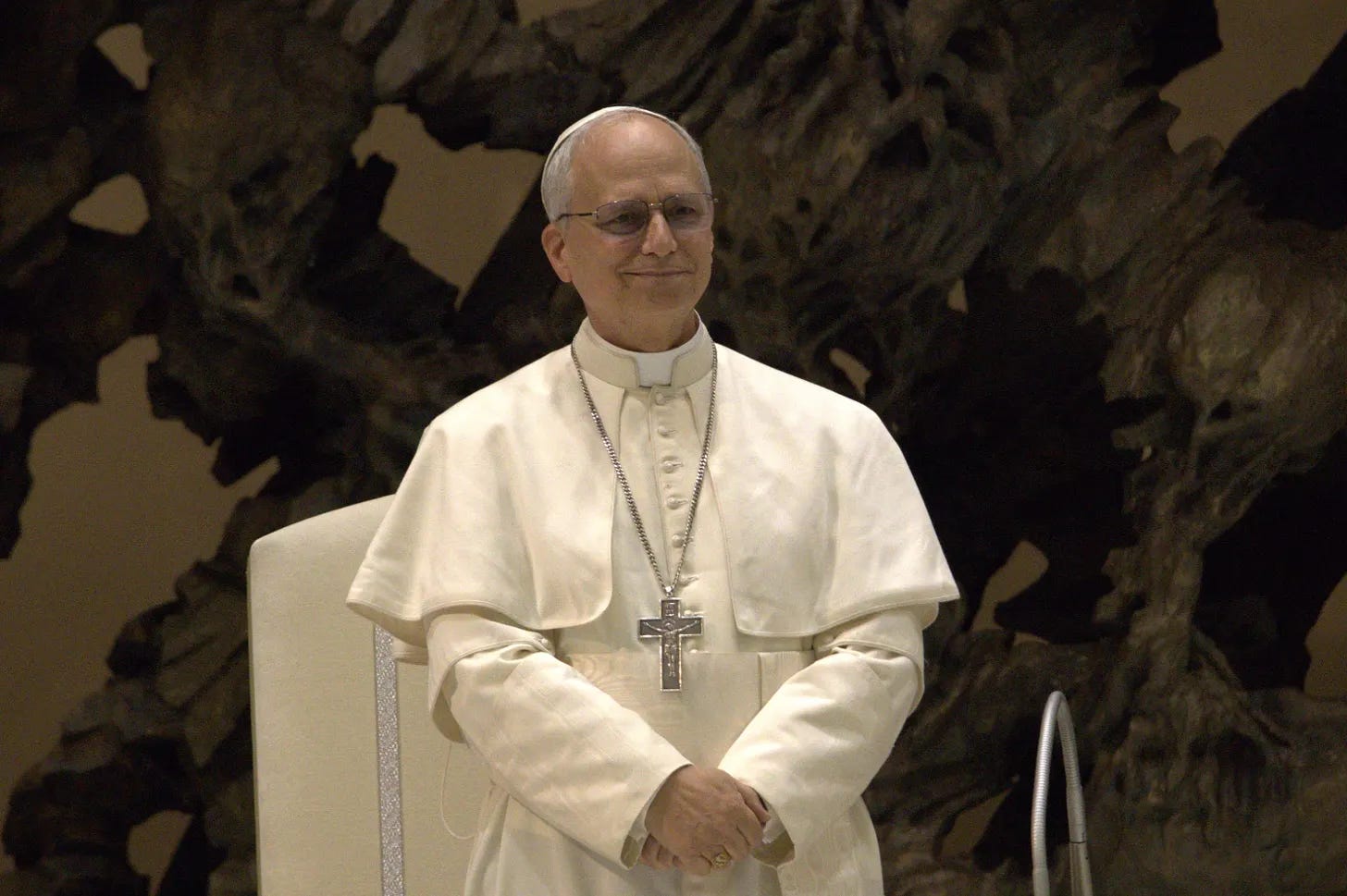
Having previously named Maria Montserat Alvarado as the incoming prefect of the Dicastery for Communications, Leo announced Sister Alessandra Smerilli, FMA, as the new prefect of the Dicastery for Promoting Integral Human Development.
Just as significantly, though, the pope appointed a cardinal pro-prefect, Cardinal Fabio Baggio, to serve alongside Smerilli. The double appointment, and indeed the actual nature of the role for a “pro-prefect”, has not been given an official or public explanation by the Holy See, and has been more or less left to speak for itself.
But what it actually says may be to rearticulate an unanswered question left by Francis-era reforms to the curia, and a simmering debate about the concepts of power and governance and sacramental authority in the Church.
Having so far sent mixed signals on the issue, how Leo eventually answers that question and resolves that debate, either explicitly through a papal act or implicitly through his subsequent appointments, could end up being one of his most important legacies.
—
The nomination of a lay prefect and cardinal pro-prefect is something of a curial novelty, begun by Pope Francis with the appointment of another religious sister, Sr. Simona Brambilla, I.S.M.C, to lead the Dicastery for Institutes of Consecrated Life and Societies of Apostolic Life in the final months of his pontificate last year.
In January of 2025, Brambilla became the first non-cleric to head the department since its creation in 1908 and, by extension, its first prefect not to become a cardinal. Instead, Francis appointed Cardinal Angel Fernández Artime, S.D.B. to serve as pro-prefect alongside her.
That double appointment was widely interpreted as a kind of hedge regarding the potential scope of Francis’ overhaul of the Roman curia in the 2022 apostolic constitution Praedicate Evangelium.
That text, which revised the organization and governance of the Vatican, described every office and authority of the curia as existing “by virtue of the power it has received from the Roman Pontiff, in whose name it operates with vicarious power in the exercise of his primatial munus.” For that reason, the constitution said, “any member of the faithful can preside over a dicastery or office,” clearing the way for laymen and women to serve at the highest levels of the Holy See’s administrative apparatus, for the first time.
The text also included the qualifier, however, to the scope for lay leadership of a dicastery: “depending on the power of governance and the specific competence and function of the Dicastery or Office in question.”
The formulation of that section in Praedicate became the center of a revival for a fierce, centuries-old debate among canonists and ecclesiologists regarding how broadly lay people can exercise the power of governance in the Church, and how essential the sacramental power of orders is for some exercises of authority.
When the constitution was promulgated, the debate was crystalized by comments from two cardinals. Cardinal Gianfranco Ghirlanda, SJ, a senior Vatican canonist and trusted Francis collaborator, argued that “the power of governance in the Church doesn’t come from the sacrament of Holy Orders, but from the canonical mission,” that is to say delegation to exercise authority from the pope.
On the other side, Cardinal Marc Ouellet, at the time prefect of the Dicastery for Bishops, called Ghirlanda’s argument “a Copernican revolution in the governance of the Church, not in continuity with or even going against the ecclesiological development of Vatican Council II.”
“As for the government of the Roman curia,” wrote Ouellet in an August 2022 edition of L’Osservatore Romano, “it is not enough to say that the canonical mission entrusted by the Holy Father is sufficient to establish the power of jurisdiction of every authority exercised in the dicasteries, be it the person designated cardinal, bishop, religious or lay person.”
To do so, said Ouellet, would perpetuate “a juridical mentality… which places the emphasis only on the delegation of power, without taking into account the charismatic dimension of the Church, which would go directly against the opening to authentic decentralization.”
Three years later, the 2025 appointment of Brambilla as prefect of the dicastery overseeing religious orders but with a cardinal serving as pro-prefect was widely interpreted as a kind of canonical compromise, allowing for a non-cleric to serve as prefect of a department which exercised direct governance over spiritual and sacramental issues — for example, the governance of religious institutes of pontifical right, and the merging and suppression of all religious institutes — but with a cardinal co-signing the relevant governing acts and effectively lending the power of orders to acts of governance when necessary.
After the death of Francis, many expected Leo would eventually direct the resolution of the lay governance debate, one way or another, though his initial moves actually appeared to show how the debate had further shifted.
Earlier this year, Cardinal Ouellet notably, if subtly, changed his position, arguing that in fact Francis’ reform “discerns the authority of the Holy Spirit at work beyond the link established between the ordained ministry and the government of the Church,” and said that “there is still uncharted territory to explore in order to shed further light on Pope Francis’ prophetic gesture.”
Yet the move by the pope last week to appoint Smerilli as lay prefect of the Dicastery for Promoting Integral Human Development is, in a way, a strange half-step backwards in the trend towards lay leadership in the Vatican — or at least a half step forward very clearly not taken.
While some dicasteries, like DICSAL, have a clearly mixed purview, involving aspects of governance that can be broadly called both administrative and sacred, this would not seem to be the case for the integral human development department which, while encompassing oversight of important bodies like Caritas, does not obviously involve issues or cases touching the sacraments or even theological matters.
It is not exactly clear, then, why Leo felt it either necessary or opportune to appoint Cardinal Baggio as a pro-prefect alongside Smerilli, since the human development dicastery is, in the articles of Praedicate, “principally concerned with matters relating to the economy and work, the care of creation and the earth as our ‘common home,’ migration and humanitarian emergencies.”
More curiously, Leo has previously shown his contentment with the idea of lay prefects as heads of dicasteries without a pro-prefect, most notably the appointment of María Montserrat Alvarado as prefect of the Dicastery for Communications, which actually is the larger department by budget allocation and, unlike Integral Human Development, has an explicitly theological aspect to its mandate.
At present, the various appointments of Brambilla, Smerilli, and Alvarado all seem to point to very different possible interpretations of Praedicate Evangelium, and different conceptions of the limits of lay cooperation in the governance of the Church.
It is possible that Leo will, over the next several years and rounds of Vatican appointments, allow a more coherent and consistent interpretation of the law to take shape organically. But, as a canonist, the pope might also consider a more explicit clarification of the law of Praedicate and how it is to be interpreted — or given that all curial appointments are papal appointments, how he intends to interpret it for himself.
One easy fix to this end could be to reintroduce the distinctions of class between Vatican departments which the Francis-era reforms did away with by abolishing the differences between those dicasteries which were variously styled congregations, pontifical councils and so on.
Having a clear segregation between which curial departments were concerned with purely affairs of sacred governance, like the Dicasteries for the Doctrine of the Faith, Bishops, and Clergy, and those which concerned purely administrative aspects of governance, like human development and communications, could make the entire Vatican governing apparatus more intuitively understandable for the universal Church, and still allow for a middle ground of those departments which might contain aspects of both kinds of governance and for which an arrangement like a prefect and cardinal pro-prefect might be well-suited.
Of course, such a reform would depend on Leo having himself made up his mind on a clear answer to the lay governance questions left open by his predecessor. And perhaps the true interpretation of his appointments thus far is simply that he is still deciding what he thinks.

