When will Leo come home?
The answer depends on what kind of pope he ultimately chooses to be.
Despite the hopes of American Catholics, Pope Leo XIV will not be returning to his home country for its 250th anniversary celebrations.
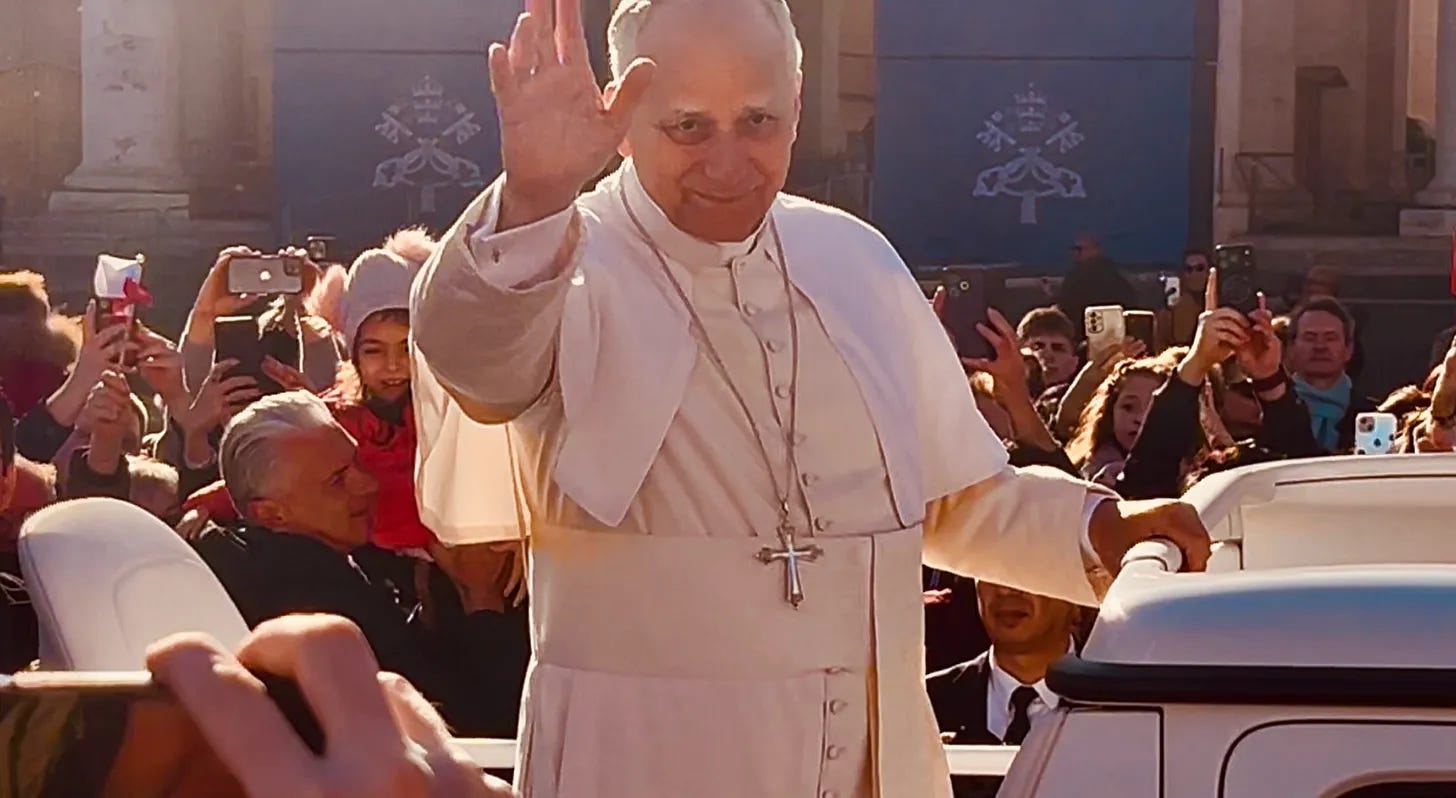
With the diplomatic distance between Rome and Washington widening over the war in Iran, what hopes there might have been for an early papal visit to the United States seem all but extinguished.
But despite the rising tensions and hardening fault lines between the Trump Administration and the Church hierarchy, and the notable example of his predecessor Pope Francis, who eschewed a papal visit to his native Argentina, for many Church watchers it remains unthinkable that Leo will simply never come home again.
The question, then, would seem to be not if, but when Leo might come to America — and the answer may depend on what kind of pope he ultimately chooses to become.
—
After the election of Cardinal Robert Prevost as the first American Bishop of Rome just under a year ago, initial hopes — if not realistic expectations — were high that he would visit the U.S. within the first 18 months of his pontificate.
But those hopes ebbed steadily amid ever increasing political concerns, with the Trump Administration launching deeply controversial immigration enforcement actions in American cities, broadly opposed by the American bishops.
Despite overtures from some sections of American episcopal leadership and indeed the administration itself, other senior voices in the hierarchy were set against an early American trip for the pope — most notably Cardinal Christophe Pierre, the outgoing apostolic nuncio, and Cardinal Blase Cupich of Chicago, now effectively the senior serving American cardinal.
As the body of U.S. bishops formed a united front behind Leo in opposition what they called abuses of human rights and dignity in the administration’s campaign of mass arrests, detentions, and deportations, any serious discussion of a papal visit to coincide with the American 250th anniversary celebrations ended, the rescheduling of the beatification of Fulton Sheen for this September notwithstanding.
In recent weeks, the fault lines between the American pope and bishops and the administration have only deepened, following the military conflict with Iran, in which the president has threatened a war of “civilizational extinction” and the targeting of civilian infrastructure.
“This is truly not acceptable,” Leo said on Tuesday, when asked about Donald Trump’s threat that “a whole civilization will die” in Iran if his terms for ending the conflict were not met. “Here there are certainly questions of international law, but even more than this a question of morality for the good of people,” Leo said, having previously challenged on Palm Sunday the U.S. defense secretary Pete Hegseth’s claim that God was somehow on the administration’s side in the conflict.
God, Leo said, “does not listen to the prayers of those who wage war, but rejects them,” going on to quote Isaiah saying “even though you make many prayers, I will not listen: your hands are full of blood.”
Added to the pope’s words have been strong statements from USCCB president Archbishop Paul Coakley, who said the president’s threat “cannot be morally justified,” and his predecessor as conference leader and serving head of the Archdiocese of the U.S. Military Services, Archbishop Timothy Broglio, who has repeatedly questioned the morality of threatened U.S. military actions in recent months.
The response from the White House has, in turn, generally avoided direct criticism of the pope in public, while making its strong displeasure known in other, idiosyncratic ways.
While all this may make the prospect of a papal visit seem almost laughably unlikely, at least in the short term, it would be a mistake to write it off completely, however.
For all the strength of his statements against U.S. military rhetoric, Leo has been equally swift to weigh in on positive moves for peace, immediately welcoming an admittedly still-embryonic ceasefire “with satisfaction and as a sign of deep hope.”
And however bombastic the White House might be in meeting criticism, it has similarly shown itself willing to change direction and tone on a dime in the face of even the smallest sign of encouragement or progress. And it is no secret around Washington that the administration would welcome a papal visit — perhaps to the point where that enthusiasm is itself a complication.
There are some obvious potential parallels to consider with the forthcoming royal visit of King Charles III of the U.K. Trump has been unsparing and characteristically colorful in his criticism of Great Britain during the current Iran conflict, but this has neither derailed the planned state visit by the king, nor dimmed the reception he is expected to receive.
—
Pulling against this, though, are a number of complicating factors.
Unlike Pope Leo, as a constitutional monarch Charles has not been a protagonist in the back and forth between Trump and the UK government and can therefore be treated as above the fray of even strained diplomatic relations.
Also, some of the Trump administration’s most prominent members, including the Vice President and Secretary of State, JD Vance and Marco Rubio, are themselves Catholics, making it difficult for the Vatican to engage with them solely as agents of a foreign government, and not public exemplars of American Catholicism, for good or ill.
The most sensible conclusion to draw out of this might be simply to wait out the current difficulties with the Trump administration altogether, and delay any serious consideration of a papal visit until after the next presidential inauguration in 2029.
The prospect of Atlanta playing host to the 2030 World Youth Day offers a medium term potential event which would make an ideal centerpiece to an American tour for Leo, in as much as it would provide an advance context for the trip totally outside of the domestic political calendar or international diplomatic events.
Given the Holy See’s institutional preference for well-managed, easily contextualized, and drama-free papal trips, this is probably the most appealing, and therefore likely scheduling for an eventual Leonine homecoming.
However, there are some possible factors which could still push for an earlier visit.
One, which might seem unlikely but should not be discounted, is the potential influence of Cardinal Cupich, understood to have been one of the most quietly adamant and influential voices against Leo visiting the U.S. this year.
By all accounts, Cupich has expressed concern that the White House could try to make political hay of a visit by Pope Leo, turning it into a series of presidential photo ops — or worse turning on the pope and making his trip the focus of partisan criticism or even protest.
On the other hand, Cupich recently turned 77 years old. Delaying a papal visit until after the next election and inauguration would mean pushing it past his 79th birthday — and his 80th if the decision was made to wait until World Youth Day 2030.
However cautious the cardinal is — perhaps justifiably so — about protecting a papal visit from presidential political entanglements, the Archbishop of Chicago is also known to relish the idea of hosting Leo in his hometown diocese.
It’s obviously an open question how much further past the nominal episcopal retirement age Cupich will continue to serve, though most predict he will continue at least through the next year. But as his eventual retirement approaches, might the cardinal warm to the idea of helping to host a pre-election visit, rather than risk watching a later one from the sidelines? It is at least a possibility worth weighing.
—
Of course, the most important unknown factor in the timing of any trip to the United States is Leo himself and what he may choose to do.
So far, just about a year into his pontificate, Leo has opted for a very measured approach to questions about his home country and global diplomatic developments — neither opting for ambiguous silence nor over-the-top or constant interventions.
Instead, the pope has kept his comments to narrow treatments of specific issues and rhetoric, rather than opting for the kind of sweeping denunciations of the administration and its policies that could box the Vatican in as events develop.
But just because Leo has begun his time as pope in a measured manner doesn’t necessarily mean he intends to remain an occasional or peripheral voice on global or American affairs.
Similarly, while the decision was taken to decline an invitation to visit the U.S. for the 250th anniversary celebrations, and all signs so far point to a sensitivity to the political climate, that could as easily signify the pope is biding his time, rather than shying away from a possibly contentious trip.
The received wisdom is that an American pope above all others would want to avoid too close an engagement in domestic affairs, or becoming a kind of pole or polarizing figure in the national discourse. This is the received wisdom for a reason; it is certainly the most small-c conservative approach and the one least likely to generate controversy or contribute to an acceleration of events beyond the foreseeable or controllable.
But we shouldn’t exclude entirely that, as he settles into the Petrine office, Pope Leo might decide to take a more direct role in the national cultural conversation — and should he choose to do so, it wouldn’t be without precedent.
Shortly after his election in 1978, Pope St. John Paul II made what turned out to be an epochal return to his home country of Poland, with a trip in June of 1979 — the first of nine — widely credited with historical hindsight in setting off a chain of events which eventually led to the country’s throwing off of Communist rule.
To be sure, the situation in the United States today is not the same as Poland in the late 1970s, but the wider point is still there to be made: it is not out of the question for a pope to have a strong moral vision for his homeland or to play a central role in driving events.
Indeed, Pope Leo may decide that he has a somewhat unique position in the global politics of the 2020s, being perhaps the only world leader immune to virtually any economic or military pressures which could be brought to bear by the White House and the only one with the luxury of being able to model a kind of reserved statesmanship in the face of often outlandish social media statements from the president.
Leo, unlike the presidents of European or other North and South American countries, isn’t obliged by the pressures of office or the realities of realpolitik to take seriously or engage directly with every news cycle coming out of Washington. But, as the American pope, when he does choose to intervene, he can do so directly and in a cadence attuned to American ears unlike any other world leader.
As such, Leo has the potential to become one of the most influential voices in American affairs. The question, then, is how much he wants to say. His first visit to America as pope will almost certainly be timed to accommodate that, more than anything else.


I really like the comparison between Pope St. John Paul II's homecoming and Leo's. It seems to me that the most important issue facing the US is the disunity and refusal to listen to each other that is a major aspect of American politics. I have no idea whether a visit here would help heal our divisions or make them worse.
Not sure if this is one of Ed.'s British-isms or a typo, but "Isiah" should be "Isaiah". Thanks for a great article!