The bishops of the Chaldean Catholic Church will begin a meeting in Rome on Thursday, with the aim of electing the next patriarch of their Eastern Catholic Church.
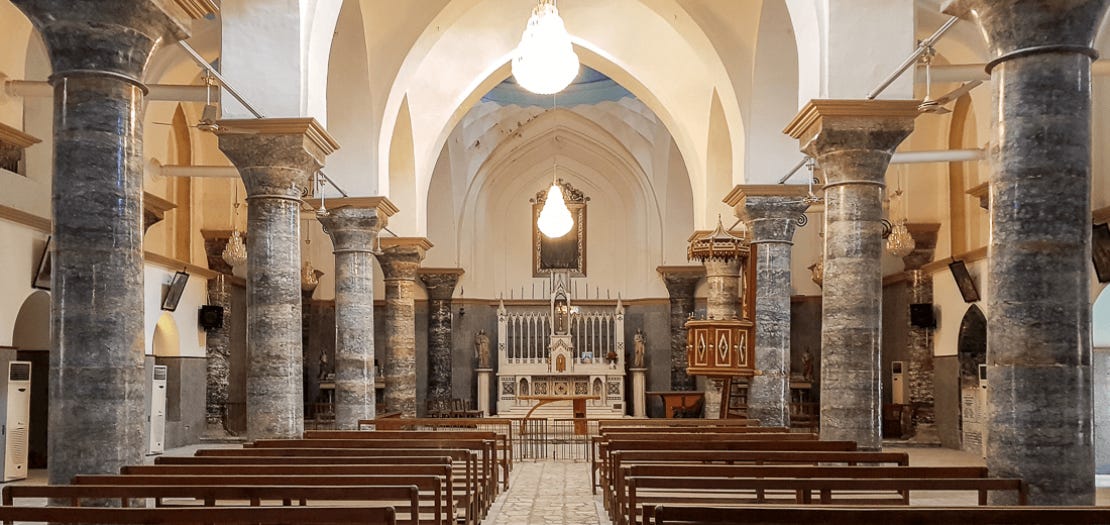
But while the Chaldean episcopate gathers to elect a leader at a time of acute crisis for their Church, predicting the outcome of their meeting requires a longer look into the history and culture of the Chaldean Catholic Church.
—
The Chaldean Catholic Church was rocked last month by the surprising announcement that Pope Leo had accepted the unexpected resignation of Cardinal Louis Raphael Sako, who had been the Chaldean Church’s leader since February 2013.
The cardinal’s resignation was a surprise because he had sometimes indicated a plan to remain in post until he was 80 years old, if he could, or at least to perdure for the foreseeable.
But it came on the same day that Pope Leo accepted the resignation of Bishop Emanuel Shaleta, a Chaldean bishop based in San Diego, who was charged with 16 counts of embezzlement and money laundering in early March, after investigative reporting from The Pillar showed that Shaleta was accused of taking hundreds of thousands from parish coffers, and attempting to cover it up by moving around money from a parish poor fund.
The same Pillar reporting indicated that Sako had been attempting to forestall Shaleta’s removal as diocesan bishop after a confidential Vatican-ordered investigation, or to see the bishop transferred to a ranking Chaldean Catholic post in Baghdad.
Sako had a long friendship with Shaleta, had taken a risk by appointing him to the San Diego eparchy, and after all that, stood accused publicly last month of attempting to paper over serious financial misconduct.
Under those circumstances, it is perhaps little surprise that Leo decided to accept the cardinal’s suddenly-tendered resignation — and, in fact, the decision was widely understood as a sign of Leo’s commitment to ensuring good governance in the life of the Church.
But the Shaleta affair is not the first unusual marker in Sako’s personal file.
In 2024, the patriarch threatened with serious ecclesiastical sanction five Chaldean bishops who did not attend a governing synodal assembly of the Chaldean Church, declining to attend largely with a vote of no confidence in Sako’s leadership.
Sako had accused one of those prelates, Archbishop Bashar Warda, of conspiring with an Iranian-funded militia leader, Rayan al-Kildani, a charge which Warda has denied.
Before that, the patriarch took a self-imposed exile of some nine months outside his eparchial see in Baghdad, over a dispute with Iraq’s president concerning a civic decree recognizing his authority. Sources in the Chaldean Church say the dispute was broadly interpreted, with at least some senior sources accusing Sako of trumping up the dispute to elevate his own profile.
More recently, Sako was involved in the most unusual dispute of his ecclesiastical career, when the cardinal denied giving a post-conclave interview on an Arabic-language Catholic television network, suggesting instead that the Iran-backed militia Babylon Brigade was in some way responsible for a fabricated television interview, in which Sako did not actually participate.
The cardinal’s denial left numerous questions unanswered.
Those controversies were the headline points of a tenure as patriarch marked by quieter controversies. But Sako’s term as patriarch was especially concerning to Chaldeans who felt that the prelate introduced liturgical changes which “Latinized” the Chaldean liturgical patrimony, and that his theological approach tended toward a “flexibility” at odds with the prevailing approach in the Chaldean Catholic Church.
His March 10 resignation, therefore, has been taken by many Chaldeans as an opportunity for a fresh start in their Church sui iuris, a reset after more than a decade of controversy and disagreement.
But how most Chaldeans take the resignation of Sako is not the question at hand. When 16 Chaldean bishops gather in Rome this week, the question will be how they perceive both the present and the future of their Church.
—
By most accounts, there are two emerging frontrunners among the bishops, representing very different possibilities.
The first — and the one most known to Westerners and Latin Catholics — is Warda, the Archbishop of Erbil, who has become well-known in U.S. Catholic circles because of his close relationship with the Knights of Columbus, and his frequent speeches and interviews in the U.S.
Warda was the de facto leader of the bishops who in 2024 opposed Sako’s synodal gathering, and has often been seen as a pole opposite Sako’s in the Chaldean landscape. The reality is more complex, as Warda has obviously had real friction with the patriarch, and at the same time, spoken well of him in public, and urged ecclesiastical commitment and docility to the Church’s hierarchy.
Even in an interview with The Pillar last month, as Warda delineated challenges faced by the Chaldean Catholic Church, the archbishop studiously avoided mention of leadership or leadership challenges among the Chaldeans.
Instead, he mentioned other “undeniable” challenges: “migration, building the faith, the struggle to preserve our identity, and the need to balance our Church between the homeland and those in diaspora. With each new conflict that arises, these challenges only intensify. People begin to lose hope for the future, and more families are contemplating leaving the country, a reality we’re witnessing here in Erbil.”
“Yet, amidst the difficulties, there are real opportunities before us,” the archbishop added.
“Our young people hold immense potential, and our educational and healthcare institutions offer more than just services; they stand as beacons of hope and investment for tomorrow. We are called to shift from barely surviving to truly engaging in our mission: a Church that educates, supports, walks alongside its people, and fosters genuine opportunities for a better life.”
Still, Warda’s election would widely be seen as a break from the Sako era, and a focus for the Chaldean Church on the combination of evangelization and regional leadership for which Warda himself has become known.
—
But Warda’s election as patriarch is far from certain.
In fact, sources say, his odds are about even with those of Bishop Basilio Yaldo, 55, who is an auxiliary bishop of Baghdad, and was a principal deputy of Sako.
Sources tell The Pillar that Sako has lobbied in recent weeks for Basilio’s election, and that lobbying has been effective among at least a few Chaldean bishops who were supportive of Sako’s direction in the Church.
And Basilio has another corner of support, too. He is from the northern Iraqi town of Tel Keppe, on the Nineveh Plain, in relatively close proximity to Kurdistan. Tel Keppe is an important and influential historically Christian stronghold in Iraq, which has been a center of Chaldean cultural identity for centuries. That pedigree gives Basilio a certain gravitas within the Chaldean community — where the village of one’s family is an important reality — and the support of some influential Chaldeans.
Basilio is, in short, seen in some corners as a stable hand at the till, a bishop with the leadership experience and gravitas to steer the Chaldean Catholic Church — making him something like the continuity candidate in the race.
While Warda can likely count support from at least half the Chaldean episcopate, Basilio might be able to muster the same.
—
There are two circumstances by which another bishop might be elected to lead as patriarch of the Chaldean Church.
The first is if the bishops deadlock in their support between Warda and Basilio. The second is if Warda decides he does not want to be patriarch, as he has reportedly sometimes told friends and supporters. The archbishop is only 56 years old, and is widely seen as an emerging leader in his church.
But he has been a diocesan bishop for more than 15 years, and during that time, has lived through the occupation of ISIS in his territory, an extraordinary exile of his people, and a constantly unstable economy. Few could blame Warda if he decided he would like a quieter call than the mandate to be Chaldean patriarch.
In either of those scenarios, though, it’s Warda who is most likely to play kingmaker: either by suggesting a compromise candidate, if support is divided, or by supporting another bishop, if he has wide support but decides against the position.
In either case, one bishop who could emerge is Archbishop Emil Nona, who led the Archdiocese of Mosul, Iraq, until he was forced by ISIS occupation into exile, and then appointed by Pope Francis to lead the Chaldean Church in Australia and New Zealand.
Nona, who said that ministering during the ISIS occupation was “the best time of my life,” is widely regarded as a visionary and evangelical leader, with experience among the Chaldean Church’s growing diaspora community around the world. As Christians have left Iraq in scores in recent years, that experience might be seen as valuable among the Chaldean episcopate.
—
There are more than 600,000 Chaldean Catholics around the world, preserving an ancient liturgical and spiritual patrimony — and attempting to live it as Christians today, both in Iraq, and further afield.
Their next leader will face real challenges, including the challenge of rebuilding trust and confidence amid the end of the Sako era. As they select the man most competent to those challenges, they’ll aim to draw from the lessons of their history, and the prospects of their future.

