
Pillar paid subscribers can listen to this Pillar Post here: The Pillar TL;DR
Hey everybody,
Today’s the feast of St. Juan Diego (and my daughter Pia’s birthday) and you’re reading The Tuesday Pillar Post.
Today also marks seven months since the newly elected Pope Leo XIV offered his first Mass as pontiff, in the Sistine Chapel, where I will have the privilege and gift to stand today.
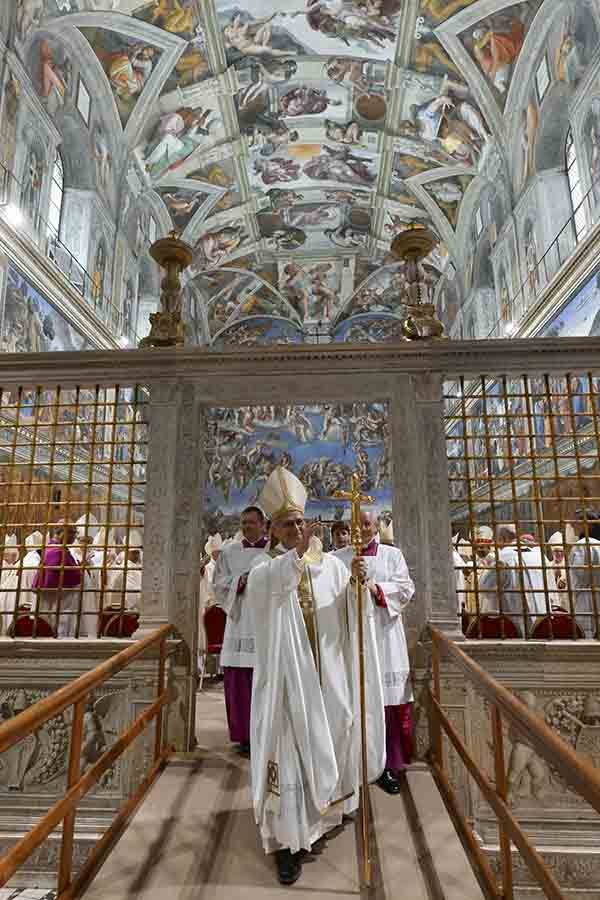
Here is what Leo told the cardinals, and the whole Church:
“Jesus is the Christ, the Son of the living God: the one Savior, who alone reveals the face of the Father.
In him, God, in order to make himself close and accessible to men and women, revealed himself to us in the trusting eyes of a child, in the lively mind of a young person and in the mature features of a man, finally appearing to his disciples after the resurrection with his glorious body. He thus showed us a model of human holiness that we can all imitate, together with the promise of an eternal destiny that transcends all our limits and abilities.
Peter, in his response, understands both of these things: the gift of God and the path to follow in order to allow himself to be changed by that gift. They are two inseparable aspects of salvation entrusted to the Church to be proclaimed for the good of the human race. Indeed, they are entrusted to us, who were chosen by him before we were formed in our mothers’ wombs, reborn in the waters of baptism and, surpassing our limitations and with no merit of our own, brought here and sent forth from here, so that the Gospel might be proclaimed to every creature.”
—
We are now — Ed and I — on the last day of a pilgrimage in Rome, traveling with extraordinary Pillar pilgrims we’ve really gotten to love.
I helped to plan every step of the pilgrimage, and still I’ve been surprised by what the Lord is saying to me.
Our first expectation was that the pilgrimage would focus on the papacy — on Peter, and the keys. Before Francis died, we thought the pilgrimage would have Mass each day in the church of a different papabile cardinal, so that our pilgrims would have a chance of saying eventually that they had been to Mass in the titular church of the eventual pope.
When Leo was elected, we had to change our plans some. We’d already had the conclave, and it didn’t make much sense to focus on visiting the titular churches of a bunch of guys who hadn’t been elected.
So we thought we’d visit the titular churches across Rome of different Popes Leo through history.
We have done some of that, and thereby seen some churches well off the beaten path.
But those churches have unexpectedly put us often in the path of the Church’s earliest martyrs — of the evangelizing Christians of the Church’s earliest centuries. So too have serendipitous moments along the way — quick visits into small and ancient churches connected to the earliest martyrs, or a rescheduled Mass that brought us to an out-of-the-way ancient-church-in-the-round, with a mosaic floor from before Constantine was a Christian.
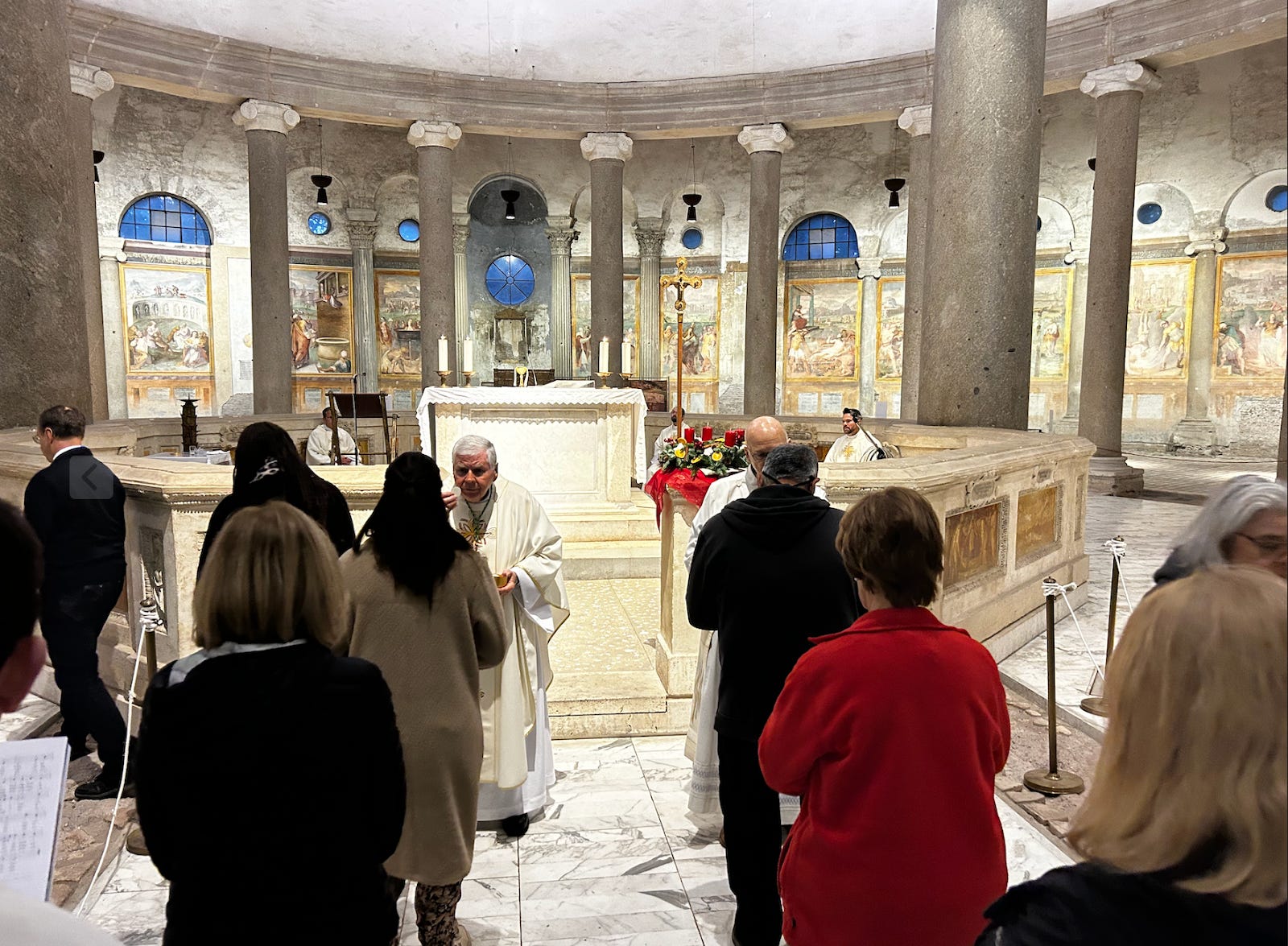
For Mediterranean people then, Rome was the center of the known world — the place through which culture and commerce and society came and went, the crossroads of everything. That’s why the fledgling persecuted Church was there, and, through its martyrs, how it spread across huge portions of the world.
I’ve been wondering where that crossroads is today. Perhaps it’s Jakarta, which just became the world’s largest city, and where Christianity is a small minority, and the Catholic Church only a fraction of that. Perhaps it’s still New York, but more likely it’s Beijing, or Delhi, or the global Wild West of the UAE.
But I’m reflecting on the call for us to learn from those early Christian martyrs — that Rome matters, because the successor of St. Peter is here, and the blood of those early martyrs poured into the soil of this place. But the call now is not just to preserve that in amber, or to bemoan that once the martyrs laid the seeds of a Christian society, and now it is lost.
The call is not to allow ourselves to be caught in the naval-gazing of synodality, or in a project tinged with reminiscent sentimentality, to hedge around what has already been gained, peering over the parapet only to look for what dangers lie beyond it.
Our call is the same evangelical imperative those early Christians had: To know that the Lord is coming soon, and to be most concerned with the transmission of the Gospel right now, to people unsaved by the waters of baptism, or outside the life of grace with God eternal.
There are in Rome big picture questions waiting to be asked about the kind of society most helpful to the sustained life of the Church, and good examples in the archeological strata of this place about what worked and didn’t work in history.
But for myself, what I keep seeing in Rome this month is how little those early Christians let themselves be distracted by theory, or nostalgia, or fear —and how urgent was their sense of preaching Christ to those who would hear, and then living together in a communion of mutual commitment, centered at the Eucharistic table, which is Christianity.
What does that mean for me? What changes does it mean for my actual life, waiting for me back in Denver with basketball practice and Cub Scouts and bills to pay? What does the Lord’s voice in my ear mean for my family — and for the apostolic work in which we are already engaged? I don’t know.
But none of us can stare into catacombs and ossuaries, at the bones of people who gave their very lives to make known the name of Jesus, and imagine that the Lord will expect any less commitment from us.
It’s Advent. Christ is coming.
—
The news
Good news for us? Ed Condon has the most insightful analysis I’ve read on both moves, how they’re related, and what they really mean about the Vatican’s ongoing relationship with the Chinese government in Beijing. The short answer? The Leonine papacy hasn’t yet addressed the bilateral China-Vatican agreement, but Leo might not want to wait for too long before he gets started.
—
Though the dogma of the Immaculate Conception was defined only in 1854, the feast enjoys a rich and long history in the Church, intertwined with many historical events.
Where does the feast day come from? How was the Dec. 8 date chosen for it? And why does the pope celebrate it by going to the Spanish Steps?
—
The situation has led to a rare public clash with the Orbán administration from the country’s bishops.
Luke Coppen reports, and you’ll only read it here.
—

This Advent, gather with fellow Catholics for a Bible study unlike any other. Bible Across America is a nationwide Bible study hosted by the St. Paul Center. During this inaugural study, we’ll encounter Christ as “Teacher and Lord,” discovering what this means for our lives as modern-day disciples.
The Leos
So back when Leo was elected, much was made of the name he had chosen as an homage to Pope Leo XIII, who was pope amid the Second Industrial Revolution — a moment in which new tech possibilities launched a cataclysmic shift in the way human beings related to each other, to work, to money, and to God.
Leo XIII steered the Church through that period by renewing and reviving old theological traditions — namely Thomism — to address new problems, which were expressed in the social doctrine of the Church.
And the conventional read on XIV’s name choice is that he wanted to evoke XIII, especially since the current Leo will be called to lead the Church through the change of era represented by AI.
But there might be more personal reasons for Leo’s name choice, which have gone largely unnoticed. Until today, at least.
The current pontiff — I’m just going to keep calling him XIV for convenience sake — is a member of the Order of St. Augustine. In fact, he was for a time the Augustinians’ superior general.
The order came together in the 1200s as a kind of amalgamation of little Italian hermit groups which had been living quite close to each other, and all doing a life of penance and poverty, not far from where St. Francis of Assisi had started his own band of brothers.
In the 1250s, Pope Alexander IV decided it was a bit chaotic to see all those little unconnected groups running around in the woods and praying and whatnot, and so he directed them to organize into a conglomerate, which would become the Order of St. Augustine, following the way of life of Augustine of Hippo.
Five hundred years later, the order was dying. It had few vocations, and not much money.
But the pope — Leo XIII — couldn’t just stand by.
He’d grown up in an Augustinian parish. He’d probably considered an Augustinian vocation, before going to the Jesuit Gregorian University, and then becoming a secular priest. He had a devotion to Our Lady of Good Counsel, an especially Augustinian Marian image.
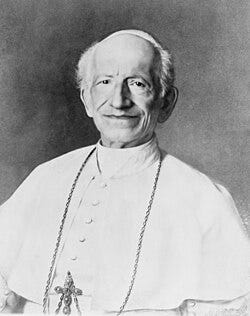
So as pope, Leo XIII did a bunch for his Augustinian friends.
He gave them money every year, he helped rebuild an ancient church for them outside of Rome. He canonized some Augustinians, he made some Augustinians cardinals, and one friar the apostolic delegate to the U.S.
He intervened to see a very smart American-Italian friar, Fr. Pacifico Neno, become superior general, and reinvigorate the order’s leadership.
XIII even put the Augustinians in charge of the parish at Castel Gandolfo, his summer house (the parish was decades later given to secular clergy instead, but still…)
But with all the things XIII was doing, the Augustinians were still struggling. And at the same time, they were losing their headquarters building — the generalate — because it was enormous, occupied prime real estate in the middle of town, and was expensive to keep up — and apparently because of some (Masonic) Italian politics.
So XIII helped the Augustinians again. He helped them find land, and finance a purchase, for a new HQ, this one directly across the street. The place had room for young friars in formation, for the order’s senior leaders, for a chapel dedicated to St. Monica.
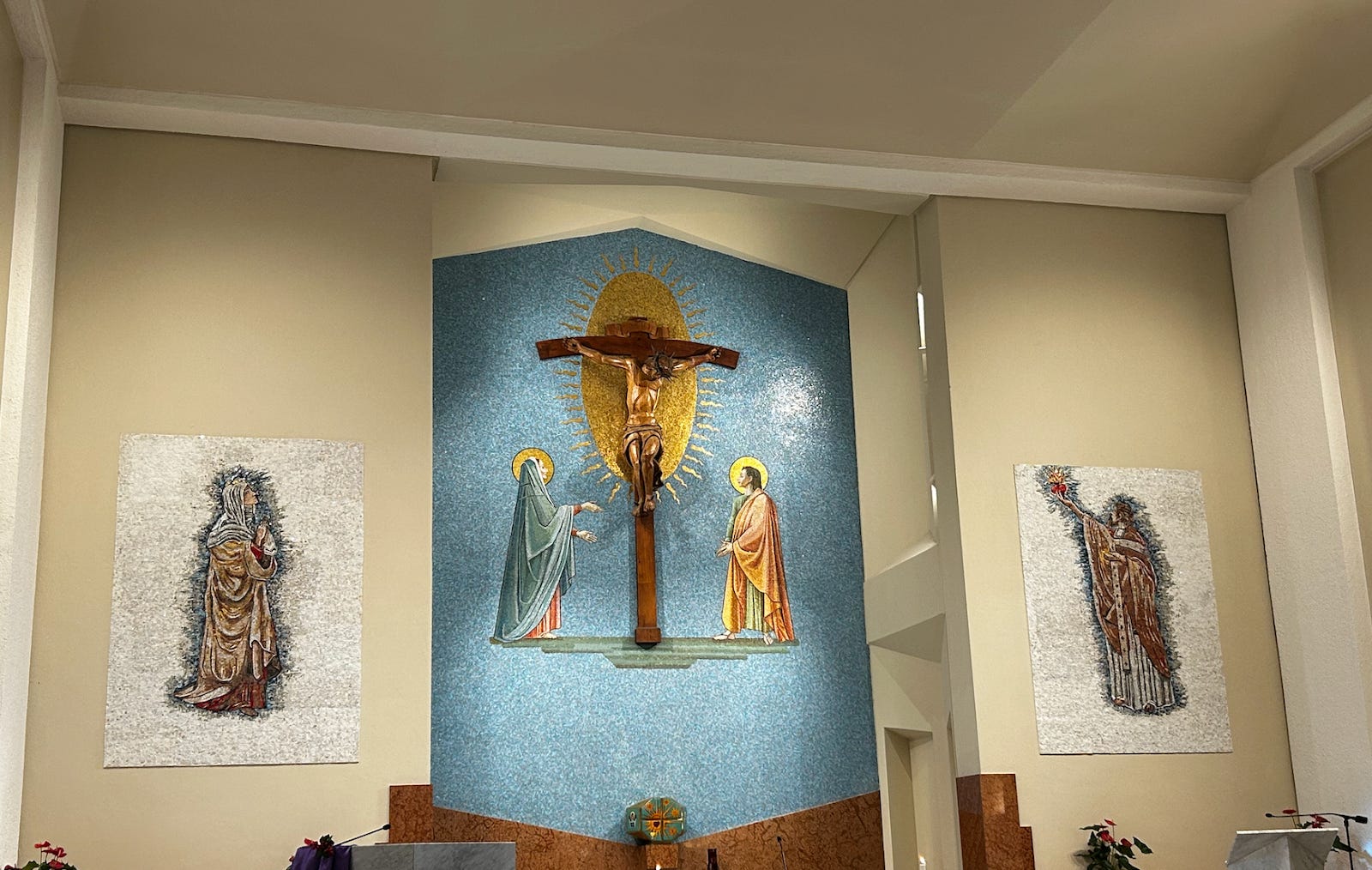
That chapel became eventually the titular church of Cardinal Robert Prevost.
For all that work, the Augustinians say that XIII saved their order from the brink of death.
And I suspect that XIV — who lived in the house that XIII built — was well aware of the debt his order owed to the last Leo.
While all that big picture stuff about the name is probably true, the most beautiful things are personal — cor ad cor, as it were. I suspect XIV’s name is also personal: a “thank you” to the man who helped save his brothers, more than a century ago.
“The heart is commonly reached, not through the reason, but through the imagination, by means of direct impressions, by the testimony of facts and events, by history, by description. Persons influence us, voices melt us, looks subdue us, deeds inflame us. Many a man will live and die upon a dogma: no man will be a martyr for a conclusion.” — St. John Henry Newman
—
Buon Natale!
I promise to tell you the story of getting lost in the catacombs of St. Priscilla.
But next week, I’m afraid.
First I’ll make an observation about the greetings of December.
There was, once, only a singular American cultural war over Christmas: Beginning in the 1990s, in the name of multiculturalism, American corporate and retail life became monocultural, and many large retail chains instructed their employees to tell shoppers “Happy Holidays” instead of “Merry Christmas.”
Holiday is a word whose etymology is not playing a trick; it is obviously “holy day,” or “hallowed day,” coming to us through the Old English “haligdæg.”
Since Christmas is the principal holy day of December, it’s reasonable to equate “happy holidays” with a Christmastide greeting — perhaps one even giving a nod to St. Stephen’s Day and the Marian feast of January 1.
But the phrase was not taken that way.