
Pillar paid subscribers can listen to JD read this Pillar Post here: The Pillar TL;DR
Hey everybody,
It’s a week of saints and feasts, and you’re reading The Tuesday Pillar Post.
To get started, I want to tell you about a guy you’ve probably not heard of before.
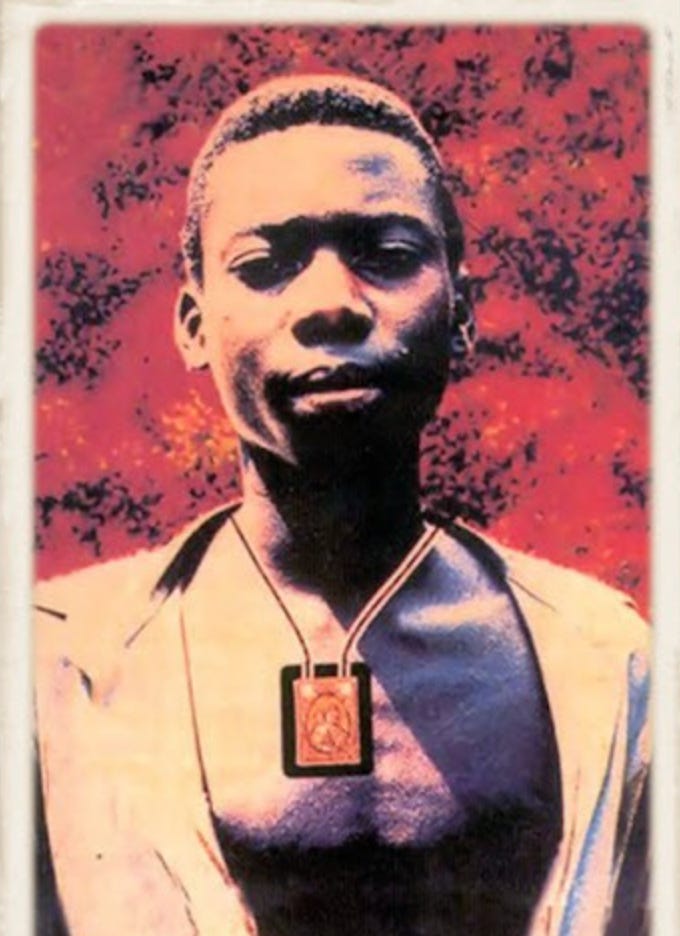
Isidore Bakanja was born in a tribal village on the Congo River in Africa, in territory then occupied by the forces of King Leopold II in Belgium. He was born sometime between 1885 and 1890, though it’s not certain exactly when.
Bakanja lived in a territory called the Congo Free State.
It was claimed personally as the territory of King Leopold — it was not a part of Belgium, but was ruled instead as an absolute monarchy, and controlled by unspeakable brutality.
Leopold saw in the Congo Free State ivory, minerals, and rubber, which he had exported and sold to increase his personal wealth. He did not see, or seem to see, the people of his territory, many of whom lived in forced labour on expansive rubber plantations.
Bakanja’s family worked intermittently at farming and brickmaking, but they were very poor, and there were few opportunities for young men to earn money in Bakanja’s village. So as a young man, he moved downriver to a larger town, where he became a stone mason.
More important, Bakanja became a Christian — he was evangelized by Trappist monks in the area, and in 1906, was baptized, confirmed, and received the Eucharist.
Bakanja took to wearing a brown scapular — a sign of faith — and to carrying with him always the rosary.
In 1909, Bakanja decided to move closer to his village, and his family, and he found work on a rubber plantation.
His boss — like many of the Belgian plantation overseers — was fanatically opposed to Christianity, and to the Christian missionaries who spoke out on behalf of the dignity of Congolese people.
Plantation owners and overseers often said that when the Gospel came, their workers would stop working —but there is little evidence of that. Instead, it seems clear that the real danger was that Christian missionaries would upend the forced labor system which benefited the Belgians who had come to work it.
Soon after he started on the plantation in April 1909, Bakanja was ordered beaten when he refused to take off his scapular. His boss began mocking him, calling him the little priest. In May, still wearing his scapular, Bakanja was ordered beaten again.
A few months later, in July 1909, Bakanja’s boss saw him praying the rosary. The boss flew into a rage. He ordered Bakanja beaten more than 250 times with a leather whip into which nails had been embedded. After his skin was beaten to ribbons, Bakanja was locked into a cell, in which no medical care was available. There, infection set in.
Bakanja ran up a fever, and there in his cell, he fought off flies. He stayed there until an inspector was due to visit the plantation, nominally charged with evaluating the conditions of workers. While Bakanja was being sent to a village, to be hidden from the inspector, he escaped into the forest.
He lay dying for days, his infection growing worse, his wounds stinking and covered in flies. Eventually, he dragged himself back to the plantation, knowing inspections were still underway.
The inspector took pity on him. He had him carried to a riverboat, taking to a home where he could convalesce. But Bakanja’s infection had become sepsis. He would not recover. In late July, a Trappist priest was brought to him. Bakanja was anointed. But he held out for two weeks, dying on August 15th, the feast of the Assumption.
His boss, a man named Van Cauter, was eventually imprisoned. But Bakanja died forgiving him — and asking his caretakers to tell his mother that he died for following Jesus Christ.
When Pope St. John Paul II beatified Isidore Bakanja in 1994, the pontiff praised Bakanja’s conviction.
“Isidore, your participation in the paschal mystery of Christ, in the supreme work of his love, was total,” the pope said.
“Because you wanted to remain faithful at all costs to the faith of your baptism, you suffered scourging like your Master. You forgave your persecutors like your Master on the Cross and you showed yourself to be a peacemaker and reconciler.”
May Blessed Isidore Bakanja intercede for us. May we keep the faith.
The news
That might sound a bit technical, and it is. But it’s also the first major financial reform of Pope Leo’s pontificate, so it says a lot about the direction the pontiff will be going.
And the kicker? Vatican sources tell us the text was first drafted by Cardinal Pell’s staff at the Secretariat for the Economy, back in 2017.
Rosica had argued in court that since both he and his alleged victim were priests at the time of alleged abuse, only a canonical court should adjudicate the matter. The Canadian judge in the case didn’t buy that, concluding instead that “the Plaintiff’s claim is not essentially doctrinal or ecclesiastical in nature – it is of interest to all Canadians and goes well beyond the internal matters of the Roman Catholic Church.”
“Moreover, the canonical court does not have an adequate internal dispute mechanism meant to cover claims for damages arising from sexual assault cases,” she continued.

For the past 28 years, Logos has brought together scholarly authors and eager readers to engage with the beauty, truth, and vitality of Christianity as it is rooted in and shaped by Catholicism. Published by the Center for Catholic Studies, University of St. Thomas (MN). Read/subscribe via Project Muse or PDC.
Two nuns were arrested in late July on highly questionable charges of human trafficking and religious conversion after they were surrounded by a hostile mob at an Indian railway station.
What is going on in India? Why are Christians facing resurgent violence?
The request is the latest in a saga roiling the Church in France, where Archbishop Guy de Kerimel is insistent that a priest convicted of child sexual abuse has the “unimpaired reputation” necessary for being appointed diocesan chancellor.
I have been reporting and writing about sexual abuse in the Church now for about eight years, and during that time I’ve often argued that many of the biggest episcopal failures on this front come from the same major blind spot — one that views the abusive priest as a suffering son in need of help, but without seeing the broader obligations to justice, healing, and especially trust, both for victims, and for an entire community.
de Kerimel is upfront about that attitude, arguing openly that not appointing his priest to be chancellor would be akin to “a form of the death penalty.”
This argument has not garnered a lot of support. And if you ask me, it suffers from three problems, especially when advanced by a bishop.
First, it doesn’t consider the prospect in this case of reoffending, or the degree to which the priest’s actions should have proven him sufficiently untrustworthy for a position of major responsibility. I call this the “layperson litmus test” — would anyone think that a layperson, convicted of the same crimes as Fr. Dominique Spina, should be eligible for rehire into positions of major administrative responsibility in the Church?
No. No one would think that. And thus the case fails the basic layperson litmus test.
Second, as I said, it fails to recognize that the priest is not the only person in the story, and that he doesn’t belong in the center of the narrative.
Fr. Spina might be sad about the social isolation which comes with not having an important chancery job. But also under consideration should be the experience of victims who see in his appointment a cavalier attitude toward their suffering, and a basic indifference toward their healing. When victims say that it’s hard for them to step foot in a church because of the way the Church handled their case, it seems that experience ought to be crucial in guiding decisions — not without real due process, of course, but with the salvation of souls as the primary guiding principle.
Third, it sells the priest short. Archbishop de Kerimel’s perspective seems to be that it’s been a long time since Fr. Spina was convicted of his crimes, that he paid his civil debt to civil society, and that he shouldn’t continue to suffer the social stigma of past behavior. It seems to me that argument is insufficiently considerate of the spiritual realities at play.
The assignment of “prayer and penance” should not be misused to mean that a priest without due process is warehoused somewhere outside of ministry or unjustly made a scapegoat to satisfy an angry mob. But when a priest is actually convicted of actually abysmal crimes — in this case, coercive sex with a child — it seems to me that the assignment of prayer and penance is actually the greatest possible mercy, the gift of time to work out with God some penitential mortification in this world.
“Prayer and penance” properly applied, is the most merciful assignment anyone can have — and likely more spiritually efficacious than an admin job at the chancery.
Anyway, there are two people who could resolve this. The first is Archbishop de Kerimel. The second is Fr. Spina. It’s noteworthy, amid the furor the issue has caused in France, that Fr. Spina himself has not resigned himself from the post.
What happens next remains to be seen.
The move comes amid turmoil inside the community, which outgoing leader Michel-Bernard de Vregille called “particularly challenging.”
There is a lot to take away from this story — but one point is an issue flagged frequently by Pope Francis, namely the frequent recent emergence of major governance problems in many of the “new ecclesial communities” founded in the late part of the 20th century.
As those communities have grown and spread, they’re facing the challenge of transitioning from institutions built fraternally around a founder’s charism and vibrancy, into institutions governed by clear norms, structures, and accountability.
The entire history of the Church has shown the difficulty of that transition, which is why the profusion of mendicant and healthcare orders founded in the medieval world had exactly the same transition problems after their (often saintly) founders died.
As in other eras, the Vatican will aim to deal with those problems in ways which protect and empower legitimate charisms, rather than suppress or eradicate them.
But that’s challenging.
Here’s the latest from the Emmanuel Community.
—
Finally in the news, a shrine to Mary, Mother of Persecuted Christians, will open in the Iraqi town of Qaraqosh, 11 years after the Christian population was temporarily driven out by ISIS.
The overall number of Christians in Iraq has declined dramatically in the 21st century, from around 1.5 million at the start of the 2003 invasion to roughly 150,000 today. Emigration accelerated after ISIS occupied swathes of Iraq from 2014 to 2017.
But the remaining Christians hope to demonstrate that Mary, the Mother of God, has been their protector.
Keeping the faith
A pair of researchers published this morning an assessment of data which indicates that a growing share of Americans raised Catholic no longer identify as Catholics in their adulthood.
More important, only 11% of people raised Catholic in the U.S. say they attend Mass every week, a pretty big drop over recent decades.
The researchers emphasized data which shows that adult religious practice can be predicted by several factors: that both parents are married and have the same religious identity, that parents demonstrate that the demands of the faith are important to them, that parents talk with their children about the spiritual life, and that parents provide warmth and structure, promoting healthy attachments.
There are other factors useful in predicting adult religious practice, like attending Catholic high school, having Catholic friends, and engagement with a congregation.
But there’s one predictive factor that strikes me as especially important to recognize and consider: That “when children grow up with many supportive Catholic adults in their lives, that increases their likelihood of remaining Catholic, even holding all the other factors fixed. Grandparents, friends’ parents, mentors, youth ministers and other non-parental adults can make a big difference.”
In short, the researchers demonstrated with data the Church’s own theological self-understanding: That the Church herself is the mystical communion of the baptized in Christ — and that salvation is not a single-player sport.
In fact, while being a faithful and devout family is good, it seems insufficient for the actually meaningful and enduring transmission of the faith to children.
The same researchers found something which most of us have experienced first-hand: That Catholics do not experience Christian community in their parishes, and that seems to contribute to diminished Mass attendance.
I grew up mostly in a small evangelical Christian community in New Jersey, and I can say with certitude that even while I have since taken up the practice of Catholicism, that small Christian community — Garwood Presbyterian Church — is a major reason I remain a Christian as an adult.
That little church was a thick community. Members of our ecclesial communion were expected to socialize with each other, to regularly be in one another’s homes, to be responsible for one another in sickness, or during job loss, or when families experienced crisis.
And because of that community, I can name a dozen adults whose own Christian faith was influential to me as a child — people who were not my parents, whose Christianity was palpably the animating force of their lives, and who were invested in my life.
No matter how good our parishes, I’m not sure we replicate that very often, which is what contributes to the decline in Catholic religious practice or identity.
The truth, it seems to me, is that we just haven’t figured out very well what parish life really can look like in the wide open spaces and suburban dystopias of modern American life. There are exceptions, but for the most part, it is possible to be completely anonymous in most American parishes, or to be detached except in the most surface ways from other parishioners.
We rightly prioritize the parish as a locus of sacramental life. But we can do so in a way that ignores the notion of parish as a home, or discount that kind of talking as fuzzy, felt-bannerish, or liberal.
It’s funny though, because the Fathers of the Church seemed to have thick Christian community in mind when they talked about common prayer, and Eucharistic unity, and even distributive justice.
That’s the kind of unity I’m talking about — the demanding sort of belonging which seems ordinary in the book of Acts, and mostly foreign to our experience.
In fact, there is a species of Catholic misanthrope I encounter, who celebrates going to Mass, and then going home, without speaking to anyone at all.
This is one of the reasons why I have a perennial soapbox here at The Pillar about the genius of the Church’s territorial parish model. Territoriality, in principle, creates a defined community of Christians who are meant to understand their interdependence, their responsibilities for and to one another, and their common call to holiness.
Thick Christian communities demand the spiritual and corporal works of mercy, not just for strangers at a soup kitchen, but for people whose names and stories are known to us. And that instantiates faith into little hearts in a way that’s hard to shake.
I’ve come to accept that where parish territoriality has been lost, it is not easily recovered, and that there are very good reasons why families choose not to worship in their territorial parishes.
But if we’re not going back to the halcyon days of parishes with territory, we need to address the notion of thick Christian community in some other way, as an ordinary experience of parish life.
And we need to be sure those communities are demanding — that they don’t include just a self-selected group of shiny happy people or cool Catholic hipsters, but that they include people who need things from us — who, in fact, demand things from us. That’s the only way we meaningfully live the Christian life, it seems to me, and the only way we meaningfully pass it on.
Desire for that is a big reason why ecclesial movements have gained some popularity in American Catholic life, and I think it’s also a big reason why the Traditional Latin Mass has gained so much popularity (relatively speaking). The little and tight knit communities of ecclesial movements, charismatic communities, and TLM parishes provide the kind of thick Christian community we have an intuitive sense that we need.
Addressing the crisis of thick Christian community seems to me the most pressing issue for the Church today — indeed, if we’re going to have synods, it seems far better to me that we talk about this than that we talk about synodality itself, for whatever that’s worth.
But for the moment, I want to tell you about Janice and Phyllis.