
Pillar paid subscribers can listen to this Pillar Post here: The Pillar TL;DR
Hey everybody,
Today’s the feast of St. Padre Pio of Pietrelcina — a Capuchin friar of the 20th century with a worldwide devotion.
He was a popular confessor, said to be able to read souls, and he received the stigmata. He was immensely popular with pilgrims and spiritual seekers, but his life was mired in controversy of the ecclesiastical kind, and he spent several years without faculties for public priestly ministry.
If I’m honest, I’ve never understood Padre Pio, never been attracted to his cult of devotion, never quite gotten him, as it were. I know people love him — and I see a picture of him in every Italian taxi cab I enter — but his mystical and prophetic spirituality has never resonated with me.
The truth is that I’ve always thought Padre Pio and his cult of devotion are a little bit weird.
But before you get mad or judgy, there’s a reason I’m telling you that.
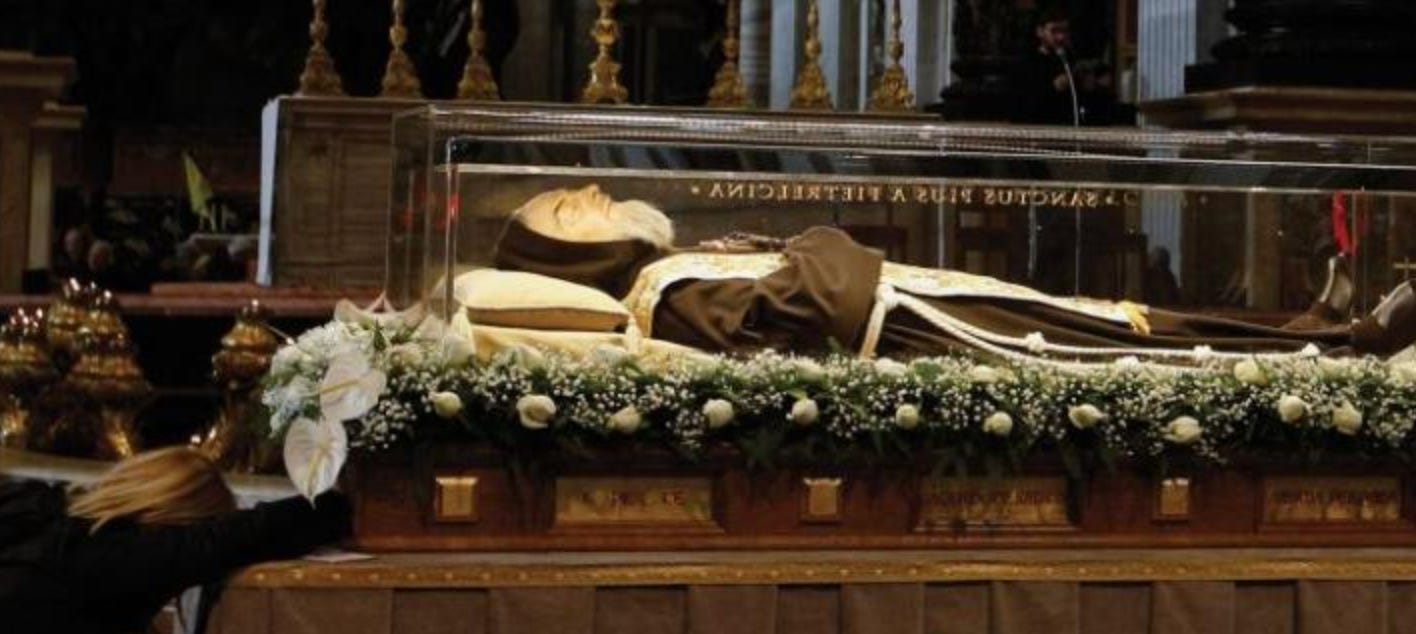
In September 2016, nine years ago, my wife made a pilgrimage to Italy. She attended the canonization of Mother Teresa, and she visited the tomb of Padre Pio.
In both places, she asked those saints to intervene for us — that after more than a decade of infertility (and two beautiful adopted children), God might give us the gift of another child, and might give her the gift of pregnancy itself.
She was pregnant the next month. Those saints intervened, and our son Daniel came into the world.
The Lord was at work.
And I think God did me a special favor by working this incredible gift through a saint I’m not especially excited about.
The communion of the Church is not a communion of vibes and feels. Ours is not a unity of mutual admiration, of doing favors for people we like because we like them, or asking favors of people we like because we like them.
The communion of the Church is that we are connected to each other through the Cross, and thus the altar. We are unified in the suffering of Jesus Christ, and incorporated together into his resurrection.
The Church is bigger than our preferences — and our obligations go beyond our affectivity.
If he interceded for us — and I think he did — Padre Pio did a spiritual solid for a guy with no affective preference for him at all, because we are both members of the one body.
We need a lot more of that.
It seems to me that regular and committed intercession for one another is among the most basic obligations of Christians, and that it should actually be a foundation of our own spiritual lives. But most of us promise to pray for people, and then it becomes an afterthought — especially if those people aren’t already friends.
Perhaps Padre Pio can be an inspiration. He prayed for me and my family efficaciously, and I can hardly be called his friend, let alone his devotee.
Let’s pray for the rest of the Church today — even for people who don’t especially care for us.
The news
Since Pope Leo’s election, rumors have floated around the Church that the pontiff is hard at work preparing the teaching documents that could come to define his papacy — an encyclical is expected next year, and an apostolic exhortation is widely reported to be released in early October.
(10/6 would work if the pope wants to give me a birthday exhortation.)
But separating fact from fiction on the pope’s plan isn’t easy. So we asked Edgar Beltran to take a crack at it. And here’s what we know about the pontiff’s plans.
But Bätzing gave a speech that reflects the German bishops’ conference ambivalence about the country’s annual March for Life, which is often accused of links to the country’s far-right political parties, despite its insistence on non-partisanship.
Bätzing said that the country’s pro-life movement should not be co-opted by “political, demographic, nationalistic, or even ethnic interests.”
There is, however, a burgeoning disconnect between Germany's bishops and the country’s practicing Catholics.

Fire on the Altar is a uniquely liturgical reading of St. Augustine’s Confessions. In this companion to Augustine’s classic work, Dr. Chad Pecknold unpacks Augustine’s vision of the human heart as an altar. When united to Christ’s self-offering in the Eucharist, our hearts are set ablaze with divine charity. At once challenging and edifying, Fire on the Altar emphasizes the call to transform your life into an offering acceptable to God.
The bill, expected to pass in November, would amend the country’s criminal code to remove criminal penalties for women who undergo abortions, and remove professional sanctions for doctors or medical personnel who perform them.
The law would not, however, formally permit abortions to take place in the small nation between Spain and France.
By law only one of the country’s two co-princes must sign legislation for it to become law, a step usually left to the French president — the other Andorran co-prince — on contentious matters. But the Vatican’s hand in the current negotiations has prompted questions over whether Bishop Serrano might also sign.
—
A fracas erupted among Catholics late last week, after it emerged that Cardinal Blase Cupich plans to give Illinois Senator Dick Durbin a lifetime achievement award, from the Chicago archdiocesan office of human dignity and solidarity.
The award, meant to recognize Durbin’s work with immigrants, has drawn a lot of criticism because the senator has spent decades — most of a lifetime, actually — aiming to achieve more legal protections for abortion, the practice of killing unborn human beings.
In fact, since 2004, Durbin has been prohibited from receiving the Eucharist in Springfield, Illinois, where the senator says he resides, where he is registered to vote, and where he made his political career as a “downstater” representing the interests of people outside of Chicago.
That’s why Bishop Tom Paprocki of Springfield responded to questions from The Pillar on Friday with a statement saying he was “shocked” that Durbin — seemingly his ecclesiastical subject — would receive such an award.
Given his prohibition from Holy Communion, that would seem to include Durbin.
“Honoring a public figure who has actively worked to expand and entrench the right to end innocent human life in the womb undermines the very concept of human dignity and solidarity that the award purports to uphold,” Paprocki said Friday.
The situation gained a lot of attention over the weekend, as Catholics mostly pushed back on the idea that Durbin’s lifetime achievements should be feted by the Church, even if his work on immigration is laudable.
And some noted the irony of the award coming in Chicago, where the late Cardinal Joseph Bernadin emphasized during his tenure a “consistent ethic of life,” by which pro-life people should be expected to affirm the right and dignity of life at all of its stages — including the unborn stages at which Durbin has advocated for the legal protection of killing.
For his part, Paprocki gave an interview to The Pillar Monday morning, in which he explained why he spoke about the award:
“Cardinal Berndardin didn't like it when people would use the consistent [life] ethic to try to argue that you can downplay the abortion issue, as long as you’re promoting other social justice issues,” Paprocki said.
“Unity does not mean that you stay silent because you don't want to ruffle anybody’s feathers. It certainly is desirable that we all speak with one voice and that we work together as Christ entrusted his mission to us. But when someone steps outside of what the Church teaches, well, I think we have to call that out,” he added.
But Cupich, hearing the criticism, issued a statement of his own yesterday.
Of course, he’s gotten pushback on the idea that an award is the same thing as dialogue, with most Catholic responses suggesting the cardinal’s claim is pretty thin gruel.
To this point, the conflict has played out exactly how anyone would expect it to. Paprocki, being Paprocki, was almost certain to weigh in on an issue he regards as wrong, and as within his circle of responsibility (given that Durbin is putatively his subject). Cupich, being Cupich, was almost certain to give an explanation while doubling down, and Catholics on the internet were almost certain to turn that explanation into a meme.
But here’s where things get interesting. Because in pontificates past, one might have expected the next step would be for Cupich, sometime in the next couple of weeks, to get on a plane to Rome, find some reason for a meeting with the Roman Pontiff, release photos of that meeting, with the apparent expectation that they’d be taken as an approbatio of his position.
That would lead to a round of criticism for Pope Francis, followed by the award itself, and then a pause before the next American episcopal controversy.
But there’s a new pontiff in town.
And, in fact, Chicago is his town, which means there’s no conceivable way that Leo XIV will be ignorant of thai brewing controversy for very long — he may well have already read about it in The Pillar, where — for my money — it’s been covered better than anywhere else.
But Leo has cast himself as both a unifier and a man who will insist on doctrinal integrity, even as he tries to help the Church “dialogue” with the world. And he’s had some fairly strong words for Catholics politicians making their peace with the secular moral order.
So now he’s got this situation.
The pontiff doesn’t have to issue an anathema to intervene. If Durbin announces a head cold in early November, and someone else gets the award — or no one does — we can probably surmise, or at least suspect, that the pontiff had a hand in it.
But if nothing happens, and Cupich continues with the conferral of the honor, well, American bishops might have questions for the American pope:
— What should we expect from you when one of us violates the consensus we’ve reached on a key issue in our public ministry?
— Does the Leonine call for unity mean not speaking out, or does it mean expectations of orthopraxy for episcopal leadership?
Before the pontiff intervenes — if he does — it’s worth watching whether other bishops will weigh in. Leo has seemed to encourage open dialogue among bishops. He’s said he wants that. Paprocki has broken the seal, and at least one other bishop — Archbishop Cordileone — has jumped in. But it seems that the pope might be informed by other bishops offering their perspectives, for or against, at least to give him a sense of the room, as it were.
By the time of the award ceremony, the Chicago Cubs might be World Series Champions. And who knows what else will happen in the Windy City.
We’ll keep covering this. So as they say at Wrigley, “Be here for It.”

By the way, there is a nerdy little subplot of this whole thing, which Ed and I have been watching closely.
Paprocki says Durbin is his subject. Cupich seems to say the same. The whole thing boils down to some interesting questions about domicile and quasi-domicile as they’re conceived in canon law.
Don't worry, nerds: We will definitely take this opportunity for an explainer on the concept.
Duc in altum?
Mrs. Kirk didn’t talk about politics or policy, she spoke — with obvious difficulty — about her husband, about their marriage, about his sense of mission, and her sense of partnership.
You don’t have to agree with Charlie Kirk’s politics to see that this woman believed in her husband, loved him well, and now carries a heavy cross.
And you don’t have to agree with his politics, or hers, to see that Mrs. Kirk will aim to carry that cross with the grace of Jesus Christ.
That grace was evident when she stood in a stadium Saturday afternoon and told the world that she forgives her husband’s killer. With evident sincerity, she seemed as much to mourn for his future as she did for her own husband.
She mourned for the young man who killed her husband, and she invoked “that young man on the cross, our Savior.”
There was something powerful there. There was a grace there.
But that’s at the center of a firestorm in this country, in which the controversy around Kirk and his politics promises to continue dividing us.
Mrs. Kirk’s speech was a big moment, but not the only one, and not the only one which will have lasting impact.
That may be true in the Church, too, where a cadre of bishops have made it a point to praise Kirk, perhaps even to lionize him, and American practicing Catholics seem divided about Kirk, and their bishops’ messages.
Many people I know say they’re inspired by Kirk. Others are livid about his politics. And a lot of people — really, the majority of practicing Catholics I talk with — are ambivalent, or uncertain, or confused, not about his murder, but his legacy — they like some of what he said but not all, and mostly, they’re not sure what or whom to trust about any of it.
They just don’t know what’s true, people tell me. I get it.
The Kirk moment brings to light what I think a lot of practicing Catholics have felt about the Trump era.
Obviously, there are plenty of Catholics who have clear and strong views on the Trump era one way or another — absolute certainty about where they land.
But I know a lot, too, who are just overwhelmed by the national moment, discouraged about political leaders on all sides, want leaders they can trust and respect, and are anxious about the state of our country.
Like I said, they’re uncertain about what’s true, and whom to trust.
That experience is set against the backdrop of a kind of Evangelical santo subito moment for Kirk, and a burgeoning divide among bishops over the whole thing.
While Cardinal Dolan calls him a modern day St. Paul, the German Bishop Stefan Oster said this morning that Kirk’s memorial service was “instrumentalized by some of the protagonists into a pseudo-religious political show.”
I wish I had any wisdom to offer at this moment, as much for myself as for anyone else. I’m in a group text with some friends who are successful leaders in Catholic ministry (I am the odd man out in that group text), and all of us are struggling, each in our way, to know what to say about the call of Christians at this complicated moment in American history.
I’m not sure if this is the start of a genuine religious revival, or textbook political messianism, or both, actually. I suspect both. But a decent portion of you will be mad at me for my uncertainty, because to you, the answer — whichever one you conclude — is self-evident and obvious. I’m sorry that’s not the case for me.
I’m mostly struck in prayer by this: Duc in altum.
Here’s why: