
Leading Church figures gathered in Austria this week to devise a “roadmap” for synodality in Europe
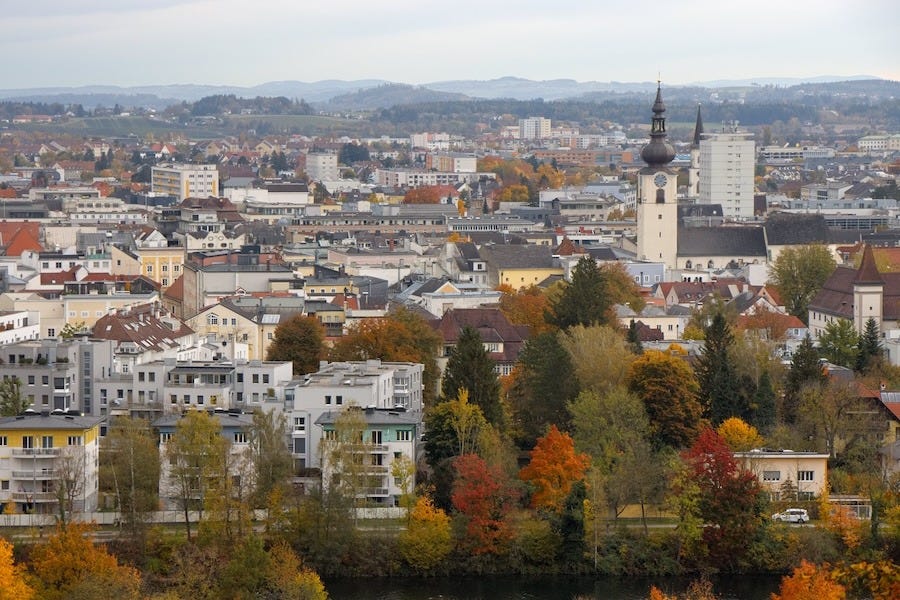
More than 180 people representing 31 countries and 29 bishops’ conferences attended the Sept. 14-17 symposium “Shaping Synodality in Europe: From Vision to Roadmap” in Wels, a city in Upper Austria with Roman roots.
The event was organized under the patronage of the Council of European Bishops’ Conferences, or CCEE, in cooperation with the Department of Synodality at the Catholic Private University Linz, which is led by Klara-Antonia Csiszar, a pastoral theologian with an Austrian, Romanian, and Hungarian background.
An invitation to the symposium promised that it would be “more than a conference.” It would, it said, “stand as a milestone for the local Churches of Europe.”
Why did organizers believe the symposium was so significant? And what issues emerged during the event?
‘A new synodal Church in the making’
In an essay published in July, Klara-Antonia Csiszar argued that the synodal process in Europe had reached a “halftime” moment, in which the Church was called to turn the aspirational reforming language of synodality into “lived practice.”
“The gap between decision and habitus [deeply ingrained habits] is the real problem of halftime,” she wrote.
Csiszar’s halftime analogy referred to 2026 as the midway point between the publication of the synod on synodality’s final document in 2024 and the ecclesial assembly scheduled to take place at the Vatican in 2028.
A Sept. 14 press release from the Catholic Private University Linz underlined the symposium’s ambitions. It highlighted the presence of “leading actors in the synodal process” such as Sr. Nathalie Becquart, undersecretary of the Synod of Bishops, and Archbishop Gintaras Grušas, president of the CCEE, and the theologians Paul Zulehner and Tomáš Halík.
“What is also becoming evident in Wels is a new synodal Church in the making — a Church committed to fostering greater participation and responsibility, and not just within its own ranks,” it said.
Two groups played a significant role in the deliberations: the 21-member Research Group of the Department of Synodality at the Catholic Private University Linz and the seven-member European Task Force for Synodality, a body coordinated by the CCEE.
Three people belong to both the research group and the task force: Csiszar, Cardinal Ladislav Nemet, the Archbishop of Belgrade, Serbia, and the theologian Fr. Christoph Theobald, S.J. Nemet, who is also vice president of the CCEE, has a Hungarian background, while Theobald is Franco-German.
Although more than 30 countries were represented at the symposium, some nations sent larger delegations than others. Judging from photographs from the event, Switzerland and the Czech Republic had nine representatives, while Germany had at least five, Portugal four, England four, and Denmark three.
Austria was a suitable host country because it has long been considered the crossroads of Europe. But the location also pointed to the prominent role played by German-speaking Catholics in the European synodal process. The symposium was covered extensively by the German-language Catholic media, but appeared to attract less attention elsewhere in the European Catholic media.
Reports produced by the symposium’s 21 working groups, which met at round tables, will be submitted to the CCEE and incorporated into the preparations for the European continental assembly that will be held in spring 2028, ahead of the ecclesial assembly in Rome. Another symposium may take place in 2027 in Louvain-la-Neuve, Belgium.
Walking together?
The global synodal process leading up to the 2023-2024 synod on synodality in Rome highlighted differences and divisions within the Catholic Church in Europe.
These were most starkly apparent during the European synodal continental assembly held in the Czech capital, Prague, in February 2023. While German delegates made the case for the changes to Catholic teaching, practice, and structures advocated by the country’s synodal way, Church leaders from Central and Eastern Europe pushed back.
German representatives argued that only structural change could eliminate the root causes of the abuse crisis and called for the inclusion of women in all areas of Church decision-making.
Central and Eastern European delegates insisted the German proposals represented a capitulation to secular culture, a watering down of Catholic teaching, and a failure to respect the Church’s God-given hierarchical structure.
So in broad terms, there were two competing visions of synodality in Prague: one emphasizing structural change and the overriding value of equality, and another seeing the process largely in terms of encouraging improved communication between the laity and hierarchy.
Reports on the Wels symposium suggest significant divisions remain, but are no longer defined so sharply by support for or opposition to the German synodal way, partly due to the new German bishops’ conference chairman Bishop Heiner Wilmer’s more conciliatory approach.
A report in the German section of Vatican News highlighted a notable difference of opinion between Archbishop Grušas and the Swiss Bishop Felix Gmür.
Grušas, who is the Archbishop of Vilnius, Lithuania, as well as president of the CCEE, apparently expressed concern that local churches “with a high degree of organization were in danger of becoming NGOs.”
Gmür “countered this argument by stating that a church like the one in highly developed Switzerland relies on strong structures and a legal framework.”
The exchange suggests a tension between local churches with highly developed institutional and legal structures — found particularly in the German-speaking world — and those that worry that bureaucratic structures can overshadow the communal and spiritual dimensions of Church life.
This difference is highly relevant when it comes to the synodal process, because Church leaders are currently focused on how synodality can be introduced at the local level. The debate is therefore about whether it’s possible to institutionalize synodality without bureaucratizing it.
Does synodality require, to cite a recent example, that the Austrian bishops should open the post of bishops’ conference general secretary to lay people? Or is it less about institutional outcomes and more about finding new ways to promote communion, participation, and mission?
Those focused primarily on institutional change tend to stress the urgency of making big decisions, emphasizing that many can be taken now without waiting for a signal from Rome. Those on the other side of the debate see no such urgency and stress the importance of careful collective discernment.
Some Church leaders in Wels appear to have accepted that there will be no common approach to synodality in Europe. The continent’s Catholics will “walk together,” but at varying speeds and perhaps in different directions.
Others seem to believe that a common vision could still emerge, but not necessarily within a compressed timetable.
At the Sept. 14 press conference in Wels, Cardinal Nemet acknowledged the Church’s diversity.
“Differences do not disappear simply by ignoring them. Those who come from a large Church should be careful not to assume that their own pace is the European standard,” he said.
He added: “Both sides have something to offer each other, but neither listens to the other enough.”
Reflecting on the reports from the symposium’s working groups, Csiszar suggested that the broad themes of a Europe-wide plan were emerging. She identified them as baptism as the common foundation of dignity and responsibility, listening, hospitality, closeness and accompaniment.
The list suggests that European Church leaders haven’t so far converged on particular institutional reforms, but rather are seeking a common pastoral and spiritual focus, while allowing plenty of leeway for each country to pursue its own path.
But Csiszar did propose the creation of a “European Church Forum for Interpreting the Signs of the Times,” which she described as a way of drawing together the experiences of local Churches and identifying new forms of synodal cooperation.
Ultimately, the Wels symposium raises the question of whether it’s possible to create a detailed roadmap without first reaching a firm consensus on the direction of travel.