German bishops to ask Rome to permit lay homilies
Bishop Heiner Wilmer will also seek Vatican approval for the synodal conference’s statutes
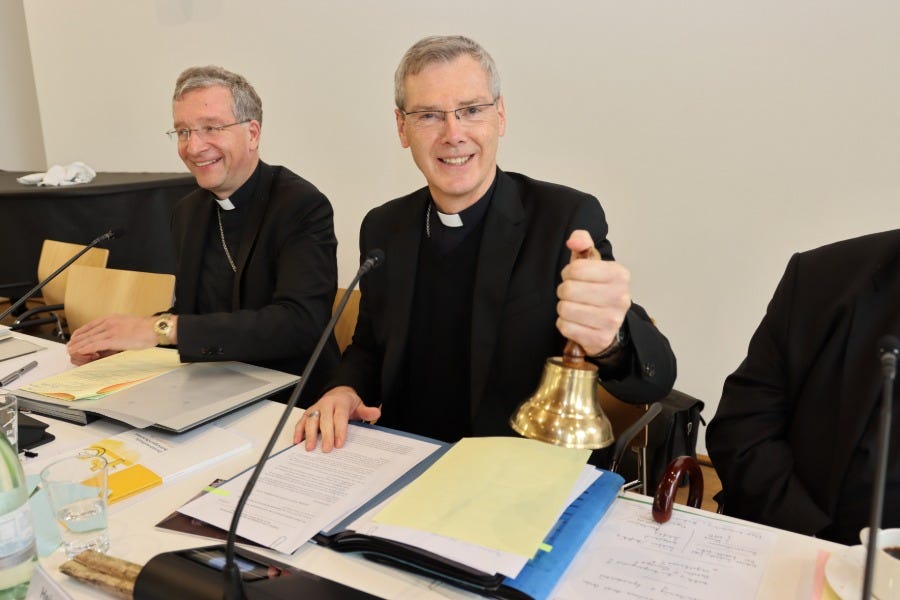
The German bishops will formally ask the Vatican to permit lay preaching at Masses, new conference chairman Bishop Heiner Wilmer announced Thursday.
According to Church law, homilies at Mass are “reserved to a priest or deacon,” but lay people can receive permission to preach in a church or oratory, “if necessity requires it in certain circumstances or it seems advantageous in particular cases.”
In a report issued at the end of the bishops’ Feb. 23-26 plenary meeting in Würzburg, Wilmer said the request to Rome to permit lay homilies originated in a resolution approved by participants in Germany’s controversial “synodal way” on March 10, 2023.
The document called on Germany’s bishops to “draw up a particular norm and obtain permission for this from the Holy See, according to which the homily can also be taken over in Eucharistic celebrations on Sundays and feast days by theologically and spiritually qualified faithful commissioned by the bishop.”
The resolution noted that it was already a “long-standing practice” in German dioceses for “persons who have qualified themselves through studies in theology and have been sent by the bishop into the ministry of proclaiming the Gospel” to preach at Masses.
It suggested the practice could be expanded to include religious education teachers, “trained people for leading liturgies of the word,” and “spiritual leaders of associations.”
Wilmer, who was elected bishops’ conference chairman Feb. 24, said the bishops had discussed the synodal way resolution on lay preaching at Masses in detail and adopted a regulation that would govern the practice.
“We now want to ask for approval for this regulation in Rome. We have agreed that I will take this with me on my next visit to Rome and explain and promote it once again in discussions there,” he said.
The German bishops’ request seems likely to be rejected not only because it is inconsistent with canon law, but also because the Vatican responded negatively to the synodal way resolution shortly after it was passed.
German Catholic media reported at the end of March 2023 that Cardinal Arthur Roche, the prefect for the Vatican’s Dicastery for Divine Worship, had written to the then-bishops’ conference chairman Bishop Georg Bätzing, rejecting arguments in favor of lay preaching at Masses.
Roche suggested that “misunderstandings about the figure and identity of the priest” could “arise in the consciousness of the Christian community” if lay people preached in place of clergy.
“Word and sacrament are inseparable realities, and since they are not merely formal expressions of the exercise of sacra potestas [sacred power], they are neither separable nor can they be separable,” he said.
The cardinal also highlighted Pope Francis’ opening in 2021 of the ministries of lector and acolyte to women.
“This openness offers lay people the opportunity to engage in meaningful liturgical ministry in the exercise of the ministry of lector and acolyte,” he wrote, expressing interest in “how this possibility was received in the dioceses in Germany.”
Five years later, there is little evidence that German dioceses have seized the opportunities for instituted ministries of lector and acolyte offered by Pope Francis.
Widespread lay preaching at Masses does not appear to take place in any other country than Germany, even in neighboring German-speaking nations.
A draft proposal circulated at Australia’s plenary council in 2022 called for the local Church to petition the Vatican to approve lay homilies. But ultimately, the assembly rejected a motion seeking to amend canon law to permit lay homilies.
In Germany, the practice dates back decades. The German bishops’ conference approved a document in 1988 that set out norms for commissioning qualified lay men and women to preach in specific contexts.
It said: “In cases where the diocesan bishop deems it necessary, Catholic lay people (men and women) may be entrusted with the ministry of preaching during the celebration of the Eucharist, in the form of a statio [introductory address] at the beginning of the service, provided that the celebrant is unable to give the homily and no other priest or deacon is available to do so.”
The document was implemented in dioceses such as Rottenburg-Stuttgart. In 1999, the Rottenburg-Stuttgart diocese issued its own document regulating lay preaching at Masses. The diocese was led at the time by Bishop Walter Kasper, who later served as prefect of the Vatican’s Pontifical Council for Promoting Christian Unity.
The document said lay people could preach at Mass when priests or deacons could not deliver the homily due to extraordinary circumstances. As examples of exceptional circumstances, it cited “physical and psychological impairments, e.g. age, illness,” “communication problems, e.g. language difficulties, specific target groups,” “overload due to a high number of sermons,” “the need for special thematic expertise,” and the “need for special pedagogical competence, e.g. children’s, youth, family church services.”
Church law says that “a homily must be given at all Masses on Sundays and holy days of obligation which are celebrated with a congregation, and it cannot be omitted except for a grave cause.”
The 1999 text presented lay preaching at Masses as a responsible way to meet the requirements of canon law when a priest or deacon was unable to preach.
At their spring plenary meeting, the German bishops also approved the statutes of a new permanent body of bishops and lay people known as the synodal conference.
The Catholic website communio.de reported Feb. 27 that the statutes “only very narrowly” secured the approval of the necessary two-thirds majority of the 56 bishops present at the meeting. The bishops’ conference has not confirmed this account of the vote.
Bishop Wilmer said at a Feb. 26 press conference that he would apply for recognitio (approval) for the statutes in Rome.
He argued that the synodal conference “represents the development of a format that takes the concerns of the global synodal process seriously and implements them in our cultural sphere, including the impetus for greater transparency, accountability, and evaluation.”
He added: “The worldwide synodal events have taught us how valuable it is to listen to one another. Synodality remains a spiritual attitude. Walking together, sharing responsibility, making decisions together — and keeping Christ at the center.”
“Trust grows from this center, and trust creates a future. It will be a matter of proclaiming the Gospel with all our strength, with words if necessary.”
