Who is the German bishops’ new leader?
Who is Bishop Wilmer? And why was he chosen to succeed the controversial Bishop Georg Bätzing?
When Bishop Heiner Wilmer gave his first public address as chairman of the German bishops’ conference Tuesday, his opening words were “Glory to God in the highest, and on earth peace to people of goodwill.”
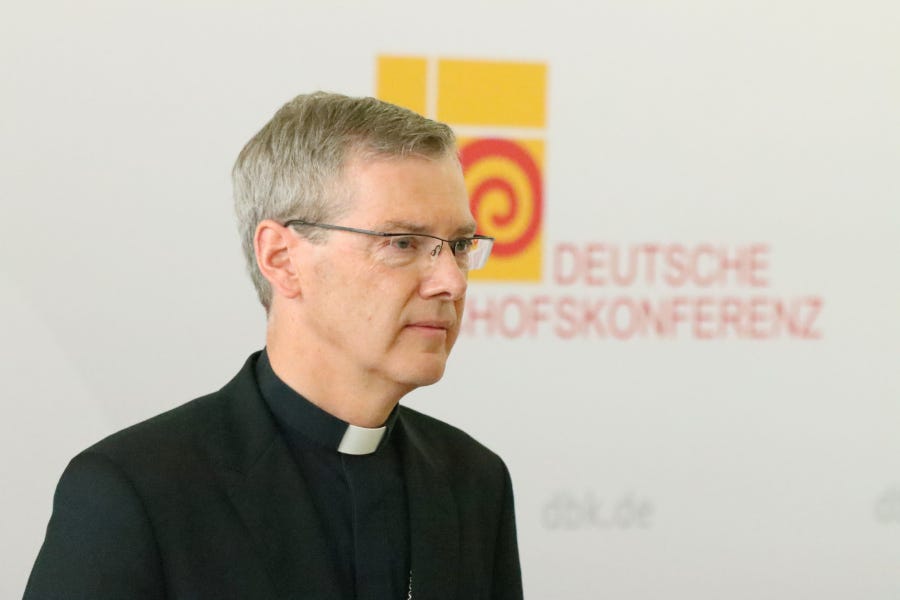
Glancing down at a text written on his smartphone, he noted that the phrase was taken from the Gloria recited at Mass.
“These verses from the Gospel of Luke convey a dual message: looking to God and looking to people,” he said. “God at the center, and peace for the world and justice as a task.”
Wilmer, the 64-year-old Bishop of Hildesheim, northern Germany, was effectively presenting his mission statement for his next six years as head of one of the world’s most influential bodies of bishops.
He is the first member of a religious order to take charge of Germany’s vast episcopal apparatus. His opening gambit suggests he will bring a distinctive spirituality to his demanding new role, one shaped by his formation in the Dehonian order.
Who is Bishop Wilmer? How has he led the Hildesheim diocese? And why was he chosen to succeed the controversial Bishop Georg Bätzing?

Who is Bishop Wilmer?
Heinrich Theodor Wilmer was born on April 9, 1961, in Emsland, a district in northwestern Germany that borders the Netherlands.
Unlike many senior Catholic churchmen, who are typically city dwellers, Wilmer grew up on a farm. To this day, he can drive a tractor. He is a lifelong supporter of the unglamorous soccer club FC 27 Schapen (currently languishing at the bottom of the regional league table). He is also a speaker of Low German (Plattdeutsch), a regional dialect considered more gritty and down-to-earth than Standard High German.
Wilmer attended a local high school run by the Dehonians, an order founded in late 19th-century France by the priest Léon Dehon, whose beatification cause was paused in 2005 because of accusations of antisemitism.
Devotion to the Sacred Heart of Jesus is at the center of Dehonian spirituality. The order’s members are encouraged to be “prophets of love,” embracing a spirit of reparation and acting as “servants of reconciliation.”
After leaving school in 1980, Wilmer entered the Dehonian novitiate in Freiburg, southwestern Germany. He made his perpetual vows in 1985 and was ordained to the priesthood in 1987. He continued his studies at Rome’s Pontifical Gregorian University, ultimately gaining a doctorate in Freiburg with a prize-winning dissertation on the French philosopher Maurice Blondel.
Wilmer taught at high schools in Germany before moving in 1997 to the U.S., where he spent two years teaching German and history at Fordham Preparatory School in New York City’s Bronx borough.
He returned to Germany to serve as a high school principal. Then, in 2007, he was elected head of the Dehonians’ German province, a post he held until he was appointed superior general of the worldwide order in 2015. The Rome-based position brought him into contact with Church leaders from across the globe and educated him in the ways of the Vatican.
His term as superior general ended prematurely in 2018, when Pope Francis named him Bishop of Hildesheim, a diocese not far from Wilmer’s birthplace. He took the episcopal motto Adiutores gaudii vestri (“Workers for your joy”), from 2 Corinthians 1:24.
As tensions rose between the German bishops and Rome over the controversial “synodal way,” Pope Francis seemed to designate Wilmer as one of his prime interlocutors. The Argentine pope received Wilmer regularly in private audiences from 2020 onward.
Pope Francis held Wilmer in such high esteem that he considered appointing him as prefect of the Vatican’s Dicastery for the Doctrine of the Faith. But the move encountered opposition, and the Argentine theologian Archbishop Víctor Manuel Fernández was named to the post instead.
Wilmer has continued to act as an intermediary between Germany and Rome under Leo XIV, who received the bishop in a private audience in November 2025.
Since 2021, Wilmer has served as the chairman of the German bishops’ commission for social issues, which elevated him into a national voice on social-political matters, commenting on everything from climate change to pension reform.
He also maintained a steady output of books, including the searching, deeply personal work Gott ist nicht nett (“God Is Not Nice”) and Herzschlag (“Heartbeat”), an imagined dialogue with the Dutch Jewish writer Etty Hillesum, who died in the Holocaust at the age of 29.
How has he led his diocese?
When Bishop Wilmer arrived in Hildesheim in 2018, the diocese was struggling with decreasing numbers and diminishing resources.
That year, the diocese had a total of 593,360 Catholics, around 45,000 of whom (7.5%) regularly attended Mass. In 2018, 7,018 people formally disaffiliated in the diocese.
By 2024, the diocese had 508,073 Catholics, around 30,000 of whom (5.8%) regularly attended Mass. In 2024, 8,851 people formally disaffiliated in the diocese.
Judged solely by the numbers, Wilmer has failed to arrest the decline in membership and practice in the diocese. But the same could be said of most diocesan bishops in Germany and elsewhere in Europe.
Under Wilmer’s leadership, the diocese plans to reduce its portfolio of buildings roughly by half in the next decade, in an effort to balance the books.
Along with other German bishops, Wilmer has promoted a reckoning with abuse. Several studies have explored the Hildesheim diocese’s historical handling of abuse cases. In 2025, Wilmer commissioned a further study that will also examine his own first years in office — a risk other bishops might be reluctant to take.
“Light must be shed on events up to the present day. That is my firm conviction,” he said at the time. “That is why coming to terms with sexual abuse remains a top priority for the Diocese of Hildesheim and for me personally.”

Why him?
Bishop Wilmer is just four days older than his predecessor, Bishop Bätzing, so his fellow bishops did not choose him because they wanted a generational shift in leadership.
When did they elect him, then? To answer that, it’s helpful to consider what German commentators believed the bishops were looking for in a new leader.
Writing at communio.de before the election, journalist Benjamin Leven identified eight qualities that could be significant in a new conference leader: proficiency in Italian, Roman experience, independence of mind, theological heft, negotiation skills, assertiveness, media friendliness, and a knack for identifying key future topics.
Wilmer ticks several of these boxes. He certainly speaks Italian, though it is unclear how well he speaks curialese, the distinct dialect spoken in the Vatican’s corridors of power. He will need to be highly proficient to convince Rome to approve the creation of a new permanent national synodal body in Germany, known as the synodal conference.
Wilmer has also carved a distinctive theological profile and, according to German media, is perceived as a bridge-builder between the German bishops’ conference’s ideological factions.
His first press conference suggests he has a clarity and directness that could appeal to the media, though he may lack the charm and good humor exuded by the most telegenic churchmen.
As well as considering his personal qualities, it’s important to note where Wilmer stands on the spectrum of the German bishops’ conference. Broadly speaking, he supports the wide-ranging changes in Catholic teaching and practice demanded by the synodal way. He will therefore be seen in the English-speaking Catholic world as radically progressive. But his connections with Rome arguably place him near the center of the conference, rather than at its far liberal edges.
His election, therefore, could be interpreted as a doubling down on the synodal way by the German bishops, but with a more diplomatic, less triumphalistic tone.
In his opening address, Wilmer presented himself as a figure who hopes to lead the German Church out of its years of torment following the abuse crisis and into a more positive future.
“We have problems and challenges, yes. But the faithful at the grassroots are in good spirits,” he said.
He added: “Catholic social teaching is a prophetic voice for all people. This voice must be amplified. Catholics in Germany want to carry the Church confidently and humbly into a new era.”
Can Wilmer persuade Germany’s divided bishops and aggrieved laity to rally behind this upbeat vision? Can he convince Rome that the synodal way will lead to authentic spiritual renewal?
The odds are certainly against him. But on the day of his election, he arguably passed one of the first tests of leadership. He set out a clear manifesto: God at the center, peace and justice for the world. Whatever the next six years bring, he has made a purposeful start.

This was interesting to read; thank you, Luke. I’m curious about the opposition Wilmer faced when Francis wanted him to head the DDF. Who opposed him, and why? Was there any internal opposition to naming Fernandez instead?
One can only hope that he will lead the Germans away from their continued path to schism.