The chairman of the German bishops’ conference has suggested that the first scheduled meeting of a controversial synodal body will be delayed absent approval of its statutes by the Vatican.
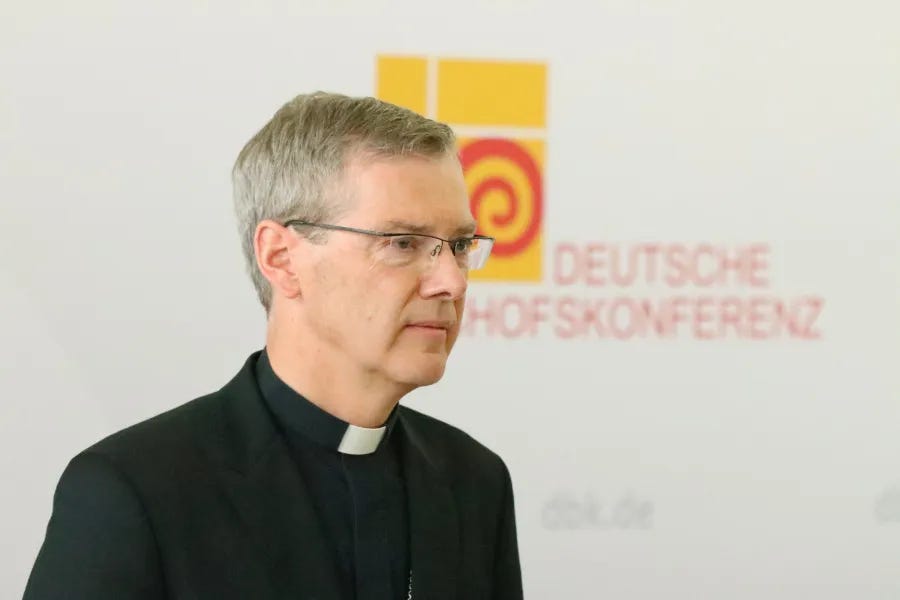
Speaking to media on Friday, Bishop Heiner Wilmer said that the first meeting of a new permanent national body composed of bishops and lay people, known as the “synodal conference,” could not go ahead unless the Vatican approved its statutes, which were approved by Synodal Way participants earlier this year.
“I personally do not expect that we will meet as early as November because of the [Roman] dynamics, because the [decision] goes from one dicastery to the next,” Wilmer said.
The concession by the conference chairman that the marquee product of the years-long German synodal process would not proceed without explicit Vatican approval, even under the guise of a provisional or informal session, appears to be the clearest indication yet that the bishops as a group are not prepared to openly defy Pope Leo XIV.
And the delay of the synodal conference’s creation — either temporary or terminal — could also signal the ultimate fracturing of a previously united majority of German bishops committed to radical reform.
—
While the multi-year synodal way undertaken by the German bishops in partnership with the Central Committee of German Catholics (ZdK) officially concluded in January of this year, the synodal conference was meant to represent a second phase of the synodal process in the country, carrying forward the previous sessions’ proposals.
The first five synodal way assemblies were dedicated to drafting controversial proposals on a range of issues concerning Church teaching and discipline, including women’s ordination, human sexuality, married clergy and lay governance.
While these meetings and the hundreds of pages of resolutions and proposals they produced were the subject of considerable commentary and criticism, including from Rome, the ultimate conclusion of the synodal way, in January, presented and considered the practical means to bring them to life in German dioceses.
The creation of the synodal conference, with a hybrid membership of bishops and lay people, would, according to synodal way proposals, “take fundamental decisions of supradiocesan significance on pastoral planning, future perspectives of the Church, and financial and budgetary matters of the Church that are not decided at diocesan level” and have a mandate to “regularly monitor the implementation of the decisions of the synodal way” in German dioceses.
The creation of a supra-diocesan body with decision making power above bishops has been a key aim of the synodal way organizers and, for several years, the incorporation of lay people into a national governing body was held up as an essential end of the synodal process by leading members of the German bishops’ conference.
This remained the stated aim of both the epicopal conference leadership and the ZdK under Pope Francis, despite frequent warnings from Roman dicasteries that such a body was not possible under canon law, nor compatible with the Church’s ecclesiology, prompting a small number of bishops – including Cardinal Rainer Maria Woelki of Cologne, Bishop Stefan Oster of Passau, and Bishop Rudolf Voderholzer of Regensburg – to withdraw from the synodal way entirely, though not in numbers sufficient to block a two-thirds majority of the country’s bishops from voting to approve synodal proposals as an episcopal conference.
However, following the election of Pope Leo XIV last year, German momentum has notably slowed, and the previously solid majority among the country’s bishops has frayed.
After a series of private papal audiences for individual German bishops in the autumn last year, including both the conference majority and minority blocks, the German conference leadership arrived for meetings in Rome to discuss the synodal conference proposal in November.
The meeting was described at the time as “sincere, open, and constructive,” and it appeared to have a more dramatic effect than previous encounters with the Vatican. In the subsequent January meeting of the German synodal body to approve the statutes for the proposed synodal conference, previously supportive bishops began speaking out against key provisions.
Cardinal Reinhard Marx of Munich and Freising, for example, despite inaugurating the synodal way during his tenure as episcopal conference chairman, roundly criticized the provision for the synodal council to be able to monitor diocesan compliance with synodal proposals.
“I foresee significant difficulties. I do not want a higher authority that constantly monitors me as a bishop. This is precisely what Rome has criticized. It is not desirable,” said the cardinal, who announced himself “firmly opposed to this proposal.”
Bishop Peter Kohlgraf of Mainz, another previously enthusiastic supporter of the synodal way’s agenda, warned that “if the synodal assembly says it is sovereign, that is certainly not compatible with the universal Church.”
This represented a remarkable volte face among the synodal bishops as a group, since they had previously remained committed to the same agenda despite explicit warning from Pope Francis.
In the end, the statutes were approved in January by the synodal body, with the participating bishops passing the text with a necessary two-thirds majority by a single vote. The bishops’ conference then subsequently passed the text “only very narrowly” in February.
Since then, Rome has shown further resolution to clamp down on German plans which go beyond acceptable teaching and practice, amid tensions over plans in some dioceses to introduce formal blessings for divorced and civilly remarried and same-sex couples, despite these being prohibited by the Vatican document Fiducia supplicans.
Cardinal Victor Manuel Fernandez, prefect of the Dicastery for the Doctrine of the Faith, took the unusual step of publishing earlier this month a 2024 letter to a German bishop critical of a draft manual for “Blessings for couples who love one another” and announcing publicly that the DDF’s critique of the draft text also pertained to a subsequent final version.
While key figures within the Church in Germany have continued to defend the synodal plans and reforms — including the plans for blessing for couples — in the face of direct papal criticism, Bishop Wilmer’s admission that the synodal conference will not go ahead without specific Roman approval suggests that support among the country’s bishops may now have slipped below the necessary two-thirds threshold.
If so, that could prove a decisive change in the dynamic of Rome-Germany relations, since it would prevent the German bishops’ conference from carrying forward controversial proposals in the name of the country’s entire episcopacy. Instead, individual bishops would be left to try to implement specific proposals and plans individually.
This, in turn, could make a canonical response from Rome, if necessary, easier to formulate and communicate — since it would concern individual bishops and not the conference as a body — and could clear the path for the imposition of canonical sanctions in some cases.
Previous rounds of dialogue between Rome and German bishops over the proposed synodal reforms have often, to some observers, appeared to be something of a choreographed stand-off in motion, with Rome being firm in its criticisms and German bishops moving forward while avoiding direct confrontation whenever possible.
For many watching from the outside, though, that dynamic has appeared to be underpinned by the sense that the German bishops were, as a united conference, too big for Rome to discipline all at once.
However, if the episcopal conference can no longer command a two-thirds majority for the synodal agenda, or count on the influential support of figures like Cardinal Marx, momentum could shift quickly.
If, for example, a diocesan bishop were now to move forward with implementing liturgical blessings for same-sex couples, he might find himself in receipt of the kind of stark canonical warnings being issued to the hierarchy of the Society of St. Pius X. That in turn could persuade more bishops to desert the synodal agenda rather than face similar consequences and further erode support at the conference level.
Indeed, given the single vote majority among the bishops which approved the synodal conference statues earlier this year, it’s possible Bishop Wilmer’s announcement that the body will not meet without Roman ratification actually signifies he is no longer confident the body has a necessary majority of bishops to carry on at all.

This is really encouraging to read. Could we hope that the leadership of the SSPX might take notes from Bishop Wilmer here and back down from their intended illicit consecration of bishops? I never would have expected to be able to write that, even a week ago.
I think it was Cardinal Consalvi who said to Napoleon (in response to “I will destroy you!”), "For 1,800 years, the rest of us have been trying to do it, and we haven't succeeded!”
…1993 years and still counting…
(2026 minus 33 =))