
Pillar paid subscribers can listen to Ed read this Pillar Post here: The Pillar TL;DR
Happy Friday friends,
I want to start by telling you a story about going to Mass.
More than a decade and a half ago, my wife and I embarked on our honeymoon. Since we both lived and grew up in the UK, we’d both seen enough of Europe that we wanted to go somewhere else for our post-nuptial getaway.
For obvious reasons — we were young, early in our careers, and had just thrown all our savings at a wedding reception — we didn’t have a lot of money to play with, but we wanted to make the most of what we had.
So we went to Jamaica. “White Lotus” was decades away from production at this point, so I didn’t have that as a frame of reference, but I essentially wanted as close to a five star experience as we could get, since I knew (and I was right) that we would probably never get the chance to vacation like this again.
I called the resort I had my eye on and quizzed them about the limits of the “all-inclusive” package, since my 25-year-old self was terrified of accidentally over-indulging and kicking off our married life by being unable to pay our first bill.
They did their best to reassure me and answer my increasingly outlandish questions. Did it include drinks? Yes. Did it include all the drinks in the bar, and not just the bottom shelf stuff? Yes. Did it include room service? Yes. Would it extend to them filling, if I requested it, our suite’s bathtub with champagne? Well… no, sir.
Ah HA! I thought.
“But we will continue bringing you as much champagne as you order, and what you do with it is up to you…”
I was sold. Though I should stress: no champagne was ordered while we were there. The beachside bartender, memorably named Rohan, produced an unmarked bottle of homemade hooch from below the bar and that became my drink of choice for the week.
It was a wonderful trip for two kids playing grown-up for the first time. At the airport, on arrival, we were handed large glasses of Red Stripe and grapefruit juice which is still, to me, an unequalled daytime drink in hot weather. And I immediately got rooked by some locals into changing my almighty dollars into local currency.
As is the way with tourists, we saw little need to leave the resort, except on Sunday for Mass. We asked the hotel to book us a taxi to the local Catholic parish. The driver asked us when we’d like to be picked back up. I said something along the lines of “after Mass, so I guess in an hour?”
He laughed. His grandmother was a parishioner and he assured me three hours would be closer to the mark, if we intended to stay to the end. My bride and I were somewhat incredulous but thought there was little to lose if we ended up with some time to pray together afterwards
There was no such time. It was the Feast of the Exaltation of the Cross and the vast majority of the congregation wore red to mark the occasion. The place was festooned with flowers, all apparently picked locally — mostly on the parish grounds from what we could tell. The church building backed up to the cliffside coast so that through the windows behind the altar you could see the sea.
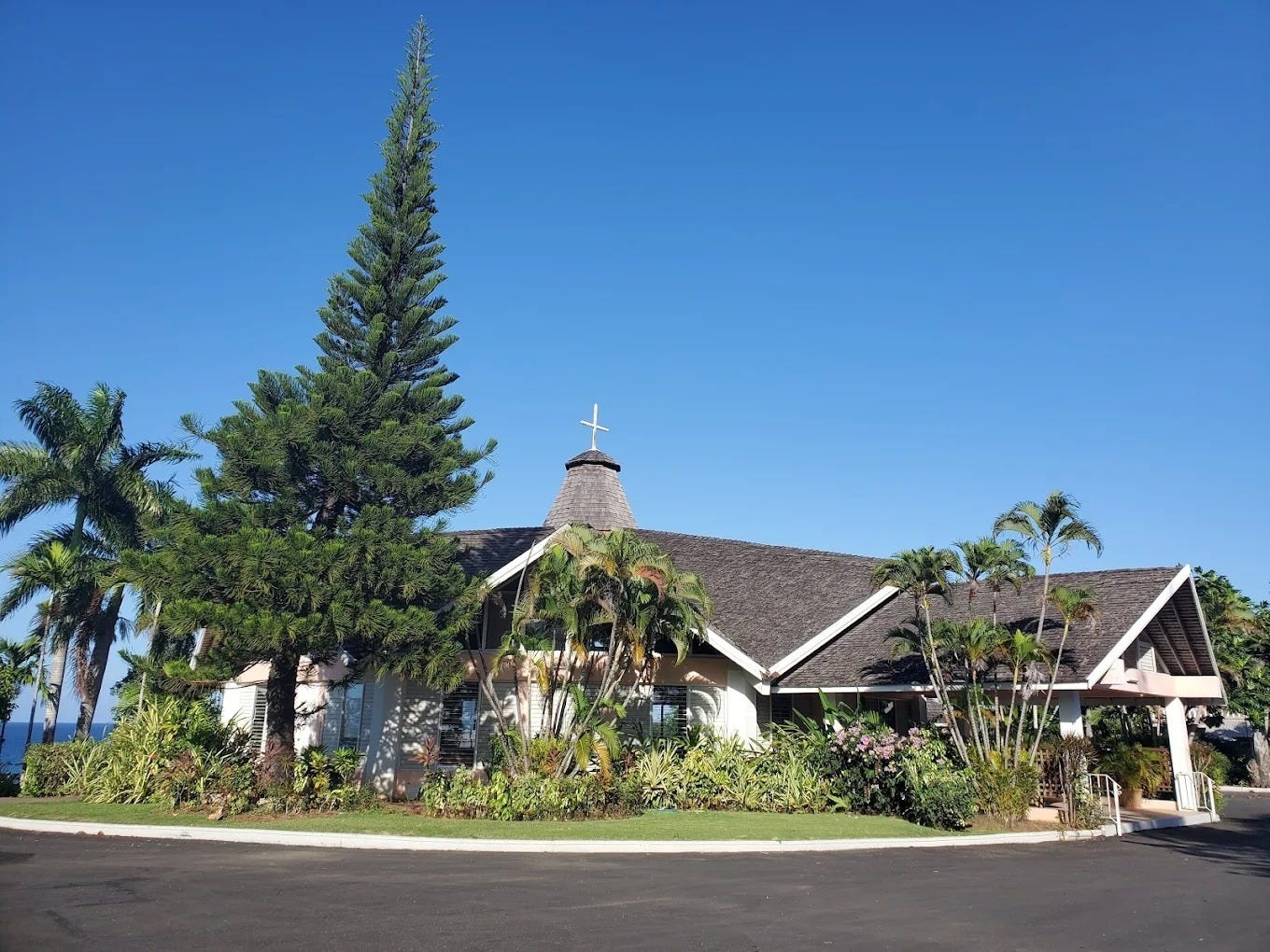
It was stunning. And, as promised, Mass went nearly three hours. After Communion, the whole assembly just stayed and sang hymns for an hour and a half, led by the choir. The final blessing was imparted when, by some unspoken common consensus, it was decided everyone had had enough.
On the way back to the resort, my wife and I mutually enthused about it all — as parents of a four-year-old I might feel differently now.
One thing we both remarked upon, though, was the pointed prayer for the preservation of the parish from hurricanes, the season for which was about to begin. That stunning sea view, we both agreed, probably came with quite the insurance premium.
I tell you this story because this week the category 5 Hurricane Melissa ripped across the entirety of Jamaica, the fiercest storm to ever hit the island since records began. More than half a million people have been left without electricity. The country’s prime minister said he has “been on my knees in prayer” as the tempest hit.
By the time it hit the area of our honeymoon parish, Our Lady of Fatima, the winds had dropped — dropped — to 160 miles per hour.
I have no idea what damage has been done to the parish and its people — despite my best efforts I’ve not been able to get through to anyone, so I think it’s safe to assume something like the worst.
At The Pillar we’ve been trying all week, also, to get in touch with diocesan and Catholic Relief Services on the island, but they’ve been occupied full-time with helping people survive. We’ll have that all as soon as we can.
In the meantime, please pray for Jamaica, and for the parish of Our Lady of Fatima. That’s what I have been doing.
Here’s the news.
The News
Nigeria’s Bishop Matthew Hassan Kukah has stirred controversy with comments on the campaign of killings in the country’ s northern region.
Kukah, a leading critic of the Nigerian government’s failure to protect the country’s Christians from relentless massacres and kidnappings, was billed to speak in Rome at the launch of Aid to the Church in Need’s Religious Freedom in the World Report 2025, and many expected another blazing denunciation of the treatment of Nigeria’s Christians.
But instead of welcoming calls for the U.S. to re-designate Nigeria as a Country of Particular Concern due to grave violations of religious freedom, he said this would only harm interreligious ties and relations with the government.
So what is going on? Well, as the bishop knows and we can often forget looking in from outside, it’s actually pretty complicated.
—
On this day in 1755, Lisbon was a crown jewel of the Christian world, a port of entry for fabulous wealth into Europe, the result of two centuries of an expanding Portuguese empire that spanned from Brazil to India.
But on the morning of November 1, with a large part of the city’s population attending Mass for All Saints, the earth began to shake. Churches collapsed, houses fell, the city was engulfed in a fire.
Today, the 1755 earthquake is regarded as one of the most devastating in modern history, estimated at a magnitude of 8.5 or 9. Almost 60,000 people were killed in Lisbon, with an estimated 200,000 killed across the Iberian peninsula and in North Africa.
The quake leveled most of Lisbon. But it also shook the very foundations of the era’s theological and philosophical thought, in a way that would affect the course of European history and, arguably, contribute to the foundational principles of the United States.
—
As Pope Leo continues to settle into his pontificate, many in Rome are still waiting on a slate of major decisions and appointments, some of them holdovers from his predecessor’s time, and some of them anticipated from any new occupant of the see of Peter.
One of the quietly less appreciated but perhaps more significant decisions facing Pope Leo will be when and how to replace the 78-year-old Cardinal Kevin Farrell.
While the soft spoken Irishman is best known for his offices as prefect of the Dicastery for Laity Family and Life and as Camerlengo of the Holy Roman Church, his most important positions are probably the constellation of appointments across the Vatican’s financial departments.
In fact, if you add up all his jobs, Cardinal Farrell emerges as the Vatican’s de facto Chief Investment Officer and the one man, more than any other, likely to shape what the new pope knows and thinks about Vatican finances.
This leaves Leo with an interesting choice to make — you can read the whole analysis right here.
—
Pope Leo’s apostolic letter on education, Disegnare nuove mappe di speranza, was released this week and has, I think, probably got an official English translation by now.
Whether the Vatican comms department’s stab at an English version of the text is readable is anyone’s guess, of course. It’ll probably be full of “modalities” and “synergy” — I’ve come to believe Vatican English translations these days are done by an AI bot programmed to talk like it’s in a faculty meeting in 1988.
But, mercifully, it doesn’t matter for Pillar readers, since we took the original Italian text and wrote up our class-notes on what Pope Leo had to say just as soon as he said it.
You can read our homework right here.
—
Tensions between the Church and state in Venezuela reached a new high this week after the canonizations of the first Venezuelan saints earlier this month.
Priests and bishops are reporting an increase in threats from the regime, while several Masses of thanksgiving following the canonizations have seen government interference.
While some worry the country is following the path of Nicaragua, where an ideologically similar authoritarian regime has set about expelling Vatican diplomats, exiling bishops and imprisoning priests, Edgar Beltran wonders if another outcome is possible.
According to him, the Venezuelan regime might count the cost of cutting ties with the Church completely to be too high – particularly given the Church’s potential as an intermediary between Venezuela and the United States.

This Advent, gather with fellow Catholics for a Bible study unlike any other. Bible Across America is a nationwide Bible study hosted by the St. Paul Center. During this inaugural study, we’ll encounter Christ as “Teacher and Lord,” discovering what this means for our lives as modern-day disciples.
Canonical trick or treat
This weekend is the double feast of All Saints and All Souls, Christmas time for canon lawyers, since this year the feasts fall on a weekend, there’s a kind of canonical double effect.
All Saints, which falls on Saturday, is normally a Holy Day of Obligation — or a “day of precept,” if you prefer. However, according to U.S. particular canon law, the obligation is abrogated when the feast falls on a Saturday. But the feast is not transferred to the Sunday, which will mark All Souls.
Because of the norms around anticipatory Sunday Masses celebrated on Saturday evening — or afternoon, depending on which canonical school of thought you follow — Saturday evening Masses in U.S. parishes will be for All Souls, not All Saints. And because of the abrogation of the obligation for All Saints, not many parishes are adding extra Saturday morning Masses to the schedule. Meaning it could prove quite a challenge to mark the feast of All Saints.
So good luck and good hunting.
That’s just for this year, then there are always questions about the practice of Mass offerings and bundled intentions for the repose of the souls of our loved ones.
There is a long-standing custom of offering priests stipends for Masses offered for specific intentions — including Masses offered for the dead. And this time of year is high season for people offering stipends. That means there can be quite a lot of votive cash coming in.
Now, the Church has always prohibited, in the words of the blessed Code of Canon Law, “any appearance of trafficking or trading” in Mass offerings by priests. As a result, the longstanding law has been that priests can usually only say one Mass each day, and receive only one offering per Mass.
And the amount of an offering is supposed to be set collectively by the dioceses of a metropolitan province, in the United States this is usually either $10 or $15, though Catholics are always able to offer more in freedom.
But a problem arose in the 20th century in the U.S., where priests started receiving many more offerings and intentions than they could possibly fulfill under the one-per-day rule. Rome was consulted and priests were allowed, by permission of their bishops, to celebrate up to two Masses per day (three on Sundays) but still only keep one offering per day. All additional offerings are to go to “purposes designated by the diocesan bishop.”
Following the promulgation of the 1983 Code of Canon Law, another practice started emerging in the U.S.: parishes took to offering Masses for a collection of intentions (and Mass offerings) from the parish on All Souls Day, making it explicit that a single Mass would be celebrated for the combined intentions specifically to be offered together on All Souls.
Rome was again asked to weigh in and decreed that it was totally not cool for priests to, on their own, opt to combine several — even dozens or hundreds — of separate intentions into a single super-intention. But it was alright if Catholics voluntarily form their own collective intention for a single Mass, like on All Souls.
Some priests got rather clever in their interpretation of all this and chose to understand that if the faithful were opting to combine their intentions into one single Mass intention, they were also, surely, freely choosing to combine their offerings into one combined offering, too. So if hundreds of intentions can be willingly combined into one Mass, so hundreds of offerings (and thousands of dollars) can be combined into the one offering a day the priest gets to keep for himself… right?
Among clerics, this practice earned the nickname of Black Christmas, thanks to the traditional liturgical color for All Souls and the sizable bonus involved.