
India’s largest Catholic lay organization expressed “grave alarm” Tuesday over a police crackdown on protesters calling for the resignation of the country’s chief election official.
The All India Catholic Union called Oct. 13 for the immediate release of all protesters detained while protesting against alleged irregularities in the updating of electoral rolls in the world’s biggest democracy.
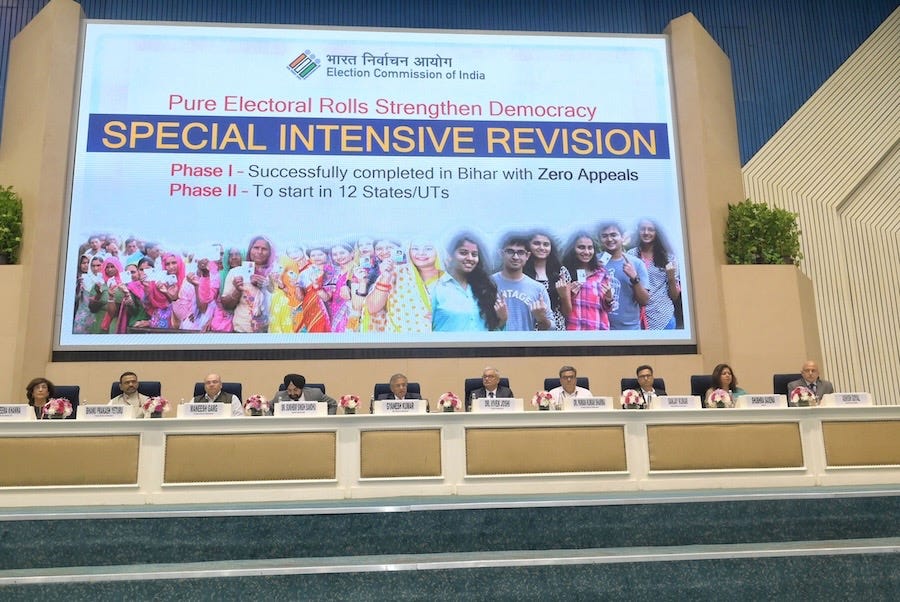
The revision process, known as the Special Intensive Revision, is overseen by the Election Commission of India, a body led by Chief Election Commissioner Gyanesh Kumar and comprising two other election commissioners.
The AICU, which represents lay Catholics from the Latin Catholic, Syro-Malabar, and Syro-Malankara Churches, said: “What began as a legitimate democratic expression by young Indians — supported by opposition parties, civil society, lawyers and journalists — has been met with prohibitory orders, mass detentions, and police action that appears designed to intimidate rather than protect.”
The AICU appealed for an independent judicial inquiry into “police excesses, especially against women, journalists, and lawyers.”
It asked for the Jantar Mantar in New Delhi to be restored as a protest site where the right to peaceful assembly is respected.
The AICU also called for the protection of press freedom and safety of women in public protest, the impartial functioning of the Election Commission, and an end to “vilification of dissenters.”
Its final demand was for “dialogue between government, opposition, and civil society to restore constitutional trust.”
Protests erupted after The Indian Express newspaper published an investigative report Sept. 23 claiming that the Election Commission’s two other commissioners had formally objected at least 14 times over 10 months to decisions about the revision of electoral rolls, registration procedures, and digital systems.
Opposition parties alleged that the removal of about 130 million names from draft electoral rolls could unfairly benefit Prime Minister Narendra Modi’s Bharatiya Janata Party.
The BJP said that 28 million of the deleted names belonged to deceased citizens, while 63 million others had relocated, 10 million were duplicates, and 30 million could not be located, citing Electoral Commission data.
The Election Commission insisted that all major decisions were approved unanimously by the three commissioners.
Adjustments to the electoral roll are highly sensitive because seven Indian states are expected to hold elections in 2027.
The 2027 Uttar Pradesh Legislative Assembly election, where the BJP will seek to retain its hold in India’s most populous state, is likely to attract particular scrutiny. A voter verification process launched in Uttar Pradesh in October 2025 reportedly ended with the deletion of 13% of names on the electoral roll, Reuters reported.
The BJP gained power for the first time in West Bengal in May 2026. The election took place after nine million voters — about 12% of the state’s electorate — were removed from electoral rolls as part of the Special Intensive Revision procedure, prompting debate about whether the deletions affected the outcome.
Religious minorities including Catholics — who number roughly 23 million out of a total population of 1.48 billion — have expressed concern about the possibility of eligible voters being excluded from the electoral process.
The Catholic Bishops’ Conference of India, which brings together bishops from India’s three main sui iuris Churches, said Oct. 7 that it was deeply concerned by the alleged irregularities highlighted by The Indian Express.
The CBCI urged the Election Commission to conduct the Special Intensive Revision process “in a free, fair and completely transparent manner, ensuring that every legitimate citizen remains on the electoral rolls.”
“Disenfranchisement must never become the ‘new normal,’” it said.
Protests continued after the CBCI statement, organized by the opposition INDIA bloc and the youth-led Cockroach movement, a satirical political party that oversaw demonstrations in July over alleged exam irregularities that led to the resignation of India’s Education Minister Dharmendra Pradhan.
The Cockroach Janta Party exploded in popularity online after it was launched in jest by political communications strategist Abhijeet Dipke. The CJP’s official website describes the party as the “voice of the lazy and unemployed” and features an image of a besuited spokesman with a cockroach’s head. It presents the insect as an image of resilience.
Although it is not a formally registered political party, the CJP has gained traction by channeling frustration at high youth unemployment and a shortage of entry-level jobs for graduates.
Protesters converged on Delhi Oct. 10, but local police denied permission for the assembly at the Jantar Mantar, saying that organizers had submitted the request too late.
The Guardian newspaper reported that authorities canceled incoming trains, closed metro stations, placed activists under house arrest, and cut the internet. Among the thousands detained were the CJP’s leaders.
BJP supporters have alleged that the electoral roll protests are politically motivated.
In its Oct. 13 statement, the AICU said that it stood with “the youth, journalists, lawyers, MPs and all citizens who seek justice peacefully.”
“India’s democracy must not become a fortress. It must remain at home for every voice,” it said.
“We urge all Catholics and people of goodwill to pray and work for truth, justice and constitutional governance.”