Is Germany facing ‘synodal fatigue’?
There is one thing that participants in the synodal way agree on: it has been a grueling process.
There is one thing that participants in Germany’s “synodal way” agree on: it has been a grueling process.
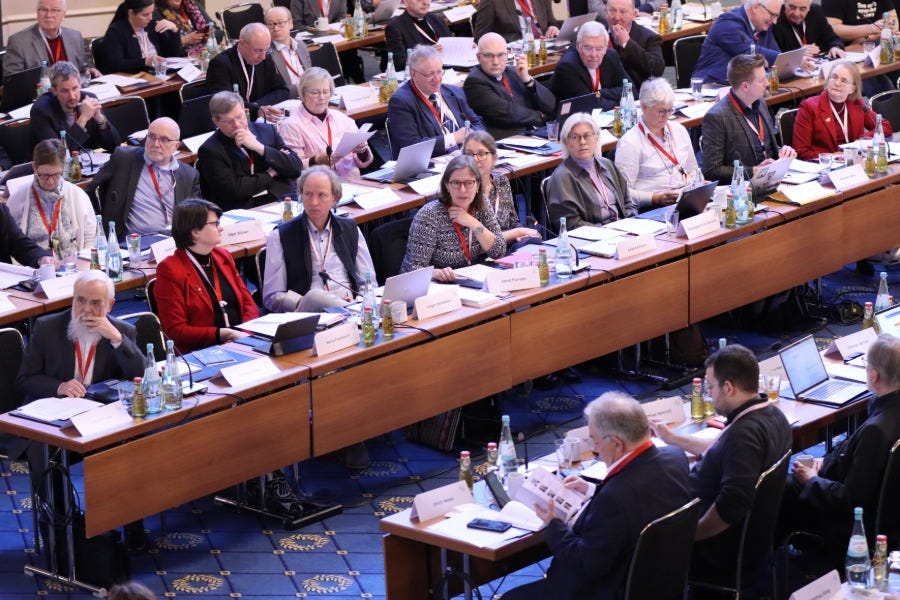
When the initiative was launched in December 2019, its organizers thought it would last around two years. Six years later, the synodal way has just concluded its “first phase.”
No wonder German media are now speaking of synodale Ermüdung, or “synodal fatigue.”
After six heated plenary assemblies and countless smaller committee meetings, the synodal way generated 150 pages of resolutions on everything from women deacons to lay preaching at Masses to priestly celibacy.
The most salient resolution called for the creation of a new permanent national body composed of bishops and lay people, known as the “synodal conference.” If the Vatican approves the body’s creation, it would mark the start of a second phase of the synodal way — one that could potentially last for decades.
The synodal conference, which is scheduled to hold its first meeting in November, is intended to replace an institution called the “joint conference,” which has brought together bishops and lay people from the Central Committee of German Catholics, or ZdK, twice a year since 1976.
A meeting of the joint conference scheduled for Feb. 13 has been canceled because too few bishops planned to attend. The body’s meetings are typically attended by 10 bishops and 10 laity from the ZdK. There are 57 members of the German bishops’ conference, so the failure to provide an episcopal quorum is quite striking.
Episcopal weariness and wariness
The cancelation of the joint conference meeting is not the only sign of synodal fatigue among Germany’s bishops.
On the final day of the sixth plenary assembly, held Jan. 29-31 in Stuttgart, participants voted on whether the new synodal conference should monitor the implementation of synodal way resolutions in dioceses. The proposal would arguably impinge on the authority of diocesan bishops to decide whether to implement the resolutions.
But when it came to a vote, only 33 of the eligible bishops were present. The measure narrowly gained the necessary two-thirds of episcopal support, but a question mark will hang over the vote because so many bishops were absent.
The plenary assembly took place weeks before the German bishops gather in Würzburg to elect a new bishops’ conference chairman, after Bishop Georg Bätzing announced he would not be standing for re-election.
In a Feb. 10 op-ed for Die Tagespost newspaper, journalist Dorothea Schmidt noted that the assembly provided an ideal platform for candidates to make a pitch to fellow bishops ahead of the vote. But, she noted, none of the frontrunners took the opportunity.
“They remained virtually invisible: their silence in the plenary session signals restraint, and possibly also distance from the ongoing synodal conflict. What they stand for in detail remains unclear,” she wrote.
“The bishops are apparently deliberately avoiding drawing attention to themselves before the upcoming election and possibly making themselves vulnerable by taking a stand on controversial issues.”
“Whether this was strategically wise or should rather be interpreted as an abdication of responsibility and courage to critically correct the path of reform remains a matter of speculation. The bottom line is that one thing above all is clear: synodal fatigue.”
There are two possible reasons why leading candidates were reticent at the synodal assembly.
The first is that most profiles of the ideal candidate to succeed the divisive Bätzing highlight the need for a unifying figure. Staking out a firm position on the synodal way might alienate one or other wing of the bishops’ conference.
The second reason is that it is unclear whether the synodal conference will win the Vatican’s approval. While several German bishops have suggested that approval is a near-certainty, Pope Leo XIV has merely said: “We shall see.” It would be awkward if a bishop enthusiastically endorsed the synodal conference, was elected bishops’ conference chairman, and then faced Rome’s rejection of the body.
But the leading candidates’ reserve might not be merely tactical. It’s possible that they are weary of the synodal way project and believe there are other, more pressing matters facing the Catholic Church in Germany.

The limits of representation
Perhaps there is also something about the way the initiative has unfolded that has encouraged not only bishops, but also German Catholics more broadly, to disengage from the synodal way. This is the progressive narrowing of participation in the project.
The first five synodal way assemblies had 230 voting participants, comprising bishops, ZdK members, and representatives of religious orders, youth organizations, priest councils, and other groups. The sixth assembly had only 177.
The synodal committee — an interim body intended to span the gap between the fifth synodal way assembly and the creation of the synodal conference — had a nominal membership of only 74, consisting of 27 diocesan bishops, 27 ZdK members, and 20 additional members elected at the fifth synodal way assembly in 2023.
The permanent synodal conference, which is due to wield considerable influence in Germany, is expected to have 81 members, comprising 27 diocesan bishops, 27 ZdK members, and 27 further members who were scheduled to be elected at the sixth plenary assembly in Stuttgart.
That’s 81 people representing Germany’s 19.8 million Catholics — a ratio of one synodal conference member per 244,065 Catholics.
The question of how 81 people can be truly representative of German Catholicism caused vexation at the sixth synodal way assembly.
On the assembly’s final day, participants discussed how to elect the 27 further members to the synodal conference. In reality, they focused on the election of only 23 people, because two posts were already reserved for abuse survivors and two for representatives of the German Conference of the Superiors of Religious Orders.
One participant proposed that posts also be reserved for young people and women. The theologian Ulrich Hemel argued that quotas should be used sparingly.
“What about Christians whose native language isn’t German? What about a quota for people from the former East Germany? Or for those who aren’t full-time employees?” he asked, according to a live report by Kirche und Leben, a Catholic news site based in the Münster diocese.
Participants voted in favor of at least five of the 23 members being under 30 years old and at least 13 being women.
Emeka Ani, a Nigerian-born ZdK member, then proposed that at least five posts be reserved for the growing number of Catholics whose mother tongue is not German.
According to the bishops’ conference, 16.7% of Catholics in Germany — 3.4 million out of 19.8 million — do not have a German passport. With five reserved posts out of the 81 available, Catholics with other mother tongues would account for 6% of the synodal conference’s total membership.
In the ensuing debate, Msgr. Christian Hermes, Stuttgart’s city dean, reportedly said: “We are reaching the limits of the concept of universal representation. The question of the future of the Church is most closely linked to the issues of gender equality and youth — other aspects must take a back seat.”
Ani refused requests to withdraw the proposal, but reduced the suggested quota from five to three. The proposal only just passed, by 67 votes to favor and 64 against, with 22 abstentions.
Ani told Die Tagespost after the vote: “Some — including prominent figures in the Church — who spoke out against this quota failed to consider that it would have made all of the Church’s criticism of the AfD appear to be bleak hypocrisy. I am glad that the Church narrowly avoided making this mistake.”
The amended election regulations as a whole were also approved by the assembly. But it is currently unclear when the 27 further members of the synodal conference will be elected.
Synodal way critics have pointed out that there is no quota for priests among the 81 synodal conference members. They argue this could lead to a situation in which priests, who arguably carry out the majority of pastoral work at a local level, are barely represented on the new permanent body. They suggest this confirms the elitist and secular character of the project.
A similar critique was leveled at the global synodal process, which appeared to be directed principally at bishops and lay people, with parish pastors seemingly an afterthought.
Not surprisingly, an in-depth study of Germany’s younger priests published in 2024 found they had limited interest in the changes to the Church advocated by the synodal way.
The alienation of significant groups within the German Church and the steady reduction in participation in the synodal way project pose a dilemma for Pope Leo XIV, who will make the final decision on whether the synodal conference should receive Vatican approval.
During an in-flight press conference in December 2025, he said: “I am aware that many Catholics in Germany believe that certain aspects of the synodal way that has been celebrated in Germany up until now, do not represent their own hope for the Church or their own way of living the Church.”
He added that there was a need “for further dialogue and listening within Germany itself, so that no one’s voice is excluded.”
When he looks at the Catholic landscape in Germany, beset by divisions and synodal fatigue, will he be convinced that the synodal conference is the right vehicle for promoting a form of synodality in which “no one’s voice is excluded”?

