
Happy Monday friends,
I hope you are enjoying the holiday.
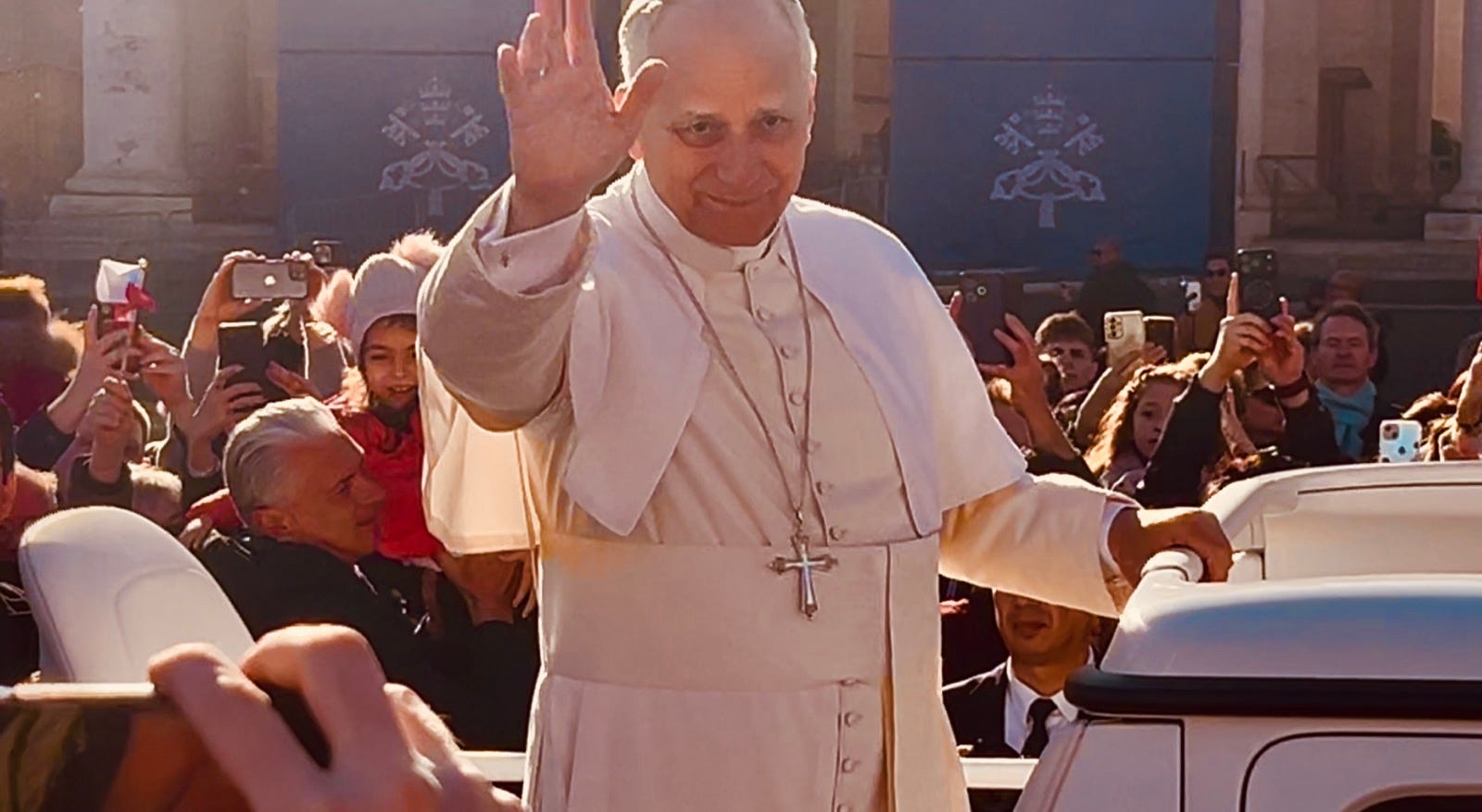
Of course, it’s a working day for us, holidays usually are, one way or another. Today saw the release of Pope Leo XIV’s first encyclical, Magnifica humanitas.
The pope’s treatise on human dignity in the age of AI, in my opinion, well lives up to its billing as a Rerum Novarum for the third millennium. You can follow our coverage on the text, and the pope’s press conference presenting it here and here.
And this morning we convened our own pocket think tank of academics and experts live-blogging their own reading of the text so you can see how they react to the text as they read it through, in real time.
If I have a quibble, and I admit it is merely personal pedantry, it is that the text consistently renders the Latin Rerum novarum as “On the new things,” when in fact (as contemporary translations of the Leonine (XIII) text make clear) the old pope was using a classical idiom better translated as “On the revolutions.”
We are, it seems to me, living in a time of revolution, and Leo (XIV) has answered the bell with his first letter. It is, I hope, just the first of many encyclicals from him still to come, and the good Lord knows there’s no shortage of issues that need his attention.
What I was not looking for in the letter, but found to my intense edification, was the answer to another question I have been wrestling with internally while trying not to fully articulate, even to myself: in the age of Pope Leo, what is The Pillar for?
When we started this project in 2021, both JD and I came to the idea as an answer — an offer of help — to a matrix of issues we saw across the whole of the society of the Church.
There were, we saw, real gaps between the Vatican’s insistence on combating abuse and corruption, and how the principles of justice, transparency and respect for the rule of law were being lived out on the ground.
And as the Church lived through cycles of synodality, both globally and particularly in Germany, we saw too a lack of clarity in the general conversation — and in the media especially — about what the Church actually teaches about her own nature, what is mutable and open to new discernment, and what is eternal, unchangeable, and Divinely instituted.
And as the geopolitical order fractured and descended into political turmoil in some places, and armed conflict in others, we saw, too, that there was need for clarity and a bulwark against selective soundbite culture of the kind which misrepresents or even perverts what the Church teaches and what her leaders were saying.
Of course, all those issues and the work we hoped to bring to the aid of our common Catholic society were products of their time. What, I have been wondering, would change under the new pontificate?
Could we still serve in the same way, as effectively? Are we — is The Pillar — still needed in the same way in the new Leonine age? It is a question that has gnawed at me this last year, even as I have been proud of the work we have been doing, which is, I claim without apology, the best there is.
Maybe, I have been asking sincerely, we are a hammer in a world with fewer nails?
This internal reckoning was not something I expected the pope to speak into with his first encyclical, and yet…
And yet this is what I read in Magnifica humanitas this morning:
“Christian communities, too, are called to commit themselves to transparency in communication and to the honest pursuit of facts. Sadly, this has not always been the case. We have witnessed with shame the emergence of painful truths concerning even members of the Church and ecclesial realities. In particular, some journalists, driven by a passion for truth, have played a crucial role in bringing injustices and abuses to light.”
“To them, I wish to repeat the words that Pope Francis used in speaking to journalists: ‘I also thank you for what you tell us about what goes wrong in the Church, for helping us not to sweep it under the carpet, and for the voice you have given to the victims of abuse.’ Yet vigilance and transparency remain first and foremost a grave responsibility for the Church herself, and we must not wait for others to compel us to confront uncomfortable truths about ourselves.”
It was, I do not mind telling you, the single most personally encouraging and reassuring thing I have read out of Rome in a very long time. And yet there was more:
“We are in need of a healthy realism that avoids both political idealism and cynicism. There is a kind of idealism that, in order to preserve its own worldview, tends to choose facts selectively, distorting and renaming them. Its proponents eventually inhabit a reality constructed to fit their own convictions. Conversely, there is also a debased form of realism that confuses observation with resignation, arguing that since force prevails, it will always prevail.”
Earlier in this newsletter I mentioned that there were no shortage of pressing issues on Leo’s desk. And some of them are more acute than pressing — verging on crisis point.
And, it seems crystal clear to me, there is more need than ever for the work we are doing here at The Pillar — not less.
In recent weeks, I’ve written about how the Leonine pontificate seems to be confronting both the German bishops’ synodal agenda and the SSPX’s plan to commit a schismatic act in July — in both cases I think we are watching a pope with a very clear understanding of whom he is dealing with and how best to proceed.
And as we’ve been tracking developments in all this, we’ve been giving you the absolute best information and analysis on what is happening available anywhere, bar none — and as the only Catholic media outlet I am aware of with a public commitment to zero, absolute zero, use of AI to generate our news.
As these stories develop, there has been and will continue to be a lot of noise — a lot of that “kind of idealism” Leo describes which “tends to choose facts selectively, distorting and renaming them” in order to “preserve its own worldview.” Another term for this would be “fake news” — which also appears in the encyclical.
Our promise to you, and our service to the Church, is to be the constant rolling antidote to this, to offer what Leo called this morning “the healthy realism that avoids both political idealism and cynicism” — as we did earlier this year when the diplomatic relationship between the Vatican and Washington became international news last month. It was us who brought you the whole story and the whole context, talking to the people who were there in the room.
And while the pope has to grapple with a tangle of perennial problems in the life of the Church — issues that require constant vigilance — we intend to be there with him, and take as our marching orders his shout out to the journalists who “commit themselves to transparency in communication and to the honest pursuit of facts.”
I’m not going to pretend that I think Pope Leo had us specifically in mind when he thanked reporters “driven by a passion for truth, [who] have played a crucial role in bringing injustices and abuses to light.”
But I am not going to pretend it doesn’t describe some of our most important, and some of our most recent work here at The Pillar either — these two stories, here and here, in the last few weeks alone come to mind.
We may be seven years on since the promulgation of Vos estis lux mundi, but this doesn’t mean that serious clerical misconduct is no longer a live issue in the Church. Sadly, it still is, as we have been reporting.
And because the Church will always be both human and divine, there will always be sin, failure, and the need for reform. Even if this can sometimes be shocking and scandalous for the rest of the Church, it’s on Leo’s desk to deal with and it isn’t going away. So it stays on our desks, too.
For a lot of people, a new pope felt somehow like “year zero” in the life of the Church; that all the issues and problems which need urgent attention and effort and sincere willingness to serve God and His Church just disappear like smoke up the Sistine Chapel chimney. But it isn’t so.
And I think for others there’s a weird desire, and some perverse incentives to go the other way entirely, to gin up a sense of perpetual grievance and crisis in the Church — to spin narratives and confect stories that harm unity and undermine truth.
The Pillar stands against all of this, and our mission is to support the kind of common Catholic culture Leo has outlined today.
A bishop whose intellect and holiness I respect more than any others once described to us the mission of a pillar as “serving by creating pressure from below and sustaining it from above.”
That’s our job for as long as we are needed. And by “our job” I mean ours — you included. Because The Pillar is not just the half dozen of us working here, or the dozens more who contribute to our pages.
The Pillar is a project which exists — has existed from Day 1 — only and solely because of the support of people who buy into this work and make the choice to pay for it.
In Magnifica humanitas Leo laid out the dignity of human work and the justice fair wages. He warned also against the unhealthy and ultimately dangerous concentration of technological resources and the means of their distribution in the hands of the patron-class.
The Pillar does not have a board of big money donors, we aren’t a “non-profit” racking up millions in tax deductible “donations” every year.
We do what we think is good work, the best of its kind, and ask a fair price for it from those who can afford it — that’s our notion of transparency. We answer for that work to God, His Church, and to our subscribers — that is our idea of accountability.
So if you read our coverage today, and last week, and last month, and if you plan to read more of it tomorrow, I’d ask you to do the right thing and help us do the best work we can.
Thanks for reading. I’m going back to work now.
Ed. Condon
Editor
The Pillar