Munich priests to Marx: Blessing guidance creates loyalty conflict
"How do you explain this obvious contradiction?"
Twenty-six priests in Germany’s Archdiocese of Munich and Freising have reportedly written to Cardinal Reinhard Marx, saying that his request that they follow national guidelines on blessings has presented them with a loyalty conflict, because the Vatican has criticized the guidance.
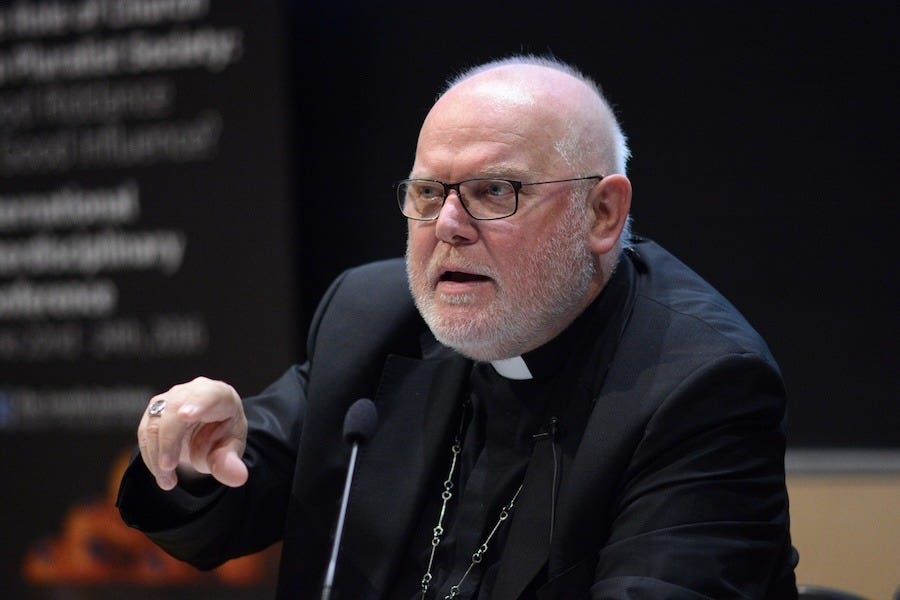
Die Tagespost reported July 23 on a May letter in which the priests requested a dialogue with the cardinal about whether they owed obedience to him as their archbishop or to “the general doctrine and moral teaching of the universal Church” concerning the blessing of couples in irregular situations, including same-sex couples.
Marx, who also serves as the coordinator of the Vatican’s Council for the Economy, reportedly responded to the letter by proposing that the national guidance be implemented in the Munich and Freising archdiocese for a one-year pilot period.
The cardinal is said to have underlined that the guidelines should not be understood as a canonically binding order and added that he would invite priests to discuss the matter after the trial period elapsed.
Controversy has swirled around the German Church’s national guidance since it was first made public on April 23, 2025, two days after the death of Pope Francis.
The text’s supporters dismissed accusations that the document’s release was timed to coincide with the papal interregnum, pointing out that it was approved on April 4, 2025.
The text, entitled Segen gibt der Liebe Kraft (“Blessing strengthens love”), was issued by the German bishops’ conference and the lay Central Committee of German Catholics via a body known as the Joint Conference.
The document was presented in an official press release as a recommendation from the Joint Conference “that the diocesan bishops proceed in accordance with the guidelines,” rather than as a binding text.
The guidance was issued in response to a resolution adopted in 2023 by participants in the synodal way, a multi-year initiative bringing together bishops and select lay people to discuss far-reaching changes to Church teaching and structures.
The 2023 resolution, on “blessing ceremonies for couples who love each other,” called for the official introduction of blessing ceremonies in all German parishes.
The Joint Conference’s national guidance has received a mixed reception from German dioceses.
The dioceses of Limburg, Osnabrück, and Aachen published the guidelines in their official gazettes, a step that publicly committed the dioceses to enacting the document’s provisions.
But the Cologne, Augsburg, Eichstätt, Passau, and Regensburg dioceses rejected the document, arguing that it went beyond the provisions of the Fiducia supplicans, the 2023 Vatican instruction on blessings approved by Pope Francis.
In September 2025, the then-bishops’ conference chairman Bishop Georg Bätzing insisted the guidelines were developed “transparently with the Dicastery for the Doctrine of the Faith.”
But Fernández told The Pillar in October 2025 that the dicastery had not endorsed the document.
Debate over the guidelines reignited in April 2026, when it emerged that Marx had written to priests and lay pastoral workers in the Munich and Freising archdiocese recommending that they follow the national guidance.
Die Tagespost reported that the archdiocese would offer training courses to full-time pastoral staff on how to conduct the blessings of couples in irregular situations. Any workers who did not wish to preside at the ceremonies would be expected to refer those seeking a blessing to a colleague or the local dean.
Following the report’s publication, an archdiocesan spokesperson described the letter as “an internal memo.” The spokesperson said there were no plans to publish the guidelines in the archdiocese’s official gazette.
Marx’s recommendation came to international media attention on April 23, when a German journalist asked Pope Leo XIV during a press conference on the flight back from his trip to Africa how he assessed the cardinal’s decision to permit the blessing of same-sex couples in his archdiocese.
According to a Vatican transcript, the pope said: “The Holy See has made it clear that we do not agree with the formalized blessing of couples, in this case, homosexual couples, as you asked, or couples in irregular situations, beyond what was specifically, if you will, allowed for by Pope Francis in saying all people receive blessings.”
He went on: “When a priest gives a blessing at the end of Mass, when the Pope gives a blessing at the end of a large celebration like the one we had today, they are blessings for all people. Francis’ well-known expression ‘Tutti, tutti, tutti’ is an expression of the Church’s belief that all are welcome; all are invited; all are invited to follow Jesus, and all are invited to look for conversion in their lives.”
“To go beyond that today, I think that the topic can cause more disunity than unity, and that we should look for ways to build our unity upon Jesus Christ and what Jesus Christ teaches.”
The German bishops’ conference and Marx reportedly declined to comment on the pope’s remarks.
On May 4, the doctrine office published a letter criticizing a draft of the national guidance that the dicastery sent to the German bishops in November 2024.
It was against this background that the 26 priests sent their May 12 letter to Marx concerning the guidance. According to Die Tagespost, two of the clerics were retired but the remainder were in active service. There were more than 900 priests in the Munich archdiocese in 2023, according to the website catholic-hierarchy.org.
Die Tagespost reported that the priests said in the letter that Marx was asking them to implement a synodal way resolution that lacked any legal binding force. They also argued that the national guidance contradicted Fiducia supplicans, because the Vatican document only allowed for spontaneous blessings lasting for a few seconds, rather than blessings with detailed liturgical considerations, as delineated in the German guidance.
The priests reportedly asked the cardinal: “How do you explain this obvious contradiction? Or does Fiducia supplicans no longer apply in our archdiocese?”
The newspaper said that they added: “Why are you asking us to act against the repeatedly expressed wishes of the Holy Father?”
The priests were also said to have questioned the recommendation to refer those seeking a blessing to a colleague or the local dean if they were not prepared to offer it. They reportedly asked what a cleric should do if they considered the referral as a form of morally unacceptable cooperation.
They reportedly wrote: “We wish, in a genuine dialogue with you, to clarify whether and how the teaching of the Church is to continue to be taught and lived in our archdiocese in unity with that teaching.”
They added that their concern was “that, among us priests and, as a consequence, inevitably among the faithful, considerable misunderstandings will arise, leading to division.”
“Out of love for the Church, we cannot reconcile this with our conscience. We gratefully await your clarifications, assure you of our prayers, and remain with cordial greetings,” they wrote.
Die Tagespost reported that if the priests were unsatisfied with Marx’s response, they would consider submitting a request for clarification to Rome.

