When the U.S. bishops’ conference met in Orlando last month, bishops voted to pass a revision to the Charter for the Protection of Children and Young People, the USCCB’s landmark safeguarding document, first issued in 2002.
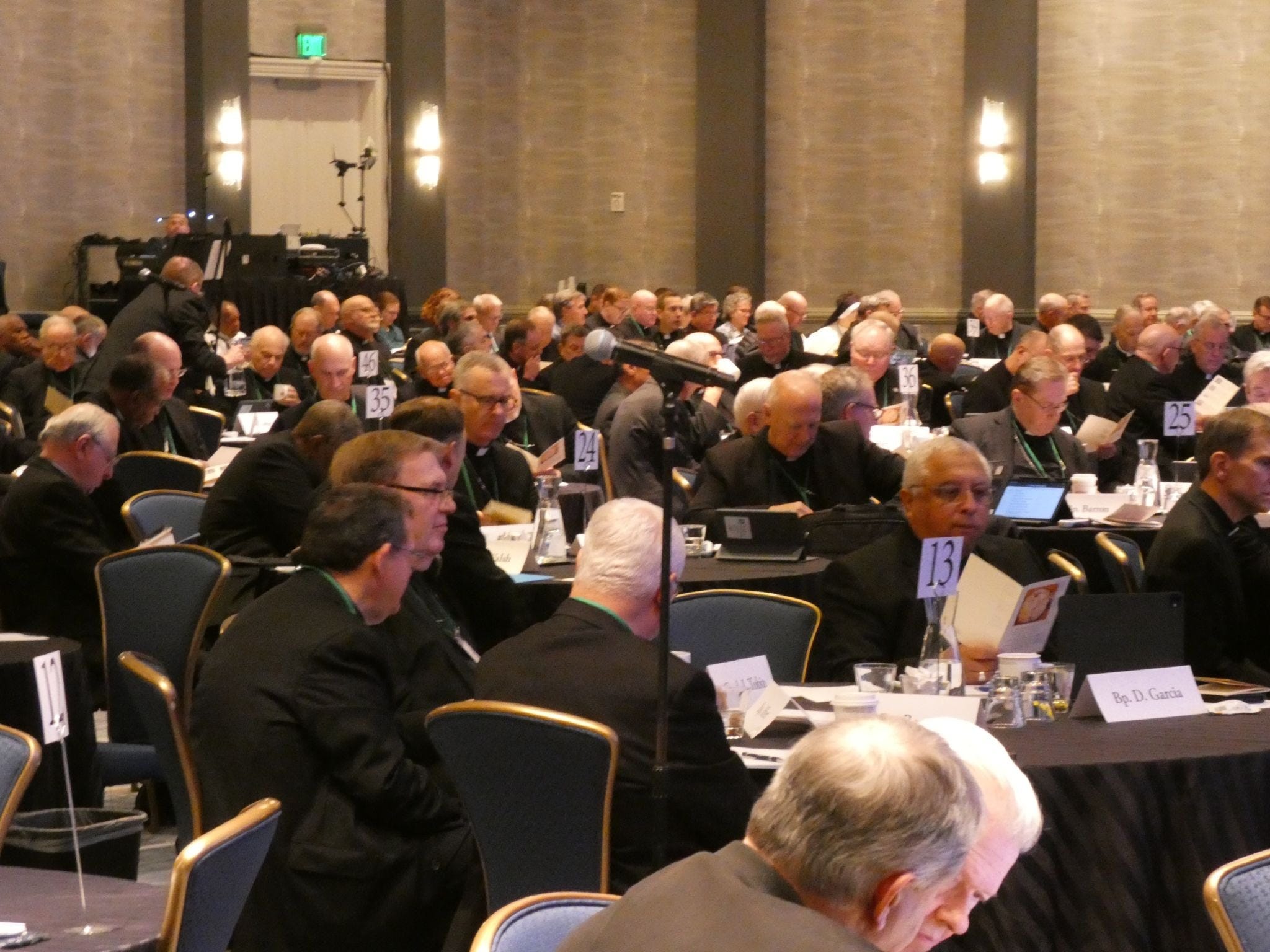
But while the revision passed, it did so amid some criticism: One bishop led an unsuccessful charge to delay a vote on the document, calling for more and broader consultation, of diocesan safeguarding leaders and priests, especially.
Victims’ advocacy groups gave the new document mixed reviews, and some sources close to the revision process told The Pillar that many people had expressed hope for a document which would broaden its scope to a wider vision of safeguarding, including the abuse and manipulation of vulnerable adults.
But bishops involved in the document’s revision said they followed a process of consultation, and that the body of American bishops decided not to expand the Charter’s scope, but to instead address related issues in a spate of documents to be released in coming years.
The Pillar talked with one such prelate, Bishop Thomas Paprocki of Springfield, Illinois, who is chairman of the USCCB’s canonical affairs committee, and was a member of the Charter revision working group. He addressed the consultation in the Charter revision process, what the USCCB will work on next, and his hope to address the challenge of electronic letters of suitability.
This interview has been edited for length and clarity.
Bishop, what are the important and positive revisions that have been made by the conference in its 2026 amendments to the Charter for the Protection of Children and Young People?
Well, I would refer back to the introduction that Bishop Knestout made when he gave his presentation to the bishops at our meeting recently in Orlando on June 10th.
In his presentation, Bishop Knestout focused on some of the areas that we changed. One of the most notable is the glossary — There’s a glossary that defines terms and refers to terms that are very important to the document.
We also have our mention of the presumption of innocence and reinforcing that for the accused.
We also talk about the mandatory Church reporters, to complement the mandatory reporting to civil authorities.
And then we also make a mention of the possibility of electronic letters of suitability. Right now we’re doing that with paper copies of letters of good standing and we’re looking at the possibility of trying to make [electronic letters] a national project.
Along with that is a recommitment to the Statement of Episcopal Commitment which came out when the charter was first promulgated back in 2002 [and was revised in 2019] — it’s a very strong statement and we reaffirmed that.
In the Charter revision process, the feedback we were getting was not to make any major revisions, that what we have has been working well — and so that’s the approach the revision process took.
Bishop Knestout mentioned in his remarks that there had been consultation with the body of bishops, and I know that various committees of the conference were consulted. During the floor discussion on the Charter, there was mention that the last full consultation of bishops on the topic was in 2022, and that many new bishops had been consecrated since then.
Do you think the consultation of the bishops themselves was sufficient? Do you think the process got an accurate reflection of the desires of the body of bishops?
Well, what we’re talking about is a revision of an existing document. So it’s not that bishops suddenly saw a new document for the first time.
I also think it’s important to look at the timeline for this.
It was at the November meeting in 2021 that the process was initiated for the revision of the Charter. I was asked to be a part of that in November of 2022, and in the year prior was the process of putting together the charter revision work group.
That charter revision work group includes the Committee for the Protection of Children and Young People, and it also involved the Committee on Canonical Affairs and Church Governance, the Committee on Clergy, Consecrated Life and Vocations, the Office of General Counsel for the USCCB, and — I’d say most importantly — the National Review Board, which is the board made up mostly of laypeople that gives us feedback and advice on these processes.
The work group began in earnest toward the end of 2022. At the June 2022 meeting, there were discussions on the revision at the [bishops’] regional meetings, and there was in December of 2022, a memo from the chairman of the committee for the Protection of Children and Young People to bishops, explaining the review process, requesting any revisions that they would have in consultation with diocesan deanery or presbyteral meetings of the diocese.
That was part of the process to get that feedback. At our [June] meeting, when there was a proposal to postpone this – to get more feedback from the bishops – I think part of the problem of doing that would’ve been to delay this even further.
I mean, the original timeline was to have the draft ready for vote and approval in November of 2024. So we’re already a year and a half behind on that, because we took time to consider some of the proposals that were still coming in, and to discuss them.
The bishops did vote down postponing it, but if we had extended this [process] to November of 2026, that would’ve delayed things even further.
And if the idea was to go get more input and feedback from presbyteral councils, for example, I would imagine that could have resulted in many more amendments that probably would not have even been finished by the November meeting, to discuss all that and get that in place into a final document.
So this had been moving along since November 2021, and a desire to get this finished. I mean, it’ll be reviewed again at some point, but I think we needed to get this done.
It seems you’re saying, Bishop, that bishops already had the opportunity to consult with presbyteral councils or with diocesan staff, and a delay would have been a second window to something that already could have been done. Is that right?
Yes, I do believe that there was an opportunity to get input.
And revision is not a major rewriting of the Charter as it was first presented, I know there are those who think that the Charter should have been expanded into other areas. The Charter revision work group received those proposals, and in the end it was decided not to do that.
Again, in Bishop Knestout’s introductory remarks, he acknowledged that. He said that the Committee on Protection of Children and Young People received feedback from the body of bishops at least three times, which reiterated that the committee was to keep the charter focused exclusively on the abuse of minors by priests and deacons.
So if there was a desire to expand that, our committee discussed that, and our response was that those are important issues – the vulnerable adults, for example, and abuse by church personnel other than priest and deacons – but the sense was that needs to be done in a different process, and not to complicate this or to dilute the focus here on minors being abused by clergy. The sense was that’s where we wanted to keep the focus.
Now that’s not to say there shouldn’t be other possibilities for dealing with [those issues] elsewhere.
For example, here in our diocese in Springfield in Illinois, we have two different bodies that deal with that in two different sets of policies. We have a review board which deals with allegations of clerical sexual misconduct of minors and then we have another body called the Special Panel on Clergy Misconduct, and that hears other kinds of misconduct — because they’re different in their nature and their difference in their response in terms of dealing with these.
And so I myself have found it helpful to have different processes rather than trying to combine that all into one.
The argument I’ve heard to the contrary is that while abuse occurs in different contexts, the phenomena of sexual abuse or sexual coercive activity in the life of the Church have also some commonality, and that there’s a desire for bishops to speak of them in a unified way, rather than fragmenting them.
Because the Charter is perceived as the bishops’ landmark document in the United States on abuse, omitting the abuse of adults from it, for example, or omitting the issues of child sex abuse material from it could seem to victims like an oversight, or could seem like a failure to recognize the degree to which those must be addressed in the Church.
Well, there are some of those things that are included now in the glossary, which is a new addition.
So for example, the mention of pornography, there is a glossary entry for sexual abuse of minors and it says, “In light of the Decalogue, for purpose of the Charter for the Protection of Children and Young People, this term refers to any contact or interaction between a minor and a member of the clergy that is perpetrated to achieve sexual stimulation or to obtain profit.”
And then it says, “It encompasses a wide range of behaviors,” and it has a list of different kinds of behaviors including child pornography. So that is specifically mentioned in a glossary here.
I think in terms of why the Charter does not go into greater detail dealing with, for example, abuse or sexual misconduct by a priest or deacon with an adult, one reason is the potential ramifications — currently under the charter and the Essential Norms, we have a policy of zero tolerance and that is not necessarily the case with adult misconduct.
If we were looking to bring those kinds of things into the Charter, that would probably also mean bringing them into the Essential Norms [which correlate to the Charter, constitute particular law for the United States, and require Vatican approval to change].
Bringing them into the Essential Norms would be the whole process of having to take that to the Holy See, and just delaying this whole thing, in order to deal with these other issues under the Charter.
These issues should be dealt with, but I think the sense is “let’s get the Charter revised now and then we will continue to have the conversations about how we address those other kinds of misconduct.”
In the past, I’ve heard a reluctance from bishops to revisit the Essential Norms because of Vatican uncertainty about the American approach to “zero tolerance” — and the prospect the Vatican would urge a different approach once modifications were on the table.
But recent changes to canon law seem to adopt or support the American approach. In light of that, why would there be reluctance to revisit the Essential Norms?
Well, I think the primary reason is because we feel that the Essential Norms have been working pretty well for the last 25 years.
I think we’ve made great strides in addressing this issue and most newly made allegations continue to be historic claims, from sometimes 40 or even 50 years ago, or more.
In terms of what’s being implemented in the seminary formation of our priests, and the ways that we’re handling responding to allegations of misconduct with minors, what we have is working.
And sometimes there’s a sense of, “Well, why fix something that’s not broken?”
And if it’s working, let’s not make any major changes to it, as that process might have some unintended consequences of doing away with something, or changing radically something that is working and that we would be better off not changing.
Among safeguarding experts in the Church, there seems to be a call toward a comprehensive safeguarding model, which expands the focus from child protection to an approach that’s more comprehensive, and takes into account other kinds of abuse.
I know you’ve said there’s value to treating different things differently, but how much consideration has been given to that idea that an overarching Charter, which encompasses various kinds of abuse and misconduct, might be more reflective of where sort of the safeguarding conversations are going?
Well, again, I think we’re talking about different categories here, and I don’t think you can have something that’s going to address everything in a single broad statement that can cover all kinds of situations.
For example, a very basic approach for the protection of children and minors is for an adult never to be alone with a minor, that you always have a parent or a teacher or someone else present. But to do something similar with an adult, which says, “Well, you can never be alone with an adult unless there’s another adult present” — I mean, that doesn’t work in the same way.
So I mean, there’s going to be different approaches to how you deal with minors, versus how a priest would be talking to an adult who’s getting counseling or something like that, and that has to be addressed differently.
Another substantive criticism I’ve heard is that while the approach of “restorative justice” is becoming more commonly discussed in the Church, it was not included as an element of the Charter. Was there some consideration of that, or some reason it was not included in discussion?
As I understand it, restorative justice is concerned with how to restore justice for those who are victims or who have suffered at the hands of someone else. And I think we’re doing that.
And restorative justice, I understand it, is broader than simply opposing penalties on the offender. You want to make the person who is injured whole and I think we’ve been doing that. — at least in my experience as chancellor in the Archdiocese of Chicago, and now diocesan bishop here in Springfield in Illinois, we have a victim assistance coordinator. We reach out to victims, we meet with the victims and survivors.
We have various ways of providing counseling — and that’s automatic is when someone comes in and makes an allegation, we immediately offer counseling and any kind of assistance. And in terms of reparations, dioceses have been paying millions to victims and survivors to that effect.
With regard to victims, our goal is to reintegrate them as much as we can back into the life of the Church. And so if there are more specific suggestions on how to do that, I, for one, am certainly open to that.
But I would appreciate maybe a little more specific guidance on what people are looking for in that regard.
As to process, I understand that consultation on the Charter revision involved bishops in their regional meetings, through USCCB committees, and consulting the membership of the National Review Board, a freestanding committee created by the USCCB.
I have been told, however, that there is some concern that the work group did not seek out direct conversations with victims about the revision, even through groups which have engaged with the bishops’ conference in the past.
Is that accurate? Is there a particular reason that kind of consultation didn’t take place?
For a project like this, you have to have some kind of a defined process and some established mechanisms for consultation.
My understanding is that kind of feedback comes through a body like the National Review Board. As to setting up meetings with other specific groups, I’m not aware that there was even a request for that specifically.
But again, the USCCB committees themselves have consultants – outside consultants, not necessarily just staff members – and then there was input from the National Review Board.
Consulting could go on endlessly. And as I said, this has been a process that started November of 2021. It’s gotten a lot of feedback since then. And so here we are in June of 2026 finally approving this document.
And again, it’s built into the Charter that it be reviewed every few years. So it’s not like this is completed, and it’s going to be this way forever.
If people feel that there are things that need to be addressed in the Charter that we didn’t address well, again, there are ways of raising that.
One is to begin taking steps for the next review of the Charter. Or to say, in light of what this Charter revision work group did, is to “No, let’s not change the charter. If there are areas that need to be addressed like vulnerable adults or any other kind of employees, church personnel misconduct, we should deal with that with other documents and other committees that would be then responsible for doing that.”
The Pontifical Commission for the Protection of Minors recently saw new statutes promulgated, and when they were released, the commission made a point to say that they had brought victims into conversation with the drafting committee for those statutes.
Is that something that the conference might look to in the future, patterned on the approach of the Pontifical Commission?
Well, it could be. I wasn’t directly involved in designing who was to be consulted in the revision; I was asked to be a member of the revision work group, and I don’t know exactly how that was put together.
But again, I think we do get input through the National Review Board. I know the review boards that I’ve worked with in Chicago and here in Springfield, usually have someone who’s a victim or a survivor on the review board.
So we do get input from people who are concerned in that regard and we take their input into account.
Bishop, I was surprised that the glossary omits a term that is as one of the most contentious on this topic: the term “credible” or “credibility.”
Was there some discussion about defining the notion of credibility, which is a term used by many dioceses, but with a great deal of inconsistency?
We did not define that term because I think that’s a term we don’t want to use.
It’s a term that civil authorities have used. Here in Illinois, for example, the attorney general is asking for a list of credibly accused, and I wound up using the word” substantiated,” which was, I think, a little more useful than “credible”.
And in the future, frankly, I think we’re looking towards talking about guilt or innocence. Because the notion of credibility is very imprecise.
I had a case here in Illinois. There was many years ago a priest who was accused; he’s now dead. The bishop interviewed the person making the allegation, interviewed the priest, wrote a memo to the file which said, “They’re both credible. I don’t know who to believe.” And that was the bottom line.
A person can come across as very credible and – well – in the case where both the person bringing the allegation and the priest seem credible, one of them is a good actor and is not telling the truth.
Was there any discussion about including in the Charter some moral commitment from the bishops about either transparency with regard to Vos estis lux mundi investigations, or the decision about whether a bishop will remain in ministry during the time under which he’s investigated under the terms of Vos estis? Was there any discussion about whether that might be appropriate fodder for the Charter?
No, because that would be beyond what the Charter is addressing.
We don’t even address that in terms of [priests and deacons]. Some dioceses have a policy where immediately upon the receipt of an allegation the priest is put on administrative leave. And other dioceses have a policy that it goes to the review board within 48 hours to determine whether or not the children are at risk and whether or not the priest should be put on administrative leave.
I’d say in terms of bishops, I would call attention to two things.
One is in the revised Charter itself.
In the very first footnote, is a reference to Vos estis lux mundi.
That first footnote says: “Since the last revision of the Charter in 2018, the Catholic Church has addressed instances of sexual abuse and misconduct that do not fall under the purview of this Charter.”
And then it makes reference to Vos estis lux mundi, issued by Pope Francis in 2023 and that it includes a means of reporting and a procedure for investigating reports of alleged sexual abuse by a bishop as well as a bishop’s interference with avoidance of civil or canonical investigation.
And then there’s also another document that Pope Francis issued in 2016. The Italian title is “Come una madre amorevole,“ which is English in: “As a loving mother,” and that provides a process for the removal of a bishop from office for misconduct.
So there are other processes out there that are referred to.
And then again, I would refer people back to the Statement of Episcopal Commitment.
The second provision of that says, “We will apply the requirements of the Charter also to ourselves, respecting always Church law as it applies to bishops. Therefore, if a bishop is accused of sexual abuse of a minor, the accused bishop is obliged to inform the Apostolic Nuncio. If another bishop becomes aware of the sexual abuse of a minor by another bishop, or of an allegation of sexual abuse of minor by a bishop, he too is obliged to inform the Apostolic Nuncio and comply with applicable civil laws.”
So the issue of abuse by bishops is addressed in the statement of commitment and the other process is referred to in that footnote.
Bishop, I heard from some Catholics — some closely involved in the process — the perception that the revised Charter does not reflect the lessons that the conference has learned, or ought to have learned, since the McCarrick saga, and what followed in 2018 and thereafter.
I wonder if you could give a response to that: Your sense of whether – and how – the conference and individual bishops have responded to the situation of McCarrick and what came after it.
The misconduct involving Cardinal McCarrick introduced, I think, to the spotlight very much the question of vulnerable adults — and in that case specifically with seminarians.
So I think that situation made us all very much aware of that, and we have taken more preventative steps to make sure that that doesn’t happen again.
I would point out that in the terrible situation involving Cardinal McCarrick, justice did prevail in the end: He was not only dismissed as a cardinal, but removed from the clerical state. So sometimes it takes a while, but justice is done. And again, that’s an important area in terms of the protection of vulnerable adults and other kinds of adult misconduct.
And again – at least in my experience – we do have a whole separate process for addressing that. And more and more dioceses are looking at those on a case-by-case basis; I know other bishops have asked how we approach that [in Springfield].
Our approach [in Springfield] is something I inherited. My predecessor, Archbishop George Lucas, was the bishop here before he went to Omaha and he’s the one who introduced what we call the special panel on clergy misconduct, and it was because of allegations involving adult misconduct with adults.
I think that process has worked very, very well here.
An important part of the Charter revision, the conference has said, is its attention to due process for priests. Obviously, the rights of priests under the Charter and Essential Norms have been a big question since 2002.
How does the revision aim to address that?
The Charter does talk very specifically about presumption of innocence and it reinforces that concept of the presumption of innocence. And I would say that that is something that perhaps has not been dealt with properly in the past.
For example, our earlier conversation about publicizing names of priests who are “credibly accused.” Well, they’ve never been found guilty in either a canonical or a civil process and some of those credibly accused priests very, very vehemently maintain their innocence, but still, they’re published.
But the publication of names is an area that is not addressed specifically in the Charter, is the publication of names. And so I think there still is a need for [addressing] that, it is an area our Committee on Canonical Affairs and Church Governance is looking at. It’s my understanding that the Holy See is also looking at the question.
The dicasteries of the Holy See have said in some letters that a priest enjoys a presumption of innocence and his name should not be put on a list, unless there’s some finding of guilt either in a civil process or a canonical process. So I think that’s something that needs further attention and refinement and we will be looking at that very carefully.
Please say more about a topic that will be of interest to many — the question of electronic letters of suitability.
Well, that’s something our Committee on Canonical Affairs and Church Governance is working on. It’s been implemented in France and in the province of Boston, and so we’re looking to see if it can be done more broadly. Paper copies are a lot of work to produce, and then a paper copy could be outdated as soon as within a day or two of its being issued. So if you have something electronic, hopefully that will be something that will be much more up-to-date.
It would be a game-changer for priests.
But I’ve always understood that one challenge is related to liability — that whichever organization maintained a system for electronic letters of suitability would incur potentially some liability.
I don’t think that would be the case, though I defer to our attorneys on that.
I’m an attorney myself, and I think that the way that I could see this being implemented would be that each diocese remains responsible for the content. We just need some common platform that we would agree on, and it does not even necessarily need to be the USCCB’s.
And I’m not an expert on the software, but I understand that it’s working very well in the province of Boston. And so I think there’s a possibility that we could do that nationally — it’s just a matter of getting some coordination of this, but without the USCCB taking on the responsibility. It would be up to each diocese to maintain the list of their priests and whether or not they’re in good standing.
As an attorney, similar information is available about attorneys. Myself as an example: If you go to the Illinois Attorney Registration and Disciplinary Commission, you can just check and you’ll find that I’m a lawyer in good standing. And if a lawyer is disbarred or suspended, that shows up on the website. So I think it’d be easy enough to do something like that, but it’s just a question of coordinating it.

