Shaleta arrest warrant details embezzlement case
‘The cash received by Bishop Shaleta was never placed into the [needy] accounts’
While a search warrant remains sealed by court order, a recently unsealed arrest warrant details the extent of financial crimes alleged against Chaldean Bishop Emmanuel Shaleta, whose resignation from ecclesiastical office was accepted by Pope Leo XIV in early March.
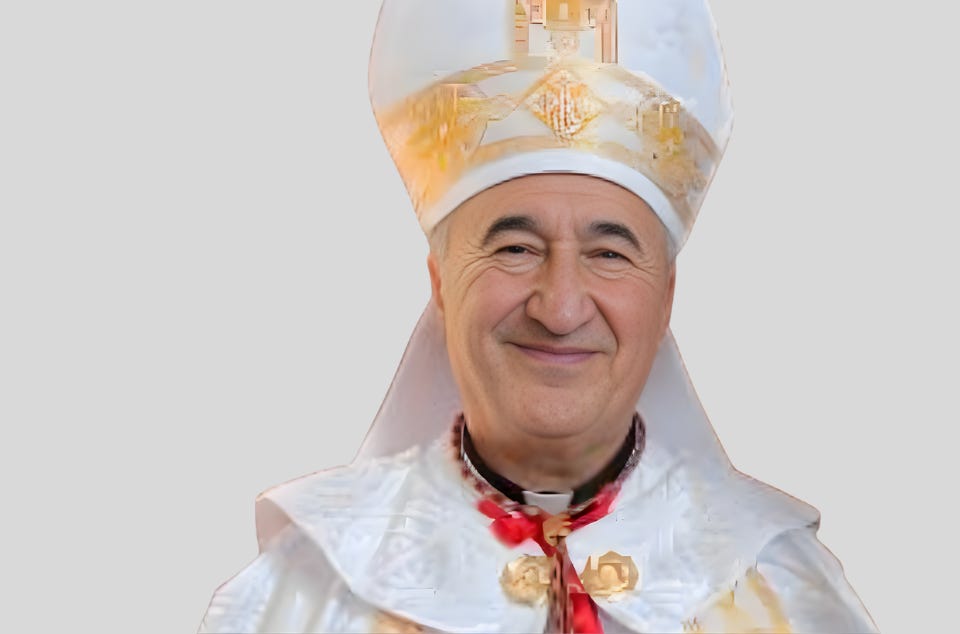
A redacted arrest warrant — omitting the names of key witnesses in the case — was ordered unsealed April 12 in the criminal case against Shaleta, who is facing money laundering and embezzlement charges.
The arrest warrant confirms reporting on the case from The Pillar, which in February broke the news that Shaleta had been accused of embezzlement and personal misconduct, amid a Vatican investigation that ended when both Shaleta and former Chaldean Patriarch Cardinal Rafeal Sako saw their resignations from office accepted March 10.
—
Shaleta, who previously led the Chaldean Catholic eparchy covering the western half of the U.S., was arrested at San Diego’s airport March 5, as he attempted to leave the United States with more than $9,000 in cash.
The bishop is accused of taking hundreds of thousands of dollars in cash from his eparchy, attempting to reimburse missing funds with checks signed by him from a cathedral charity account.
Shaleta pled not guilty March 9 to 16 criminal counts of money laundering and embezzlement, and saw his resignation from office accepted by Pope Leo the next day.
While most documents in the case remain sealed, the bishop’s recently unsealed arrest warrant details the case against him.
Consistent with The Pillar’s reporting, the warrant says that Shaleta first fell under suspicion in December 2024, when “discrepancies” were noticed in eparchy and cathedral bank accounts, including “approximately $427,345 missing from the [eparchy’s ‘needy account’] over an eight-month period.”
The warrant details the allegation that Shaleta perpetrated a rent scam, by directing a tenant to pay him monthly rent on an eparchial property in cash, and then writing checks from the eparchy needy account to cover the missing money in the cathedral account.
Between March 1 and October 31, eight such checks were written from the needy account, the arrest warrant recounted — most for $33,990, but the first for $34,000.
“The cash received by Bishop Shaleta was never placed into the [needy] accounts to reimburse the checks written to the [cathedral accounts],” the warrant alleged.
In addition to the rent scam, the arrest warrant recounted the charge that, “it appeared Shaleta would receive cash for church related trips, perpetual Masses, and other rental hall related costs.”
When that and other funds were found to be missing, “Bishop Shaleta was unable to provide documentation or records of how the cash was spent,” and “later claimed the cash was given to those in need in Iraq without providing further information,” the warrant’s affadavit alleged.
The bishop was released from jail in early March after making a bail of $125,000. A San Diego judge ordered the bishop to undergo GPS monitoring until his trial, noting the amount of money he is alleged to have stolen, and the fact that he was arrested while at the airport, with a flight booked to Europe, and more than $9,000 in his possession.
Shaleta is next due in court for a readiness hearing in June, with an eventual trial likely to begin in August.
—
The Pillar first reported a Vatican investigation into Shaleta in February, concerning both the financial crimes detailed in the arrest warrant and the prospect of personal misconduct.
The bishop is alleged to have made frequent trips to a Tijuana brothel linked to the human trafficking industry, and known to have maintained a longstanding and close relationship to a woman with whom he shared a bank account and unfettered access to each others’ homes.
The Pillar also reported that while Shaleta submitted a letter of resignation from his diocesan post in late January, Sako lobbied at the Vatican and among Chaldean bishops to see the bishop transferred to an administrative post in Baghdad, as a high-ranking official of the Chaldean patriarchate.
Sako had previously acknowledged to The Pillar that he raised the prospect of a transfer to Vatican officials, but suggested the idea was floated only before the Vatican-ordered investigation into Shaleta was “clear.” Sources have told The Pillar that the dicastery received a report on the case in late 2025, well before Sako polled Chaldean bishops about a transfer this year.
Sako’s resignation was accepted March 10, the same day as Shaleta’s, in a move widely taken among Chaldeans as indication of Vatican displeasure with the patriarch’s involvement in the case.
For his part, Shaleta has said he is the victim of a media campaign and of Chaldeans in his diocese who opposed his leadership.
If convicted, Shaleta could face 15 years in prison.


Can a PDF of the warrant be embedded in the article?