
Hey everybody,
You’re reading The Tuesday Pillar Post, and today’s the feast of St. Jerome, a great saint and doctor of the Church, on whom we still depend for a great deal of the Church, some 1,600 years after his death.
But since you’re reading The Pillar, I will presume you know something about Jerome already. So I want to tell you about Venerable Norbert McAuliffe, who was born in Manhattan on September 30, 1886, and who died 72 years later and thousands of miles away, in the small Ugandan village which had become his home.
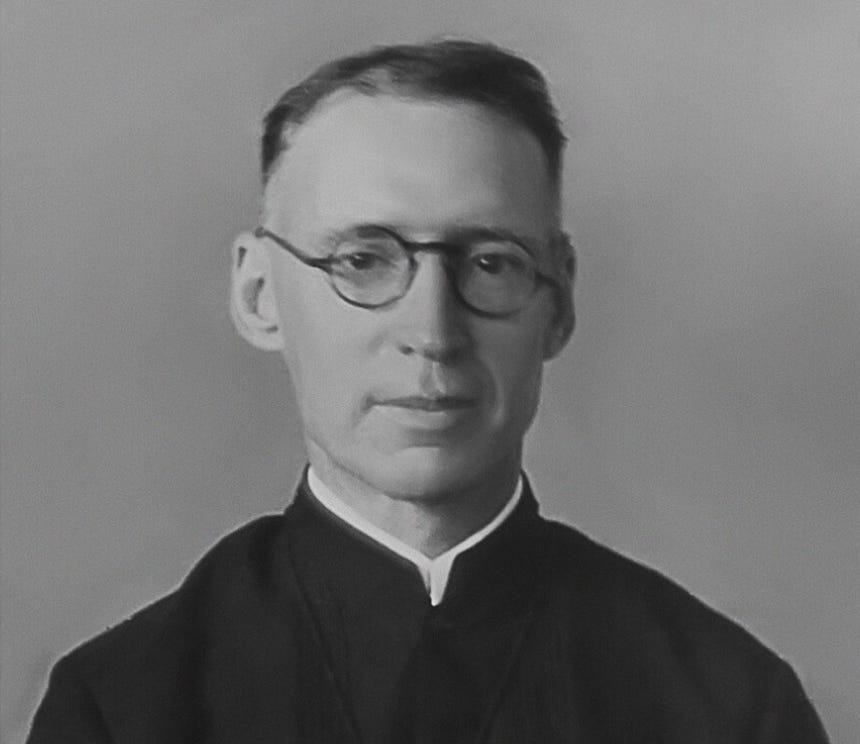
John McAuliffe was the son of Irish immigrants — his father Daniel was a dockworker, his mother Lizzie raised five children.
Daniel died when John was a toddler; Lizzie died two years later. John and his siblings went to live in a country home for orphaned children, run by Dominican sisters. There, John learned the faith. He learned that God loved him, and had created him for something extraordinary.
When he was 16, he met the Brothers of the Sacred Heart — missionary schoolteachers — and he left the orphanage to join their house of formation.
While other young men learned the office, and the liturgical pattern of religious life, John was well familiar with them already, because of his life among religious in the orphanage.
In November 1902, John formally entered the novitiate, taking the habit and the religious name Norbert. He professed first vows a year later. Soon after, he began teaching school and then became a principal in rural or poor communities in Indiana, Mississippi, and Oklahoma.
Norbert lived a happy religious life in American schools for decades. He saw his community grow, and he saw them fruitfully teach the faith.
And then, in 1934, his province asked for volunteers, brothers who would start a new community in Uganda. Their services were needed at a boys’ high school which had been started by Italian missionaries, but which needed English-speaking teachers, because of the laws of Uganda, which was then a British colony.
We don’t know much about his interior life. But we know that Norbert volunteered. And we know what the Ugandans observed about him: That whenever he had a spare moment, as students worked problems on the blackboard or between classes, Norbert was praying the rosary. We know that during the riposo after lunch, an hour of rest from the noonday sun, Norbert made a holy hour in the chapel.
We know that he told his peers that he stayed in the chapel to let God’s love “come to me,” in a way it had, he said, since his childhood.
He fasted, he had a calming presence, and the people of Gulu, Uganda, nicknamed him Dano Ma Lego: “The Man Who Always Prays.”
When World War II began, the brothers had to leave Uganda, where young men were enlisting to defend the British empire, and where coffee and cotton production stepped up for the war effort. While Ugandan soldiers fought in Somalia, Madagascar, and Burma, McAuliffe sailed to Metuchen, New Jersey, to direct the novitiate of his religious community.
But at first the moment he could, Brother Norbert made the two-month trip back to Uganda. While the school expanded, he focused on the order: creating a house of formation for Ugandan vocations, and becoming regional superior. But even as he grew busy, he was found most often in his beloved chapel, before the Blessed Sacrament.
He got sick in late June, 1959. He was only sick for a few days before he died at 72, with more than 20 African missionaries at work in his province, and more than 50 men in formation.
I suspect few people in the U.S. knew that he had lived or died. But in Uganda, his funeral was a days-long affair, celebrated by the Bishop of Gulu, and attended by priests, religious, and families who had been formed by his decades of proclaiming the Gospel.
His was a life of prayer and presence. What else are we made for?
The News
The cardinal sat down with The Pillar last week, to give his take on the early months of Leo, and the work of his dicastery on some key issues — including global migration.

Fire on the Altar is a uniquely liturgical reading of St. Augustine’s Confessions. In this companion to Augustine’s classic work, Dr. Chad Pecknold unpacks Augustine’s vision of the human heart as an altar. When united to Christ’s self-offering in the Eucharist, our hearts are set ablaze with divine charity. At once challenging and edifying, Fire on the Altar emphasizes the call to transform your life into an offering acceptable to God.
In other words, the resignation of Bishop Ciro Quispe Lópe could be the beginning of a Leonine reshaping of the Peruvian episcopate.
And you can read about the whole deal right here.
In total, Zanchetta spent only about three-and-a-half years under house arrest in a monastery in Orán, including an eight-month hospital stay in Rome between Nov. 2024 and June this year.
So does the recent decline in Church “exits” suggest the Church is bouncing back in the region? Or is German-speaking Catholicism still on the rocks?
Plus, he’s got an asteroid named after him.
In other words, Fr. Richard D’Souza might be the most interesting man in the world.
And he talked recently with Luke Coppen about his work, about faith and science, and about unlocking the mysteries of the universe.
“My scientific discoveries help me to praise God even more for the magnificent way in which he created the universe,” he told The Pillar.
Really, read this. It’s absolutely fascinating.
I told you last week there was an interesting canonical domicile subplot to this whole thing, and that an explainer would be forthcoming. Well: Here it is, the answer to everything you’ve wondered about canonical domicile.
And, friends, the comments in this explainer told me that you have even more questions about a related canonical issue — parish territoriality and registration. So we’ll do our darndest to get you another explainer out on that issue ASAP.
For now, here’s the Durbin domicile dossier.
—
And while Cardinal Cupich has not indicated any plans to withdraw the lifetime achievement award to Senator Durbin, a growing number of bishops have called for him to do so.
The Pillar is tracking episcopal statements on the award, and you can catch up on the latest here.
I would be remiss if I failed to draw your attention to the statement of Milwaukee’s Archbishop Jeffrey Grob, which came in an interview with Catholic World Report. Before his appointment to Milwaukee, Grob was an auxiliary bishop and chancellor in Chicago, under the leadership of Cardinal Cupich.
Grob was asked what he thought about the Durbin award, and told the interviewer that: “I haven’t given it too much thought. There are certainly people we want to honor, but we cannot compromise who we are and our traditions. We are a Church that is pro-life.”
He was pressed a bit more, asked what he might say if Cupich called to ask him advice. The archbishop said he would dodge the question: “I would talk to him about how well the Milwaukee Brewers are doing,” Grob said.
In short, the archbishop made it clear that he would not offer an opinion, even if asked, on the following question: Should a Catholic politician who has long advocated for the legal protection of abortion — sufficiently to be barred from the reception of Holy Communion — be given an award specifically related to human dignity?
If asked, he would talk about baseball.
Now, I like baseball. In fact, I’ll write a bit about baseball in this very newsletter,
But if you ask me, changing the subject to baseball points toward the evangelical problem the Church is facing right now.
Decades into the dictatorship of relativism which Benedict XVI lamented, it should be obvious that young people and spiritual seekers are looking most to the Catholic Church for objective, concrete answers about the questions which plague them — What is a person? What is the meaning of my life? Why do I suffer? How can I know what is true?
The reason the Traditional Latin Mass is popular among young people is because it gives them a sense of connection to a 2,000 year patrimony which stands as a bulwark against the chaos of a world whose meaning is increasingly subject to self-definition.
And the influencers — including clerics — to whom young people are attracted are those who defy that trend, and offer some clear and intelligible reading of humanity and the human condition.
Of course, there are bishops criticizing the populist influencers — clerical or lay — who’ve become voices of credibility among young people, privately deriding them as religious fundamentalists, or distortionists of the Catholic faith. And in some cases, those labels fit.
But outside voices grow popular when bishops can’t — or won’t — take basic stands, even when asked to, and when they seem perfectly comfortable, even proud, insisting on sticking their heads in the infield sand at Miller Park.
—
A few weeks ago, after the Annunciation school shooting, a U.S. metropolitan issued a statement I didn’t understand.
While offering prayers and the Lord’s embrace, Archbishop Edward Weisenberger of Detroit urged that Catholics make “firm endeavors to end the superabundance of handguns and assault weapons in our great nation.”
I was struck by this, because in the moment he issued the statement, I was feeling especially powerless to know what ordinary Americans could do about the frequency of mass-shooting style gun violence in America, and I was despondent that our sclerotic federal legislature might ever even take up a conversation about guns, let alone achieve some actual response to the challenges we face.
So I wanted to know what “firm endeavors” I should make. Not archly, not ironically, not to be a smart-aleck, but because the archbishop seemed to have in mind something I should do — something I could do — to help our country, and as a Catholic, I really wanted to do it.
I reached out to a spokesperson, and asked something like this: “What firm endeavors should I make? What firm endeavors could a family make? Or a parish? What is the path in mind here?”
The next day, the spokesperson got back to me: “Archbishop Weisenburger is comfortable with his statement as is.”