The Mothman cometh, to Westminster
Bishop Richard Moth is named the next Archbishop of Westminster
Pope Leo XIV named Bishop Richard Moth as the new Archbishop of Westminster Friday, in his most significant appointment to the Catholic Church in England to date.
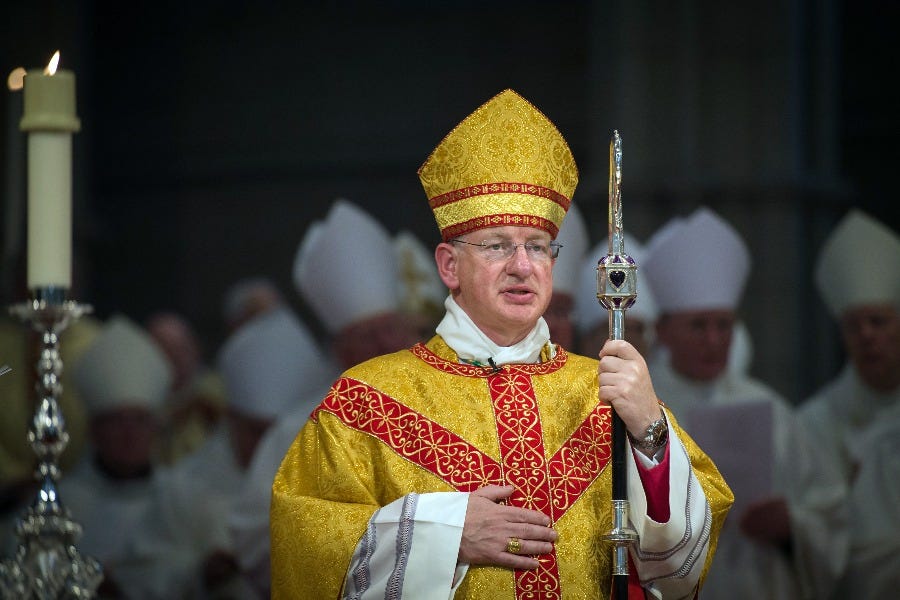
Moth, the Bishop of Arundel and Brighton since 2015, will succeed Cardinal Vincent Nichols, who turned 80 in November.
Moth, a 67-year-old Africa-born bishop with a passion for social justice, is not the first bishop of the southern English diocese to become Archbishop of Westminster. He follows in the footsteps of Cardinal Cormac Murphy-O’Connor, who moved from Arundel and Brighton to Westminster in the year 2000.
At 67, Moth is the same age as Murphy-O’Connor when he became Archbishop of Westminster. Murphy-O’Connor held the post for nine years, which suggests Moth’s tenure could last around a decade.
As Archbishop of Westminster, Moth will be the most prominent Catholic leader in the U.K. and is likely to succeed Nichols as chairman of the Bishops’ Conference of England and Wales.
Moth was not one of the initial favorites to succeed Nichols. His name began to emerge shortly before the cardinal’s 80th birthday on Nov. 8. Leo XIV and his advisers were likely drawn to the bishop because of his reputation as an efficient manager, his extensive ecclesiastical experience, his strong U.K. establishment ties, and his engagement with social issues.
Charles Phillip Richard Moth was born in Chingola, a copper mining town in Northern Rhodesia (now Zambia), on July 8, 1958. His parents returned to the U.K. not long after the birth of their only child, settling in Kent, a county in South East England.
Moth became an altar server in his Kent parish. At the age of 11 or 12, he began to discern a call to the priesthood, inspired by his pastor, Fr. Gerry Flood. Moth has described Flood, who rode a motorcycle, as “a very holy man, a prayerful man, [with] a deep care for the people in the parish.”
Moth entered the now-closed St. John’s Seminary, Wonersh, in 1976, at the age of 18. He was ordained a priest of the Archdiocese of Southwark, which covers London south of the River Thames, on July 3, 1982. He served initially in a parish in south London, before pursuing further studies in canon law at Saint Paul University in Ottawa, Canada. He worked for many years on the archdiocese’s marriage tribunal.
In 1992, Moth was appointed personal secretary to Southwark Archbishop Michael Bowen, a post he held for almost a decade. He was then appointed vicar general and chancellor of the archdiocese.
In 2009, Pope Benedict XVI named Moth the Bishop of the Armed Forces, the U.K.’s military ordinariate. He chose the episcopal motto Pax et gaudium in Domino (“Peace and joy in the Lord”). The role took him all over the world, including war-torn Afghanistan.
In addition to his work with military personnel, Moth took up the role of liaison bishop for prisons for the Bishops’ Conference of England and Wales — a post he continues to hold.
The role is relatively high profile as the Catholic Church is one of the leading voices for prison reform in the U.K. He has met regularly with politicians to lobby for reforms and wrote the foreword to the bishops’ 2024 document “Remember Me: A Catholic Approach to Criminal Justice,” which stressed the need for rehabilitation programs and support for prisoners’ families.
Moth has additionally served since 2011 as chairman of the board of governors of St Mary’s University, Twickenham, helping to strengthen the Catholic institution founded in 1850.
In 2015, Moth was named Bishop of Arundel and Brighton, succeeding Bishop Kieran Conry, who had resigned after admitting to a sexual relationship. The diocese includes Arundel Castle, the ancestral seat of the Dukes of Norfolk, who have traditionally played an influential role in English Catholic life.
Moth has also served as chairman of the bishops’ conference’s department for social justice, which covers life issues, marriage and family, and mental health, as well as prison ministry.
In June 2025, Moth was drawn into a dispute when a politician who voted in favor of an assisted suicide bill said he was barred from Communion by a priest of the Diocese of Arundel and Brighton. Moth, who strongly opposed the bill, invited the politician to meet with him in person to discuss the situation.
Moth has spoken in interviews of his love for horse riding and driving Land Rovers, an upscale SUV brand. He also has an interest in military history. He is an oblate of Pluscarden Abbey, a Benedictine foundation in Scotland. During his annual retreats at the abbey, he enjoys hillwalking.
Commenting on his abilities in a 2024 interview, Moth said that “one of the few gifts I have is stamina, so exhaustion doesn’t come too often.”
The Archdiocese of Westminster is one of England’s smallest dioceses in geographical terms, but has one of the largest Catholic populations. The archdiocese, which covers London north of the River Thames and the county of Hertfordshire, serves around 450,000 Catholics. The archdiocese has 212 parishes and 206 schools.
There are roughly 500 priests serving in the Westminster archdiocese. Observers believe that one of Moth’s principal tasks will be to support clergy, some of whom are demoralized due to increasing responsibilities amid a decline in priestly vocations.
Moth will be installed as the 12th Archbishop of Westminster at London’s Westminster Cathedral on Feb. 14, 2026.


‘Cause the light was on.
I appreciate that the picture shows +Moth in close proximity to a lit candle…