
Pillar paid subscribers can listen to JD read this Pillar Post here: The Pillar TL;DR
Hey everybody,
It’s really, really cold out there, and you’re reading The Tuesday Pillar Post.
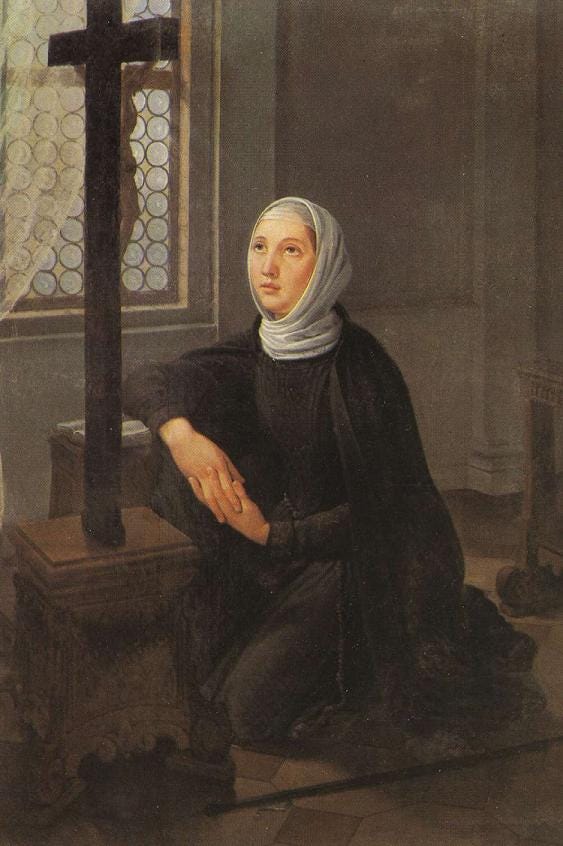
So let me start by telling you about Angela Merici, the saint who said no to the pope.
Angela was born in 1474 in the cool northern Italian town of Desenzano, on the edge of a big, beautiful mountain lake called Garda.
It might have been a great place to grow up. But Angela didn’t really get to find out, because when she was 10, her parents died. Angela and sister went to live with an uncle, while her older brothers kept the family home, and farmed their parents’ land.
We don’t know much about young Angela’s life, until her older sister died suddenly — I’m not sure how — but without anointing and the last rites of the Church.
Her sister’s death, and especially without sacraments, impacted young Angela. She started doing penance for her sister’s soul. She started offering mortifications and fasts. She prayed more. And soon, she joined the secular Franciscan order, which then was known to most people as the “brothers and sisters of penance.”
Angela pledged as a teenager to become a consecrated virgin — to give her whole life to Christ and his Church. But she had no idea where God would lead. Until she discovered a need.
Angela was about 20 years old when her uncle died, and she returned to her hometown. She had a little property by then — it would have been her dowry if she’d gotten married, but was instead hers to do what she wanted with.
And as Angela got to know her neighbors, she realized something: only the richest girls in Desenzano had any kind of catechesis, or even much education to speak of. If they didn’t have wealthy parents, the young girls of Desenzano had almost no chance of even basic Christian education.
So she opened her home. She started teaching them. They learned the Christian faith, and along the way, Angela taught literature and poetry and mathematics. Her home became a school, and other women came to join her work. They became a community.
To us, none of that sounds especially remarkable, it seems like the origin story for a bunch of religious orders we’ve heard of: A person does some apostolic work for the poor, other people join them, and soon they’re a community, right?
But in Angela’s time, consecrated women lived monastic lives. They lived behind walls, they were given over only to contemplation. These women were different. Some lived in Angela’s home, others lived in their own homes — they were given over entirely to apostolic work, but living independently, united in apostolic work and their commitment to penance.
All of it came through Angela’s own palpable love of God — which many of her companions said they wanted to follow because of its radiance.
“She was like a sun that gave light to all the others,” one wrote. “She was like a fire, a conflagration of love that set them all alight. She was like a throne of God which instructed them…”
Soon they started other schools. In 1524, Angela temporarily lost her sight, but regained it on a pilgrimage to the Holy Land, reportedly while she was in prayer.
The next year, she went to Rome for the 1525 Jubilee Year — just like many Pillar readers did last year, for the 2025 version. Pope Clement VII reached out to her. He had heard about her schools, and he wanted the same thing in Rome. He asked her to stay, to found schools, to replicate her success at the heart of the Church.
It wasn’t an easy invitation for Angela. She had confidence she was doing what God wanted in her life. She saw a path of Providence on which she was living. But the pope was asking her to do something. The successor of St. Peter. When the pope asks you to do something… you know… it’s not easy to say no, I imagine.
But she did say no. She told the pope she didn’t want the notoriety of living in Rome, and she wanted to continue what God was doing in her life. She went home.
And in 1534, 12 women joined Angela to formally found the Company of St. Ursula. They were a transformational movement in consecrated life. They would pray together and work together, but live in their own homes. They would follow the evangelical counsels, but not take public vows. They would be consecrated to virginity, but they would not take habits. They would be available, as catechists, wherever they were needed.
And they perdure until today.
Sure, a group of Angela’s followers eventually took up the path of more typical religious life, becoming cloistered Ursuline nuns and making vows, while continuing the education of young girls as an apostolate.
But after a long history, including periods of government suppression and refounding, Angela’s vision for the Company of St. Ursula also endures today — women living much as Angela and her companions did, as a secular institute, a unique and remarkable form of consecrated life which owes a great deal to the vision, courage, and faith of Angela Merici.
I’m struck most especially by the conviction which saw her strike out into a new way of doing things, and then to have confidence in God’s plan even when the pope himself suggested something else for her.
I hope I have the confidence to follow where the Lord leads me. I hope all of us do. May St. Angela intercede for us.
The news
It has been more than one year since the Cathedral of Notre Dame in Paris officially reopened, following five years of intensive reconstruction after the calamitous fire which had threatened to destroy the building in April 2019.
Most of Notre Dame’s restoration efforts have met widespread acclaim — but the choice of liturgical furnishings inside the cathedral has proven controversial — as Pillar readers know.
But the history of liturgical furnishings at Notre Dame is a lot more interesting than you might think.
Here’s the deal, in the first of a two-part series from Nico Fassino.

This Lent, join Catholics across the country as we gather again for Bible Across America—the nation’s biggest Catholic Bible study. During our Lenten Bible study, Shane Owens and guests will blend biblical expertise with lived experience, unpacking the Bible’s practical relevance as we prepare to celebrate the Lord’s resurrection.
The 63-year-old archbishop — who turned down Pope Francis’ plan to make him a cardinal — said he was resigning out of obedience to the Holy See — and it turned out he had been the subject of an apostolic visitation in the weeks prior to his resignation.
Outside of Indonesia, Syukur’s departure — and the circumstances which led to it— could be a sign that Pope Leo will apply a decidedly more systematic and thorough approach than his predecessor to dealing with episcopal misconduct.
Ed Condon’s got an insightful analysis on that front.
The March is an interesting place — for most of its history, the March focused on a call for the U.S. Supreme Court to overturn Roe v. Wade, which happened with the 2022 Dobbs decision.
But that Roe was overturned doesn’t mean we’ve resolved the issue of protecting the unborn in this country. On the contrary — as Brendan Hodge breaks down the numbers, it’s clear that abortion numbers are rising across America — especially with the rise of telehealth abortions, which make it easy for out-of-state doctors to prescribe abortion pills even for patients in states with significant abortion restrictions.
So what’s a snapshot of abortion today in America? And do people identify as more or less pro-life since Dobbs?
Brendan Hodge has got all the numbers you’re looking for.
I was not at March for Life 2026, regrettably — I had some obligations at home which kept me there, much as I find the gathering of people who attend for the March for Life a generally edifying (and fascinating) thing to be a part of, or to cover.
I think the March for Life matters because of its formational potential. It requires of participants a certain level of commitment: They must take an often long and uncomfortable bus ride, they must don layers of polar fleece and wool socks, they must get by on limited sleep and Hardee’s breakfasts —and they must do so with a sense that being pro-life demands of people sacrifice.
I suspect (and I know from my own experience) that leaves an impression, and forms character, and has the potential to orient someone to the more radical demands which being pro-life should make of each one of us. That — plus the sense that one is not alone in one’s convictions — can do a great deal towards actually building a culture of life.
In fact, I think the March for Life experience is a keystone to the formation of cultures of life in communities across America — and I know pro-life people doing extraordinary things in their communities, who attribute to the March for Life experience an important element in their formation of their character.
Last week, the programming of the March for Life came under sharp rebuke, with some of America’s most direct pro-life voices panning Vice President Vance’s speech, especially over the Trump administration’s approach to mail-order telehealth abortions, which account for a growing share of American abortions overall.
The criticism on Vance’s remarks was mostly that they seemed to ignore the telehealth abortion question, except to urge pro-lifers to be patient and strategic — taken by many in the crowd as a sign that his boss’ administration wasn’t going to change anything on that front, but at least he’d overturned Roe.
The Vance speech divided pro-lifers, just as it will doubtlessly divide all of you in the comments section.
My own observation is that the March for Life has a crippling “look at me” inferiority complex, and that shapes much of what’s happening on the dais.