Transalpine Redemptorist founder excommunicated for schism
The judgment followed Fr. Michael Mary Sim’s illicit episcopal consecration
The head of a traditionalist group who was illicitly ordained a bishop on a remote Scottish island Saturday has been declared excommunicated after a diocesan canonical process found him guilty of schism.
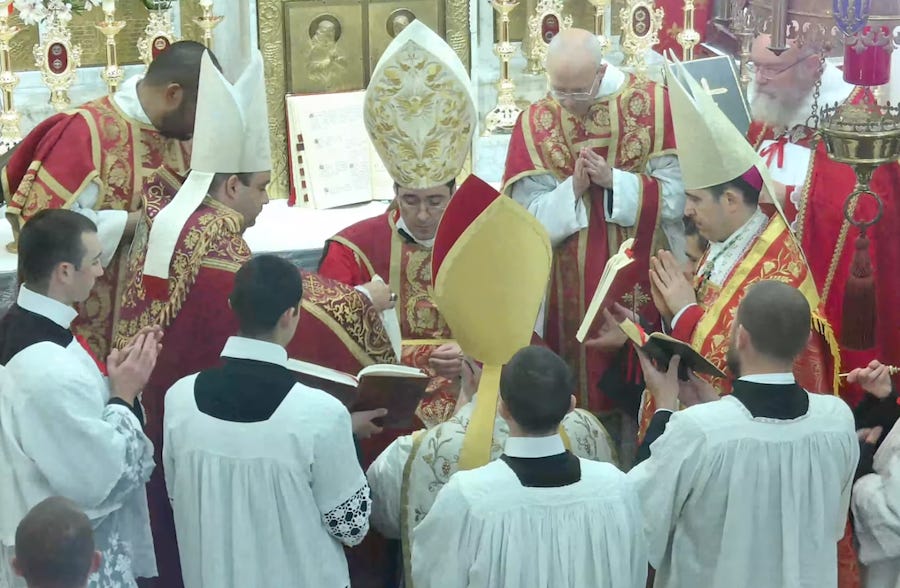
Fr. Michael Mary Sim, F.SS.R., the founder of the Congregation of the Sons of the Most Holy Redeemer (Transalpine Redemptorists), was excommunicated, dismissed from his ecclesiastical office as superior of the community, and forbidden to offer Mass and other sacraments, Bishop Hugh Gilbert of Aberdeen announced July 25.
In Church law, excommunication is defined as a “medicinal” penalty that is intended to inspire the offender to seek reconciliation, rather than as a merely punitive measure.
In a statement, Gilbert explained that the penalties were a consequence of Fr. Michael Mary’s adoption of sedevacantism, the position that the popes since Vatican Council II were illegitimate.
Gilbert said the situation was compounded by the priest’s July 25 episcopal consecration without papal mandate on the privately owned island of Papa Stronsay, which is part of the Orkney archipelago off Scotland’s northeastern coast.
The Canadian sedevacantist Bishop Pierre Roy served as the principal consecrator at the live-streamed ceremony. The co-consecrators were Brazilian Bishop Rodrigo Henrique Ribeiro da Silva and Spanish Bishop Fernando Altamira Alaníz, who also hold sedevacantist views. All three men trace their episcopal lineage back to the Vietnamese Archbishop Ngô Đình Thục.
Fr. Michael Mary was the primary signatory of the community’s May 2 declaration that referred to postconciliar popes as “papal pretenders.” The document had a total of 28 signatories, indicating the overall size of the group that has inhabited the island since 1999.
In his July 25 statement, Bishop Gilbert said: “For some time now the Diocese of Aberdeen has been pursuing a canonical process against the Rector Major of the Congregation of the Sons of the Most Holy Redeemer, Fr. Michael Mary Sim.”
“This religious community is principally based on the island of Papa Stronsay, Orkney, within the Diocese of Aberdeen and is subject to the oversight of the bishop. The action of the diocese was occasioned by various statements issuing from the community and especially by its adoption, spearheaded by Fr. Michael Mary, of the position known as ‘sedevacantist.’”
“This position affirms that our Holy Father Leo XIV is not a true pope, and that neither he nor the bishops in communion with him are to be recognized. At the same time, statements were made and actions taken calling into doubt the validity of ordinations in the post-conciliar rites.”
“Further affirmations posed an opposition between an ‘old’ and ‘new’ Church. All of this is instinctively repugnant to the Catholic sense of the faith, exposes those involved to ecclesiastical penalties and, unless repudiated, separates them from the communion of the Catholic Church.”
Gilbert announced the diocese’s judgment following the completion of its canonical process.
“Regrettably, I find Fr. Michael Mary guilty of the charges brought against him, most notably that of schism. He is therefore declared to be excommunicated, dismissed from ecclesiastical office, and prohibited from the celebration of Mass or the other sacraments,” he said.
“In accordance with the relevant canonical norms, the competent dicasteries of the Roman curia have been kept informed of the steps taken by the diocese. In the event of a sincere change of heart on his part and the making of reparation, these penalties may be lifted.”
Gilbert added: “More recently, Fr. Michael Mary has sought ordination from sedevacantist bishops, who have no permission from myself to act within the diocese and do not have the required papal mandate. The ceremony they conducted July 25 compounds the situation and exposes Fr. Michael Mary and those who take part to a further range of canonical penalties. This is a clear break with the Church.”
“By means of these events, the congregation and its now deposed superior have removed themselves from the communion of the Catholic Church, and the faithful of the diocese should have no dealings with them.”
“On her part, the Church urgently invites those involved to repent and to return to that union which they once enjoyed. The Church, who is the Mother of us all, will welcome them warmly.”
The Transalpine Redemptorists — who are distinct from the Redemptorists, the worldwide congregation established by St. Alphonsus Liguori in the 18th century — emerged in 1988 from the orbit of the Society of St. Pius X. Members combine a devotion to the Traditional Latin Mass with the spirituality of St. Alphonsus.
After Pope Benedict XVI expanded access to the Traditional Latin Mass, the Transalpine Redemptorists were reconciled with the Holy See in 2008. Gilbert erected the community as a clerical religious institute of diocesan right in 2012.
But in October 2025, the group issued an open letter declaring that it rejected several major documents issued under Pope Francis. Gilbert responded by saying that the positions expressed in the letter were “incompatible with the Catholic sense of the Church’s unity.”
After the Transalpine Redemptorists announced the illicit episcopal consecration of Fr. Michael Mary, the bishop issued a statement describing the act as “unlawful and a grave act of disobedience, separating those taking part from communion with the Catholic Church.”
On the last weekend before the ceremony, Gilbert asked priests across the Aberdeen diocese to celebrate Masses using prayers for the Unity of the Church, an option in the Roman Missal’s section for “Masses and Prayers for Various Needs and Occasions.”
In a pastoral letter read out in churches July 18-19, the bishop lamented the impact of the episcopal consecration without papal mandate on Church unity.
Fr. Michael Mary sought to justify the community’s trajectory in his first sermon following his illicit episcopal consecration, delivered July 26.
The 72-year-old, who was born in New Zealand, said the Transalpine Redemptorists had “tried our best” to fit in with the wider Catholic Church but discovered irreconcilable differences.
“Whether they are guilty in their souls, nobody knows and we do not foment against them. But we know, for ourselves, we’re happy to be away from their clutches. And whatever species they are, we find ourselves to be a different species,” he said.
“We pray for them and I’m sure that in their own way, they are praying for us.”
He argued that the Catholic Church had changed its way of praying, resulting in a change of belief, citing the saying lex orandi, lex credendi. As examples of changes, he cited guitars, folk music, and overhead projectors at Masses, as well as receiving Holy Communion in the hand.
He also commented on Bishop Gilbert’s recent decision to expand access to Traditional Latin Masses in the Aberdeen diocese. The Masses were originally offered weekly by members of the Transalpine Redemptorists at the Church of Our Lady of the Garioch and St. John the Evangelist in Fetternear, a hamlet in Aberdeenshire. Following the community’s drift toward sedevacantism, a diocesan priest presided at the Masses. They are now offered every Sunday at the non-parochial church by Transalpine Redemptorist priests who have distanced themselves from the community.
Fr. Michael Mary argued that the expansion was “political” and “nothing to do with true, sincere love of the sheep.”
He added: “What a great blessing it is to be out, to be out of a false hierarchy that is perverting the faith.”
Fr. Michael Mary had not responded by press time to a request to comment on Bishop Gilbert’s July 25 statement.
Bishop Gilbert declined a July 27 request for comment.
