
A professor of theology at The Catholic University of America was announced as the new head of cultural outreach at the Department for Homeland Security’s Office for Partnership and Engagement.
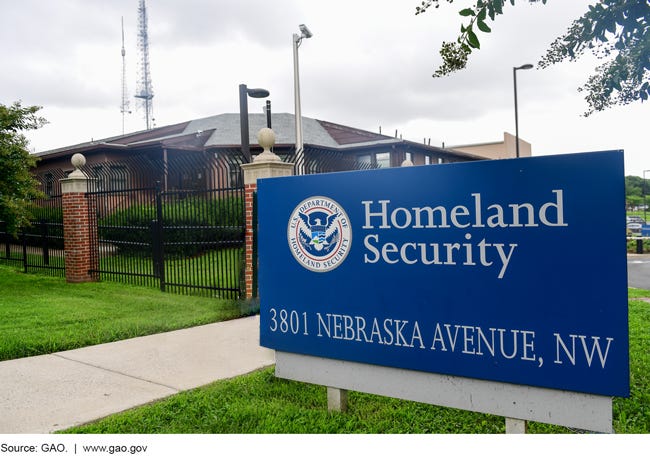
The D.C.-based university announced Chad Pecknold would be on a leave of absence from his position at Catholic’s School of Theology and Religious Studies, where he is a tenured professor, with the school’s website listing him as on leave from 2026-2028.
The move is, in many ways, not unusual. Tenured professors at many academic institutions, including CUA, take leaves of absence either to work on special projects or to serve in some external role for a period of time.
In the case of The Catholic University of America, faculty stints in government service are not uncommon — in 2019 Prof. Robert Destro went on leave from the university’s Columbus School of Law after being appointed to serve as Assistant Secretary of State for Democracy, Human Rights, and Labor.
Indeed, the university, which was founded by papal charter under Pope Leo XIII and incorporates the episcopate of the United States into its governing structures, often cites its founding mission to “give the Republic her best citizens.”
But Pecknold’s appointment specifically has drawn attention since he is taking up a post at the government department responsible for one of the Trump administration’s more controversial policies — a campaign of robust immigration enforcement, detention, and deportation.
Those policies, and the manner of their implementation, have drawn public and direct criticism from bishops across the country, including Washington, D.C.’s own Cardinal Robert McElroy, along with the United States Conference of Catholic Bishops, and Pope Leo XIV.
As such, many media commentators have asked whether there would be tension between Pecknold’s government role and his status as a theologian at the university most closely linked to the ecclesiastical hierarchy, especially if the Church and administration again butted heads over DHS policy.
While Pecknold’s new role will almost certainly throw up challenges and tensions for any Catholic in public life, the unique status of CUA and its theology faculty actually add layers of canonical nuance.
How? Well, that’s interesting, and The Pillar explains.
Let’s start at the beginning: Can professors just ‘take a break’ from their tenured positions?
Absolutely. It happens all the time. In fact, the opportunity for a permanent faculty member to step out from time to time and work on a special project or external role can be an important part of keeping a university’s teaching roster fresh, engaged with outside events and currents of thought, and stimulating new areas of research.
This outside work isn’t part of the work of the university, but it also doesn’t affect the terms of academic tenure and freedom which faculty enjoy, even while they are on a break from their positions. So, even if — hypothetically — a professor took a leave of absence to work on a highly controversial area of government policy implementation or communications, it wouldn’t impact the terms of their academic position when they returned to the university, or impede them from doing so when their leave expired.
So tenured professors just can’t get fired, even if they take another job?
Well, the point of tenure is to make sure academics have the intellectual freedom to think and work without having to fear for their jobs if they do or say something controversial.
But this doesn’t mean tenured professors have jobs for life, no matter what. Professors can see their tenure cancelled if they do something which can be classed as “moral torpitude” — an inappropriate relationship with a student or an act of criminal significance, for example.
Tenured positions also have some basic requirements of competence and activity, meaning the professors have to maintain some kind of minimum standard of teaching capability and intellectual content for their courses.
There is also always the possibility of some major change to the program in which a professor teaches. So if, for example, a professor of data analytics saw the entire program of research and course offerings to students cancelled, that could also lead to the termination of the tenured position.
That last possibility isn’t very likely in the case of a theology professor at Catholic U. though, for some very specific reasons.
Because isn’t Catholic U. a ‘pontifical university’ or something, and doesn’t this mean professors there have to be totally in line with Catholic teaching?
Well, let’s get our terms clear first. People often talk about Catholic U. as a “pontifical university” but it isn’t, strictly speaking. It was founded by papal charter, but it doesn’t fall under the direct authority and supervision of the Holy See in the way that, say, the Pontifical Gregorian University in Rome does.
Instead, the bishops of the United States have a direct institutional link with the university’s governance through the USCCB.
But Catholic U. does have what canon law calls “ecclesiastical faculties” for the sacred sciences like (most importantly) canon law, but also theology and philosophy. This means that these teaching faculties can confer degrees in the name of the Church and established by the Church, not just of the university as a civil academic institution with a Catholic identity.
Those degrees — STDs, JCDs, PhLs, for example — are distinct from degrees like an MA, or a Ph.D — which are also offered at Catholic University.
Ecclesiastical faculties are very important, since ecclesiastical degrees are a basic requirement for many important governance and teaching positions in the Church, as well as essential for the education of seminarians.
But don’t you need special permission to teach theology in a Catholic college?
Oh yes, you do. There is actually a lot of canon law governing higher education and Catholic colleges and universities and faculties — especially those which teach the sacred sciences.
Ex corde ecclesiae, the apostolic constitution on Catholic universities, recognizes the idea of free academic inquiry for scholars, even within sacred sciences like theology, saying that “the Church, accepting ‘the legitimate autonomy of human culture and especially of the sciences,’ recognizes the academic freedom of scholars in each discipline in accordance with its own principles and proper methods, and within the confines of the truth and the common good,” and that “theologians enjoy this same freedom so long as they are faithful to these principles and methods.”
Now, especially in theology and similar sacred subjects, the “confines of truth and the common good” are a little more carefully defined by the Church, since they touch directly on matters of faith and morals.
In fact, Ex corde requires specifically that “all Catholic teachers are to be faithful to, and all other teachers are to respect, Catholic doctrine and morals in their research and teaching,” but “in particular, Catholic theologians, aware that they fulfil a mandate received from the Church, are to be faithful to the Magisterium of the Church as the authentic interpreter of Sacred Scripture and Sacred Tradition.”
Citing the Second Vatican Council’s dogmatic constitution Lumen Gentium and the Code of Canon Law, it also reiterates that “It is necessary that those who teach theological disciplines in any institute of higher studies have a mandate from the competent ecclesiastical authority,” which is usually the diocesan bishop.
In short, if you teach theology in any Catholic college or university, you need to have a mandate from the local bishop to do so. But at Catholic U., which has an ecclesiastical faculty of theology, there’s a whole other layer of law.
The separate apostolic constitution on ecclesiastical universities and faculties, Veritatis gaudium, makes it clear that there is a different notion and standard of academic freedom at issue:
“Those who teach matters touching on faith and morals [in ecclesiastical schools] are to be conscious of their duty to carry out their work in full communion with the authentic Magisterium of the Church, above all, with that of the Roman Pontiff.”
“Those who teach disciplines concerning faith or morals must receive, after making their profession of faith, a canonical mission from the Chancellor or his delegate, for they do not teach on their own authority but by virtue of the mission they have received from the Church.”
So a theology professor at any Catholic university has to have due regard for truth and the common good, and require a mandate from the local bishop to teach. But ecclesiastical professors operate on a whole different plane, literally teaching in the name of the Church. As such, a much more rigorous standard of fidelity to the magisterium is required by canon law, along with a formal profession of faith and the significantly enhanced “canonical mission” to teach, not merely the local bishop’s mandate.
Sure, fine, that’s the legal theory but make this real for us — what does all that mean for Prof. Pecknold if DHS and the Church have another big policy confrontation?
Well, let’s not get ahead of ourselves. It is possible that recruiting a theologian from a Catholic university might result in a more Catholic approach to DHS’s work.
But it is fair to note that recently the entire American episcopal hierarchy joined ranks to vocally challenge the enforcement campaign by Immigration and Customs Enforcement, a subsidiary agency of DHS. And Pope Leo took the unusual step of wading into a domestic policy debate highlighting the need for — and by implication the lack of — due process for those detained for immigration offenses.
The U.S. bishops have also highlighted the curtailing of basic religious freedoms for immigration detainees.
It is also fair to say that the administration has taken a direct, sometimes personal line in opposing the Church’s stance on all these issues — whether it is the vice president claiming the bishops’ opposition to immigration enforcement is financially motivated, or President Trump taking personal aim at Pope Leo.
In any event, there is certainly potential for a director of “cultural outreach” at DHS to be found in an awkward position.
But while there would likely be a lot of commentary and social media back-and-forth about how a renewed conflict between DHS policy and the Church could or should affect Prof. Pecknold’s academic position at the bishops’ university, ultimately the real decision maker would be Washington’s Cardinal McElroy.
As the Archbishop of Washington, where Catholic U. is located, the cardinal is the competent authority to issue the necessary mandate to teach theology in a Catholic university. And, as the ex officio chancellor of the university, he’s also the responsible official for granting the canonical mission to teach at an ecclesiastical school.
Both the mandate and the mission are granted at the time of appointment and don’t lapse with a leave of absence, they would have to be revoked. And the extent to which the cardinal might want to make such a direct and personal intervention into the academic life of Catholic U. is probably very limited.
That having been said, last year McElroy described the administration’s immigration policy as “a comprehensive governmental assault designed to produce fear and terror among millions of men and women who have through their presence in our nation been nurturing precisely the religious, cultural, communitarian and familial bonds that are most frayed and most valuable at this moment in our country’s history.”
Earlier this year, the cardinal co-signed a statement in response to ICE enforcement actions in Minneapolis, saying that “we are witnessing a grave departure from our nation’s deepest moral commitments and from the values of human dignity, restraint, and accountability that our faith traditions uphold. When the power of the state is exercised without regard for life, justice, or the common good, the foundations of democracy itself are put at risk.”
This being the case, the cardinal apparently considers government immigration enforcement to be a matter of truth and morals, if not necessarily a matter of faith in the academic sense. So, while the chances of McElroy deciding to make Prof. Pecknold personally the locus of some future standoff between the Church and the administration are probably very slim, they aren’t zero, either.
Fine. Hypothetically, if a bishop like Cardinal McElroy did take away the mandate and canonical mission from a professor like Pecknold, would that mean he lost his tenure at a university like Catholic U.?
Well, hypothetically, not necessarily. No. For a start, the mission and the mandate are distinct things. In theory it would be possible for the cardinal to revoke one without the other.
Say, for instance, he withdrew the canonical mission to teach in the name of the Church but not the mandate, it would be theoretically possible for a professor to continue to teach in a limited or restricted capacity at the university’s department of theology.
The professor wouldn’t be able to teach seminarians, or handle those classes or courses which counted towards the ecclesiastical degree in theology, as opposed to a civil degree in theology or religious studies. But he could still, technically, teach theology in the university, provided a course load could be contrived to meet the minimum requirements of a tenured position.
If both the canonical mission and mandate were lost, though, it could affect the situation of tenure, even though it is effectively a legal part of a civil contract of employment, and not necessarily subject to canon law. That has happened before, for what it is worth, even at CUA.
In 1986, the theologian Fr. Charles Curran lost his mission and mandate to teach at CUA. after repeatedly dissenting from aspects of the Church’s moral teaching on human sexuality and life issues.
Curran sued the university and chancellor Cardinal Hickey, arguing that his dissent from Church teaching and even his inability to teach theology in a Catholic university ought not negate the terms of his academic freedom and tenure. He lost that lawsuit, though, and eventually joined the faculty at Southern Methodist University.
"It is possible that recruiting a theologian from a Catholic university might result in a more Catholic approach to DHS’s work."
Right, and it's equally possible that a pig might suddenly stand upright and begin speaking in perfect Mandarin. Considering the way Pecknold has been cheerleading for ICE, I won't hold my breath for it
So would these be sort of the same criteria that happened with Weisenburger firing Ed Peters, Ralph Martin, & Eduardo Echeverría in July 2025? He removed their mandate & canonical mission? That whole situation was such a mess.