
Who are the priests of Rome? A look at the numbers
Who are the priests of Rome? Where are they from? How old are they?
Pope Leo XIV is set to ordain eight new priests for the Diocese of Rome next weekend.
While most European dioceses would envy ordaining eight priests in a single year, it’s one of the smallest Roman ordination cohorts on record, after just six new priests were ordained in 2020 and 2017, and just five in 2011.
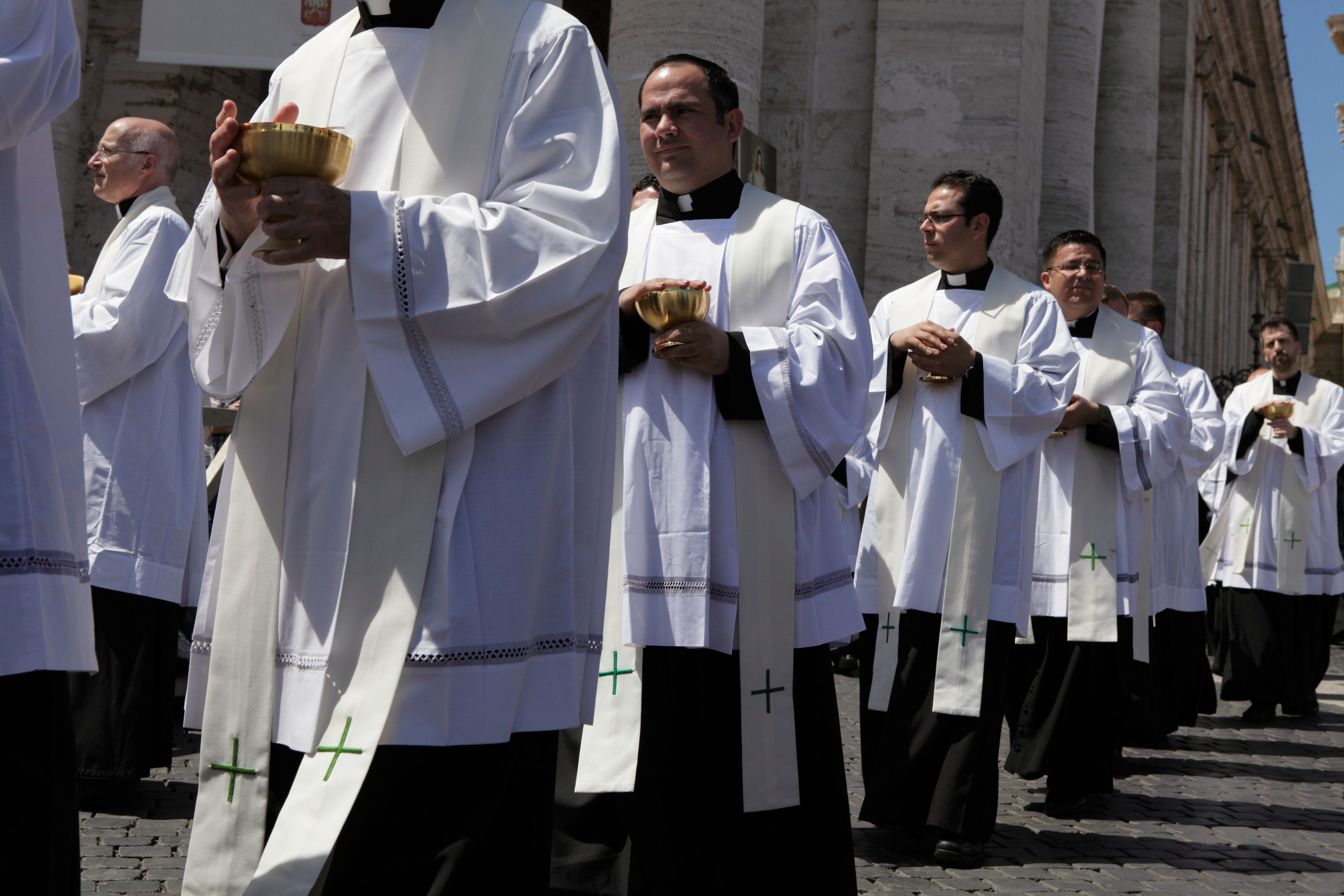
The Diocese of Rome is aided by hundreds of foreign priests coming for studies and religious priests serving in their Roman houses and institutions, which guarantees there will be no shortage of priests in the pope’s diocese in the foreseeable future.
However, the number of priests working in the Diocese of Rome nearly halved between 2000 and 2023, while the number of seminarians at the Pontifical Roman Seminary also halved between 2009 and 2026.
What do the numbers show about the true vocational situation in the pope’s diocese? Who are the priests of Rome? Where are they from? How old are they?
The Pillar takes a look.
Ordinations
As the epicenter of Catholicism, Rome had long enjoyed a significant number of vocations to priesthood and a full seminary.
However, that has changed in recent years.
For example, there were 21 priests ordained in 1990. Five years later, the number reached a peak of 35. The number fell below 20 for the first time in 2009, when 19 priests were ordained.
Since then, the highest number has been 18 priestly ordinations in 2019, in a year with an exceptionally large class; no other year since 2015 has had more than 13 ordinands.
Most Roman seminarians study for the priesthood at the Pontifical Roman Major Seminary. A smaller number are formed elsewhere: at the Almo Collegio Capranica, the historic Roman college long associated with training priests for higher ecclesiastical service, or at the Redemptoris Mater Seminary, run by the Neocatechumenal Way, whose priests are incardinated into the Diocese of Rome.
These seminaries, however, do not publish statistics of their number of seminarians.
And in some instances, priests from religious congregations serving in Rome are also ordained alongside the diocesan priests.
While the Diocese of Rome does not publish an annual breakdown of where its new priests were formed, the years in which it has released those figures offer a useful snapshot of trends.
In 2006, for example, Pope Benedict XVI ordained 15 priests:
7 from the Redemptoris Mater Seminary
5 from the Pontifical Roman Major Seminary
2 discalced Carmelites
1 from the Almo Collegio Capranica
In 2008, 18 priests were ordained:
13 from the Pontifical Roman Major Seminary
9 from the Redemptoris Mater Seminary
3 from the Madonna del Divino Amore Community
2 from the Priestly Fraternity of the Sons of the Cross
1 from the Capranica
1 from the Pontifical Collegio Urbano
In 2017, 10 priests were ordained:
4 from the Pontifical Roman Major Seminary
2 from the Redemptoris Mater Seminary
1 from the Brothers of Our Lady of Mercy and from the Family of the Disciples
2 who studied in the Roman Seminary but were ordained for other dioceses
There have been 11 priests ordained in Rome each of the last two years. In 2024, six came from the Major Seminary, three from Capranica, and two from the Redemptoris Mater. In 2025, seven were from the Major Seminary and four from the Redemptoris Mater. The Diocese of Rome has not published a breakdown for 2026.
A 2020 study showed that among the priests ordained in the Diocese of Rome between 1991 and 2020, 34.6% studied at the Roman Seminary, 25.8% at the Redemptoris Mater seminary and 5.6% at the Capranica, and the rest in other Roman colleges or with religious congregations.
Seminarians
The Pontifical Roman Seminary is the principal major seminary of the Diocese of Rome. In the 1980s, it housed more than 150 seminarians.
But the Roman Seminary has long included students from beyond the diocese itself.
In 1853, the Seminario Pio — established for seminarians from other dioceses of the Papal States – was merged into the Roman Seminary, which continued the practice of receiving seminarians from other Italian dioceses, especially those near Rome.
In time, it also began welcoming candidates from other parts of the world. As a result, a significant minority of its students have historically been seminarians from beyond the Diocese of Rome.
Overall, though, the number of seminarians has fallen significantly in the last 17 years. In 2009, there were 117 seminarians, 54 of whom came from Rome, 45 from two dozen other dioceses in Italy, and 18 from countries such as Croatia, Haiti, and Ukraine.
In 2018 there were 63 seminarians, of whom 35 were Roman, 18 came from other Italian dioceses and religious congregations, and 10 came from countries such as Haiti, China, and Spain.
Currently, there are 55 seminarians in the Pontifical Roman Major Seminary, broken down as follows:
Diocese of Rome: 31 seminarians
Archdiocese of Cagliari: 1 seminarian
Archdiocese of Chieti-Vasto: 2 seminarians
Archdiocese of Lecce: 1 seminarian
Archdiocese of Otranto: 1 seminarian
Diocese of Albano: 3 seminarians
Diocese of Civita Castellana: 1 seminarian
Diocese of Macerata: 1 seminarian
Diocese of Molfetta-Ruvo-Giovinazzo-Terlizzi: 2 seminarians
Diocese of Patti: 1 seminarian
Diocese of Porto-Santa Rufina: 2 seminarians
Diocese of Soroti (Uganda): 2 seminarians
Apostolic Prefecture of Azerbaijan: 1 seminarian
Work of Jesus the High Priest: 5 seminarians
Apostolic Community of Mary Ever Virgin: 1 seminarian
Clergy and religious
The clergy of the Diocese of Rome has always been distinctive for its marked international character, owing to the large number of priests who come to Rome for studies or to work in the Roman curia, as well as members of religious congregations living in their motherhouses or serving in the apostolates their communities maintain in the city.
In recent years, the Roman clergy has gotten both older and smaller, although it is hard to know by exactly how much.
For example, if you take 1999 as a point of reference, you would find 3,451 diocesan priests in Rome — more than double the 1,353 recorded in 2022, and four times the 860 listed in 2023. But does that mean more than 2,500 Roman priests died, left the priesthood, or were excardinated over the span of 27 years? Not exactly.
It appears that 1999 was a statistical anomaly. The number of diocesan priests was listed at 1,635 in 1990 and 1,561 in 2000, making the 1999 figure an outlier. It likely reflects a change in the criteria used to define a “diocesan priest.”
Something similar seems to have occurred between 2022 and 2023. The 2023 figure appears to count only priests incardinated in Rome, while the 2022 total may also have included priests serving in the diocese without being incardinated there — many of them likely foreign clergy studying at Rome’s pontifical universities.
Meanwhile, the number of religious priests has fallen significantly from 4,330 in 1999 to 1,820 in 2023. The number of female religious has hovered around 22,000 since 2000. And the number of permanent deacons has skyrocketed from 29 in 1999 to 149 in 2023.
The number of parishes in the Diocese of Rome has also sat around 320-330 for the past few years. However, the diocese is also home to four major basilicas, 61 minor basilicas, and 112 churches belonging to religious institutes.
In addition, the diocese has 169 rectory churches, mostly historical churches in the city center, and 31 national churches, such as San Luigi dei Francesi, one of the four French churches in Rome, or the Frizekerk, the Dutch church at the footsteps of the Vatican. It also has 21 Italian regional churches (similar to national churches but belonging to a region of Italy, such as Santo Spirito dei Napoletani), and 12 churches belonging to Eastern Catholic communities.
Age and nationality trends
There is only a single study comparing the evolution of the Roman clergy between 2017 and 2020, so it is difficult to talk about trends. But the mean age of Roman priests in 2020 was 57.6, with 45.2% of priests falling between the ages of 45-49 years old and 16.76% over 74.
While most age statistics between 2017 and 2020 are quite similar, the age at ordination increased from around 29 years old to about 35 years old.
The same study shows that the Roman clergy is very diverse by nationality. Just over a quarter of priests incardinated in the Diocese of Rome were foreigners in 2020, coming from 56 different countries. This is an increase from 2017, when about 1 in 5 priests was a foreigner.
Moreover, only 1% of foreign priests incardinated in Rome were over 74 years old in 2020, compared to more than 15% of Italian-born priests incardinated in Rome.
While Rome has always had a significant number of foreign priests, most were not incardinated in the Diocese of Rome but are instead studying in Rome or working in the Vatican while having a temporary pastoral assignment in the Diocese of Rome. Between 1927 and 1990, only 51 foreign priests in total were incardinated into the diocesan clergy.
Over the last century, 42% of the foreign priests incardinated in the Diocese of Rome studied at the Redemptoris Mater Seminary, founded in 1988, making it responsible for a significant part of the growth in foreign priests in Rome.
In 2017, 39% of foreign priests incardinated in Rome came from Europe, but that number fell to just under 36% in 2020. In 2020, the largest share of foreign priests in Rome – some 38% – came from the Americas. Another 15% came from Asia, 10% from Africa, and a single priest from Australia.