
Bishop Heiner Wilmer joined Protestant and ecumenical officials Monday in declaring that “grave fears have become reality” following the Alternative for Germany’s landslide victory in the Saxony-Anhalt state election.
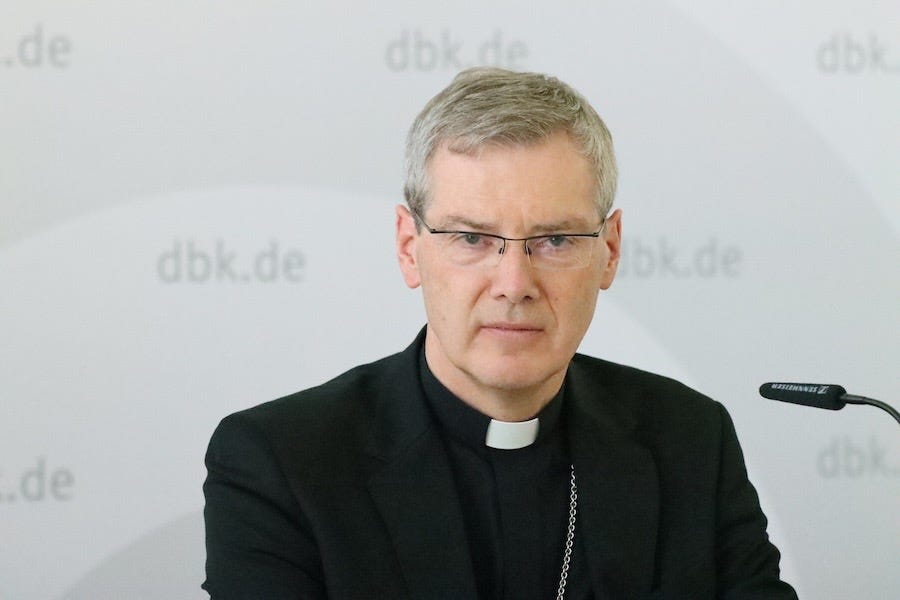
The chairman of the German bishops’ conference issued a joint statement with Bishop Kirsten Fehrs, leader of the Protestant Church in Germany, and the Rev. Christopher Easthill, chairman of the Association of Christian Churches in Germany, noting that the AfD was “by a clear margin the strongest party” in the eastern state following the Sept. 6 vote.
“We call on the election winners to respect the state constitution and the Basic Law [federal constitution] without reservation, and to uphold the dignity of all people regardless of their origin, religion, way of life, achievements, or position,” the Christian leaders said Sept. 7.
According to a provisional count, the AfD — which advocates stricter immigration and asylum laws — won 43.8% of the vote in the state with a population of around 2.12 million people, ahead of the Christian Democratic Union at 17.2%.
Although the AfD came well ahead of the CDU, which has governed Saxony-Anhalt since 2002, winning 39 of the state parliament’s 83 seats, it fell short of the 42 seats required for a majority.
The AfD is unlikely to be able to form a government on its own, and the CDU,the Social Democratic Party, the Greens, and the Left Party have ruled out cooperation with it. The Sahra Wagenknecht Alliance, which won 5.3% of the vote, has ruled out a formal coalition with the AfD but has left open the possibility of some form of cooperation with an AfD-led government.
In 2023, Saxony-Anhalt’s domestic intelligence agency classified the AfD’s state branch as a confirmed right-wing extremist organization. The AfD rejected the classification as politically motivated.
Church leaders in Saxony-Anhalt issued a joint statement Sept. 7 expressing “great concern” at the election result.
“This state election has profoundly changed the political landscape in Saxony-Anhalt,” said the statement signed by Bishop Gerhard Feige of Magdeburg, Bishop Friedrich Kramer, head of the Protestant Church in Central Germany, and Karsten Georg Wolkenhauer, president of the Evangelical Church of Anhalt.
“The state is divided. Our concern is for social peace and for people living together in our state. The election result reflects widespread dissatisfaction among large sections of the population.”
Saxony-Anhalt has one of Germany’s highest unemployment rates and is experiencing significant demographic decline, with deaths far outnumbering births and younger people continuing to leave the state.
Irme Stetter-Karp, the president of the lay Central Committee of German Catholics, said the election represented “a radical political upheaval.”
“The AfD fell short of an absolute majority. I urge all democratic parties not to enter into a governing coalition with right-wing extremists under any circumstances,” she commented Sept. 7.
The German bishops unanimously declared in 2024 that Catholics could not vote for the AfD as it had undergone “several waves of radicalization” and was now “dominated by a racial-nationalist attitude.”
An analysis by the Forschungsgruppe Wahlen, a polling institute in Mannheim, concluded that Christians voted for the AfD in Saxony-Anhalt at significantly lower rates than the religiously unaffiliated.
Only around 300,000 people — roughly 14% of the total population — belong to the Catholic Church or Protestant Church in the state, which is located in the former communist East Germany.
According to the analysis, published by the German Catholic news agency KNA, while the AfD gained 43.8% of the vote overall, it won 47% among the religiously unaffiliated, compared with 32% among Catholics and 33% among Protestants.
The CDU — which is led by Chancellor Friedrich Merz, a practicing Catholic — earned only 17.2% of the total vote in Saxony-Anhalt, but attracted 26% of both Catholic and Protestant voters.
The Forschungsgruppe Wahlen concluded that 37% of Catholic men and 38% of Protestant men voted for the AfD, compared with just 26% of Catholic women and 29% of Protestant women.
Among voters ages 16 to 34, only 23% of Catholics voted for the AfD, compared with 39% of Protestants. In the 35-to-59 age group, 37% of Catholics and 38% of Protestants backed the party.
Ulrich Siegmund, the AfD’s lead candidate in Saxony-Anhalt, was raised a Catholic, but reportedly formally left the Church in 2017.
The AfD’s Saxony-Anhalt branch said in its July manifesto that if it took power it would seek to revise the system of state payments to Germany’s largest religious bodies, including the Catholic Church and the Protestant Church in Germany.
The manifesto noted that the state government channels more than 40 million euros (around $46.6 million) annually to the churches in the form of state payments that originated as compensation for historical seizures of Church property.
The manifesto promised to keep the overall amount of funding unchanged, but make the money available to all Christian communities in proportion to their membership. It would also insist funds were spent only on clergy salaries and building maintenance, with a requirement that churches provide evidence of how the money is spent.
The manifesto also said the party would work at a federal level to end the state’s role in church tax collection, with the aim of requiring Catholic and Protestant communities to collect their own membership dues.
In Germany, religious communities that are corporations under public law have a right to levy taxes on their members. Every person in Germany who is officially registered as a Catholic and liable to pay income tax is required to pay church tax equivalent to 8-9% of their income tax liability, depending on the region in which they live. The state collects the sum on the Church’s behalf, usually directly from employees’ paychecks, while claiming a percentage of the total revenue.
Bishop Feige has previously expressed fears that the AfD in Saxony-Anhalt’s policies could cause a financial crisis in the Magdeburg diocese, which is considered one of the poorest of Germany’s 27 dioceses.
List of my grave fears:
-Schism
-Mass Apostasy
-Widespread Heresy
.
.
.
.
.
- a pro market, immigration-restrictionist party winning elections