
Pillar paid subscribers can listen to this Pillar Post here: The Pillar TL;DR
Hey everybody,
First, an announcement.
Ed and I are headed to Rome this week for the inaugural Pillar Pilgrimage. In fact I’m already here — and I brought my parents — and Ed arrives Wednesday.
And we’ll be doing a live episode of The Pillar Podcast on Thursday, Dec. 4, at 8pm, at The Drunken Ship Pub in Rome’s Campo de Fiori.
If you live in Rome, or even close to it, you should come. It’s going to be a great time. Especially because we’re trying something new: This is an “off-the-record episode” of The Pillar Podcast — we’ll have a great Catholic conversation, play some games, do some shenanigans, and have an all-around good time, but we won’t be recording any of it.
Instead, it’ll just be an experience for those of us who are in the room. And if that works, we’ll try hard to take “off-the-record” episodes to three or four or five cities in 2026.
So Thursday, Dec. 4, at 8pm, at The Drunken Ship Pub in Campo de Fiori, we’ll be having a great time. We just hope somebody actually shows up!
Ok, today’s the feast of Blessed John van Ruusbroec, and you’re reading The Tuesday Pillar Post.
I bet you never heard of John van Ruusbroec.
Neither had I — but he’s an Augustinian, and since the pontiff is one too, it seems like we should all brush up on the Augustinian saints and blesseds, in case there’s a quiz.
He lived in the 1300s, outside of Brussels. We don’t know about John’s father, but we know that his mother eventually entered a convent, and that when he was 11, John moved to the city’s St. Gudula Cathedral, to be raised by an uncle, a priest assigned there.
John was ordained at about 25, and was a parish priest, and a canon of the cathedral chapter — which means he lived at the cathedral and had a kind of common life with the other priests there.
In two decades of parish ministry, John became kind of famous as a catechist — writing pamphlets against a heretical spiritualist movement that had become popular in that region. He is said to have written in plain, simple language, because his goal was to convince local Catholics to remain faithful to the Church.
He was so famous that people invited him everywhere, and made long weekends out of coming to hear him speak. Was he the Fr. Mike Schmitz of his day? I don’t know — that depends on whether he’d discovered the power of the “in a year” format. But if he wasn’t Schmitz, he was close, that’s for sure.
Eventually — after 26 years in that work — John wanted a more prayerful life. With a few other priests, he made his way to a hermitage outside Brussels. Other priests came to live with him, and then young men desiring priesthood, and within six years, their community was formalized as a community of Augustinian canons regular.
This means, by the way, that John wasn’t the same kind of Augustinian as Leo XIV. The pope belongs to the Order of St. Augustine, founded in the 1300s as a kind of amalgamation of some hermit communities in Italy. John was a canon regular of St. Augustine — an older form of religious life, dating back in some ways to the time of St. Augustine, and taking their modern form in the 1100s. There still exist Canons Regular of St. Augustine — in fact, they operate a school in Chiclayo, the Peruvian city where Pope Leo was a bishop.
Anyway, vocations weren’t the only ones coming to John’s hermitage outside of Brussels.
Because John’s pamphlets had been so popular, lay people came to him for guidance. So many people came that he couldn’t see them all, so he took up writing again — writing eloquently about the spiritual life, and the experience of divine love in prayer.
Now, therefore, hear and understand;
To the good and inward man, who enters within himself, free and empty of all earthly things, opening and uplifting his heart reverently towards the Eternal Goodness of God, there is thrown wide the Heaven which was shut, and from the Face of Divine Love there blazes down a sudden Light, as it were a lightning-flash; and in that Light there speaks the Spirit of Our Lord, in this opened and loving heart, and says: “I am yours, and you are Mine: I dwell in you, and you dwell in Me.”
In this meeting of the Light with the stirring of God, is so great a joy and delight of the soul and body in his uplifted heart, that the man knows not what has befallen him, nor how he may endure it.
And this is called “The Song of Joy,” which has no words, and which no man knoweth, save him who has conceived it in his heart.
And this it is which lives in the loving heart that is opened to God, and closed to all created things.
And thence comes “Joyfulness”...
John was remembered as a saint almost from the moment of his death. But his body was lost or destroyed in the French Revolution — as were many, but not all, of his writings.
There’s something to that. A man who wanted to live entirely consumed by Divine Love, leaves nothing for us but a testimony of that love.
The news
We did not have a newsletter on Friday, so there’s a lot of news to summarize for you:
While the statement — the first such release since 2023 — points to improvements, it does not address the significant Vatican pension deficit, and shows the Vatican is depending on short-term revenue sources to shore up its ongoing operational shortfall.
And in an analysis thereof, Ed Condon asks a critical question: Does the Vatican’s financial report indicate sustainable progress, or a positive blip in an otherwise dismal forecast?
Here’s what we can figure on that question — and what factors matter most for the future.
—
Cardinal Victor Fernandez told reporters that there are no plans to change canonical discipline for polygamous converts to Catholicism, which allows a man to choose the “wife” with whom he will contract a valid union after being baptized.
This is not a trivial concern.
Fernandez explained that African bishops “have told us about very violent situations in small villages; we’ve had cases in which the man chose one woman, and left the rest on the street, in the desert, and the women even died of heatstroke, of hunger.”
—
The kidnappings come amid a rise in violence against Christians, and a growing trend of school kidnappings for ransom.
In that vein, Nigeria’s President Bola Tinubu has declared a “nationwide security emergency.”

This Advent, gather with fellow Catholics for a Bible study unlike any other. Bible Across America is a nationwide Bible study hosted by the St. Paul Center. During this inaugural study, we’ll encounter Christ as “Teacher and Lord,” discovering what this means for our lives as modern-day disciples.
His appointment as an auxiliary bishop last month makes him one of more than a half-dozen “continent-crossing” bishops appointed in Leo’s reign — men appointed to be bishops far from the places where they were born.
Of course that fits with the pope’s own pattern of life — the Chicagoan became a bishop in Chiclayo, Peru, a continent away from his hometown. So are such appointments becoming a papal hallmark?
—
Irme Stetter-Karp, a key architect of Germany’s controversial synodal way and one of Europe’s most outspoken progressive Catholics, was re-elected Friday as president of the lay Central Committee of German Catholics.
Stetter-Karp, who is also at the forefront of a push to establish a permanent new synodal body in Germany, won a second four-year term at the organization’s helm by 127 votes in favor to 31 against, with 11 abstentions
What does that mean for Germany? Read all about it.
—
Published Nov. 26 but dated two weeks earlier, Pope Leo’s motu proprio Immota manet orders that five prefectures – groups of parishes – in the Diocese of Rome be united — again — as the central sector of the diocese, which had been abolished by Francis in October 2024 after a public divide between the priests of the sector and their vicar.
—
In a blow to fans of ecclesiastical nicknames, Pope Leo XIV named last week the Polish churchman dubbed the “Lynx of Łódź” as the next Archbishop of Kraków.
The move has gained a lot of attention — Krakow, the one-time see of Pope St. John Paul II, is a big appointment, and “The Lynx” was reportedly a favorite of Pope Francis.
But can much be gleaned about Pope Leo from the appointment? Luke Coppen breaks it down.
—
Summa contra curation
As I mentioned, Ed and I are helping to lead a pilgrimage of Pillar readers this week, and I want your prayer requests. Really. Put them in the comments, or email me, and I’ll bring those prayers to the chair of St. Peter, the tomb of St. Paul, and everywhere else we spend time in prayer.
But I want to offer a little reflection about Advent, which is actually what I am going to tell our pilgrims when the pilgrimage gets started tomorrow.
I was thinking this week how easy it is to slip into the mindset of approaching a pilgrimage like a consumer. As we prepare for Rome, I’ve been thinking about the places I want to take our pilgrims, and the spiritual experiences I want them to have in different places. And there’s a danger of making a pilgrimage something mechanistic: We should go into this holy site and pray standing right here, so that God can give us this experience, and then we should check that off our box and get the next thing.
In other words, the danger is a kind of commodification of the spiritual life: I want these “God experiences” — for myself or for other people — and this is how I’ll get them.
But God wants mostly to give gifts — to us and to other people — outside our expectations, and well beyond our capacity to predict.
I came to Rome a few days ahead of the pilgrimage with my parents. I wanted to get ahead of jet lag, have time to meet with my friends in Rome, and to give my parents a day in the Eternal City — they’ve never been — before the large group of the pilgrimage.
Since they’ve never been, I was eager Monday night, a few hours after we arrived, to take them to St. Peter’s — which has always given me an incredible sense of God’s presence, and the beauty of the Church.
(Bernini’s work at St. Peter’s, by the way, is so much richer and more beautiful and theologically complex than I think most people give it credit for.)
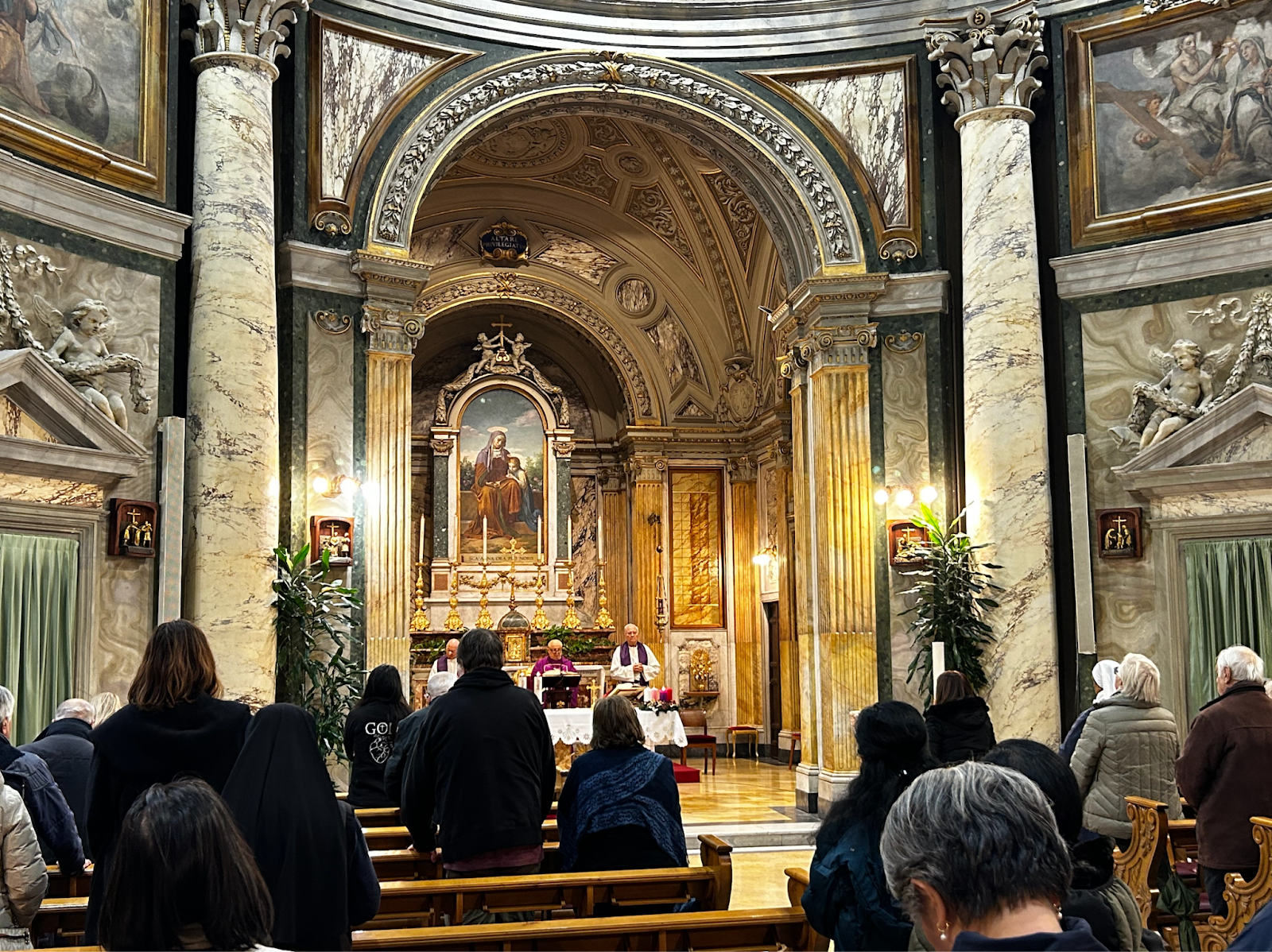
On the way, I had us pop into the little parish church of St. Anna, just blocks from St. Peter’s. I had us stop because St. Anna is a bit of trivia for me — it’s the territorial parish of the Vatican City State, and thus in a real way that pope’s own parish — and I think that’s a good bit of canonical arcana to know about.
I thought we’d be in-and-out; it’s pretty small. But I didn’t expect for my mom to have a completely unscheduled and deep spiritual experience there.
She didn’t tell us much about why — she said it had something to do with being a grandmother, like St. Anne. She’s a private person that way. But she told my dad and me that the Lord was speaking to her there, and that she wanted to go back for Mass.
That meant a slightly hurried jaunt through St. Peter’s, so we could make it on time for Mass to start. My parents still were bowled over, as anyone would be, at the pope’s own basilica — one of the most magnificent in the Christian world — but it was the little parish down the street where the Lord spoke to my mom yesterday, and I watched her respond, with tears in her eyes.
Advent is a kind of pilgrimage, even if we’re not going somewhere. And even if we don’t treat Christmas with material consumerism — a fixation on buying actual stuff for people — there is a way of framing Advent in spiritual consumerism: that we’ll have these experiences in this way on this date or at this liturgy.
I’m going to try putting that aside, and instead, try listening for the Lord in whatever way he wants to speak on the trip to the Christmas feast. It might be at exactly the liturgies I expect, with exactly the kind of warm fuzzies I expect. Or it might be something completely different than I would have hoped to curate for myself.
But that’s rather the point, isn’t it?
—
“Crazy scam?”
I have written before, and often, about balloons of all kinds — racing balloons, propaganda balloons, spy balloons, and historic balloon trips. As a guy mostly full of hot air, I’ve got a soft spot for balloons, whenever they pop up in the news.
I have never before written about smuggling balloons. But it’s a string I’m ready to start pulling.