
Pillar paid subscribers can listen to this Pillar Post here: The Pillar TL;DR
Hey everybody,
It’s the 10th Tuesday of ordinary time, and you’re reading The Tuesday Pillar Post.
Pope Leo is in Spain, and Ed and I are heading to Orlando today for the spring meeting of the U.S. bishops’ conference. I’ll get to both those things in just a minute.
But first: Pope Leo XIV celebrates next week the 44th anniversary of his priestly ordination, which took place June 19, 1982 at Santa Monica degli Agostiniani, in Rome.
Later, Leo had the unique distinction of taking Santa Monica degli Agostiniani as his cardinatial titular church — I have no idea how many cardinals eventually became the protectors of the very churches where they were ordained, but it can’t be very many, you’ve gotta figure.
And however far he’s come in the 44 years since ordination, it’s worth noting that the pope now lives a stone’s throw from that building, and until he moved in March, he lived literally across the street, in the Palazzo del Sant’Uffizio.
A few months ago, I saw Augustinians use a side door to bring a takeout order into that building. I’ve since believed that I witnessed delivery of the pontiff’s own Chinese food, and I take it as a point of pride that I like the same Vatican-adjacent Chinese restaurant he does.
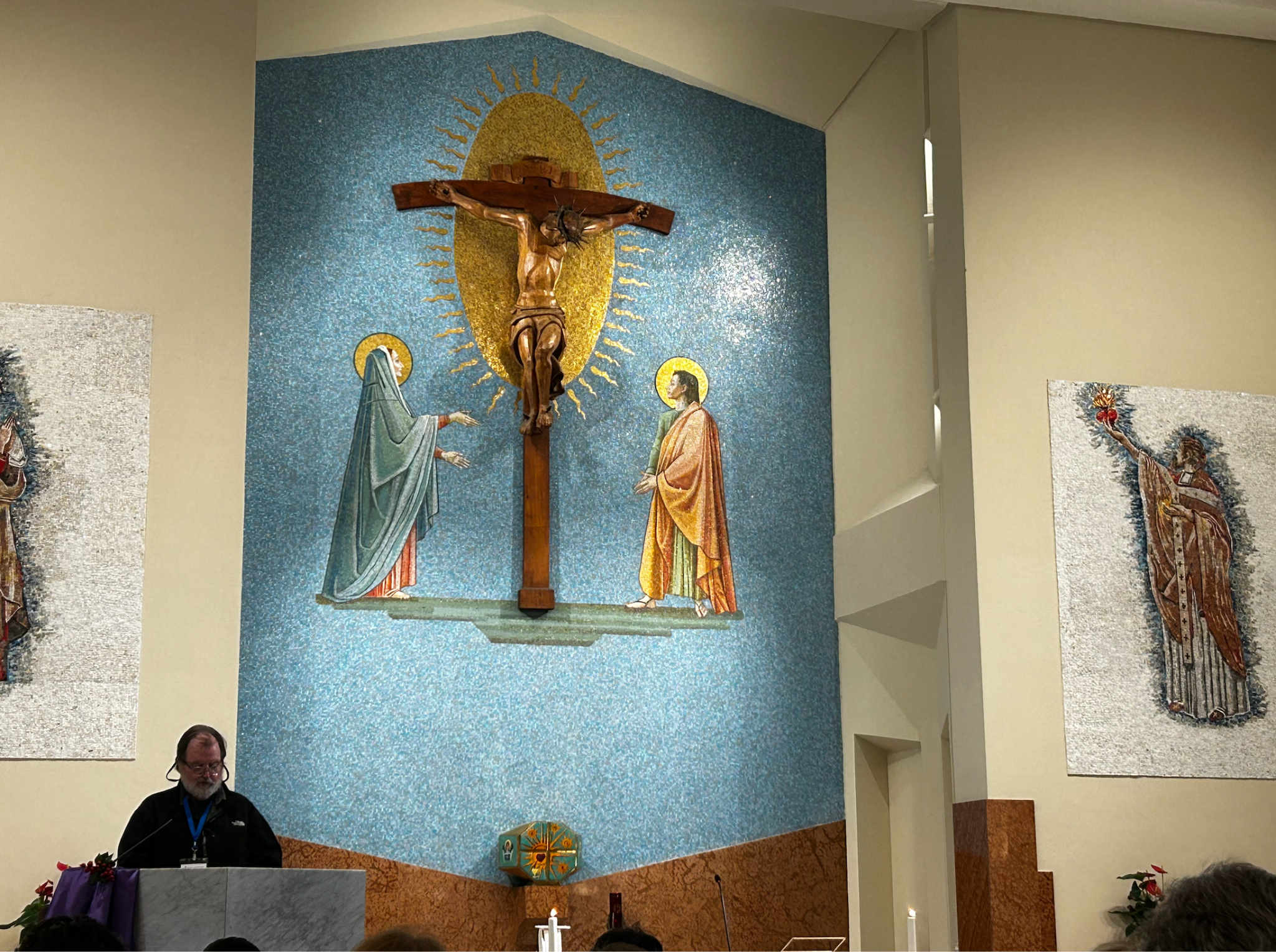
The pope was ordained a priest by Bishop Jean Jadot, a long-time Vatican diplomat, and eventually a polarizing figure in the Roman curia, who was famously not made a cardinal by JPII, despite his holding an office usually occupied by cardinals.
That’s an interesting bit of historical trivia. But Leo’s diaconal ordination offers an even more interesting one — and one that connects him to an unusual figure in American Catholic history.
Leo — then just “Robert” — became a deacon on Sept. 10, 1981, at St. Clare of Montefalco parish in Grosse Pointe Park, Michigan.
(To its credit, and to my surprise, the parish doesn’t seem to mark this on its website, while I’d be marketing the hell out of that at every opportunity.)
The ordaining bishop for his diaconate was a complicated and well-known figure in American ecclesiastical circles: His Excellency, the Most Reverend Thomas Gumbleton, once an auxiliary of Detroit.
I won’t go into Gumbleton’s whole history here, but he was no stranger to controversy in the life of the Church, to say the least — for both good (supporting victims of clerical sexual abuse), and for ill (like that his theology was often criticized as outside the bounds of Catholic doctrine.)
Of course, that Gumbleton ordained Prevost doesn’t say anything about either man, in particular — few men choose who will ordain them to diaconate, and most bishops ordain lots of men over the course of their ministry.
Instead, what struck me about the connection was how small a world the Church is, and how much of a front row to American Catholic history Pope Leo has had. For all the changes and challenges and trials of the past 40 some years, Prevost has connections — real and personal connections, often — to the players.
A pope has never had the kind of experience with America that Leo has, to say nothing of the understanding that comes with it.
I’m not sure why, but that Gumbleton ordained him a deacon crystalized that for me: He’s been just as much immersed in the life of the American Church as any of us, even if he’s spent large swaths of time elsewhere.
All the goofy stuff about the White Sox and deep dish pizza aside, the Vicar of Christ is formed from the very same Americanness of my parish, and my community, and my home, even.
He is, whatever else is true, really one of us.
In Providence, I think, and not just coincidence, he was elected pope for our 250th anniversary, and at a moment of national reckoning about what America is, and what she wants to become.
Not every word that comes from the mouth of a pope should bind our conscience, but I suspect we’d do well to listen carefully to every word that comes from this one.
And pray for him on June 19th.
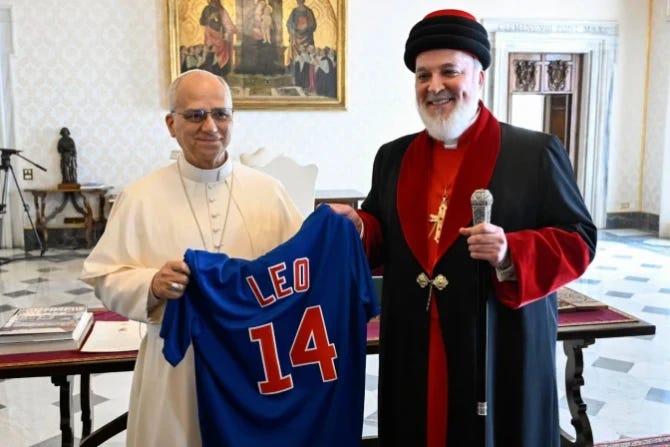
But for real, let’s stop sending so many sports jerseys. The pope has, uh, gotten the idea already.
The news
Pope Leo is in Spain right now, and by most accounts, the pontiff is hitting it out of the park.
It has already become conventional wisdom that the speech he gave Monday to members of the Spanish legislature will go down historically as one of Leo’s intellectual tent poles.
It touches on the rule of law and Christian anthropology, a just economics and politics, the ends of culture, and the transcendent destiny of every single human soul. I suggest you read it.
But for my money, the sleeper speech is the pope’s meeting with the country’s episcopal conference. Because Leo laid out to the bishops a vision for evangelization. And I encourage you to think about it, before writing it off as possibly a bit jargony, or a bit optimistic. Leo is proposing something concrete and something hard: borne of reflection on the re-evangelization of Spain by the Catholic monarchs Ferdinand and Isabella, and those who came after them.
It also calls for radical trust:
“Pilgrims often set out at night, and the initial darkness of the path can often frighten them. The vespers hymn, ‘Night is the time of salvation,’ reminds us that if we are in good company, the difficulties of the journey and the danger of getting lost are reduced. It is the Lord who leads us; he is the master of history and of each of our stories. He determines the rhythm. We walk behind him; indeed, we walk with him as members of one body.”
…
“Many men and women of our time do not directly reject God; often they carry in their hearts a deep thirst for meaning, truth, belonging and hope, even when they do not know how to name it. The Church is called to recognize these longings, to listen to them with respect, and to offer — as Peter and John did to the paralytic at the temple gate — the treasure entrusted to her: Jesus Christ, in whose name a person can rise and walk.”
But let me also mention the mostly unexpected controversy Leo’s visit has stirred up in Spain, which he seemed to resolve today in Barcelona with only a few words.
Barcelona is the capital of Spain’s Catalonia region, which shares much of the Catalan culture and language with some parts of eastern Spain, along with southern France, a little bit of Sardinia, and the tiny principality of Andorra. It is also the locale of a frequent independence movement in Spain, centered around Catalonian cultural identity and language.
And this week, the pope has been getting push from the Catalonian independence movement to speak the Catalonian language during his time in Barcelona. Separatist politicians spoke to him in English and Italian only, not Spanish, urging him that “speaking the tongue of the land that welcomes you is a wonderful act of love and respect.”
In Spain, some took that exhortation as an act of disrespect to the pope. Others expressed concern that papal remarks in Catalan would be used politically by the independence movement. Still others pointed out that the pope doesn’t actually speak Catalan, while he could speak from the heart in Spanish.
But when Leo got to Barcelona Tuesday, he spoke Catalan at least twice. He seemed already to dispel the controversy by speaking the language inside Barcelona’s cathedral, as part of his prepared remarks.
Leo has a way of dispelling controversy with humanity, and that’s a good thing for Holy Mother Church.
For myself, I must admit that I have only one brush with the tricky difference between spoken Catalan and its close cousin, Spanish.
In 2002, when I was 19, I had the good fortune to be in Barcelona for Holy Week and Easter. I went to the Easter vigil at Barcelona’s cathedral. And soon after the Mass started, I wondered if my Spanish had suddenly gotten much worse. While I’d fully expected to understand about half the liturgy, I was batting much closer to .300, or even .250.
It wasn’t until several readings that I realized the Mass was being offered in Catalan. With that realization, and having sat for several hours in the very warm cathedral, I soon after fell asleep for most of the rest of the Mass. I was in a front pew, because I’d wandered there before the Mass, and no one had quite decided to tell me it was otherwise reserved for catechumens.
Mind you, I didn’t want to fall asleep, it just happened. And I must confess, I didn’t fight it near well enough.
And that, dear readers, is how I met Cardinal Roberto Gordó. Soon after the Mass ended, he approached me, asking in Spanish (thank God!) why an American had slept in the front pew through so much of his Mass.
It was a fair question. I mumbled an answer. We took a (long lost) photo, and he, no doubt a bit puzzled, sent me stumbling into the night.
At any rate, Catalan is not Spanish, and the pope doesn’t speak it, but he did a good turn to show his affection for the people of Barcelona. (And I even understood most of it.)
Meanwhile, for a good run down on the whole trip, Edgar has you covered.
—
On Friday, The Pillar brought you the stories of Major League Baseball chaplains — the priests bringing the sacraments to the big leagues.
“Most of these guys are in their 20s, early 30s, when a lot of people in the Church tend to step away from their faith,” one clubhouse chaplain told The Pillar. “They’re successful or making a lot of money, so many times faith gets relegated to the background. Our presence there helps them to keep practicing the faith.”
This is a good story. And these guys (and these guys alone) can keep bringing the pope jerseys, if that’s what they want to do.
—
Bishop Osório Citora Afonso was killed by gunmen early Saturday morning in his residence, in the city of Quelimane, Mozambique, The Pillar reported Saturday.
Early reports indicate that the gunmen scaled building walls, disabled a security system, and shot the bishop in the chest with a Kalashnikov.
In other words, the killers are unlikely to be a couple of local kids in a robbery gone wrong. Whatever happened was decidedly more sophisticated than that.
But by Monday, there were few leads, which is why we reported then that African bishops have demanded a thorough investigation into a killing that some locals believe could have been perpetrated by organized Islamist forces, organized crime cartels, or political factions.
A bishop has been killed, it looks like an assassination. Pope Leo has expressed “deep sorrow.” Read the latest.
But while local representatives say that audit protocols are effective, one expert has questioned hiring practices, after it emerged that the employee was hired to work with vulnerable populations despite having an extensive criminal history, involving violent crimes and the use of multiple different social security numbers and birth dates.

For the first time in over 50 years, the Church in the U.S. will begin praying a new translation of The Liturgy of the Hours. Ascension is designing an edition with exceptional readability and top-of-the-line materials to faithfully serve the Church’s daily prayer for generations. Preorders open July 1.
Finally, the U.S. bishops are set to vote this week on a revised version of the Dallas Charter, the document first published in 2002, and formally entitled the “Charter for the Protection of Children and Young People.”
The charter was published as part of the bishops’ response to the 2002 revelations of abuse and cover-up in the life of the Church. It does not constitute particular law, it is instead a moral agreement among the bishops, committing to certain standards for safeguarding and in allegations of misconduct.
The text has been revised before. But in some corners, expectations were high for a broad rethink in the current amendment cycle, given the lessons the Church has learned about abuse of all kinds, including that involving adults, and given the broader calls for episcopal accountability concerning both sexual misconduct and the proper handling — or not — of allegations.
The version up for a vote this week is, from my perspective and Ed’s, something much closer to a tweaking than a rethink. Some of the tweaking has long been called for — including a broader moral commitment to due process — but it is not a systematic revision of the whole thing.
I’d point out a couple of things.
First, despite the much broader sense of abuse we’ve had in the Church since 2002, the Charter remains explicitly focused on the abuse of minors. It’s important to focus on the abuse of minors. But the bishops’ charter can be about whatever they’d like it to be about, and it’s not clear why they’ve chosen to limit the scope of their moral agreements on safeguarding to this singular element of a decidedly more complicated picture.
They should expect questions about that in Orlando (at least from us), and I wonder if it will be an element in the actual discussion of the text, or explained when Bishop Barry Knestout explains the revision work to his brother bishops.
Second, while the revised text makes some pledges toward transparency of information, it does not offer specific commitments to release information about allegations and their handling, even those including bishops. It mostly goes unspoken these days, but it should be remembered that in 2018 and 2019, bishops often punted on releasing information related to Theodore McCarrick, and other episcopal scandals, sometimes citing temporary legal obligations to keep information unreleased.
Eight years later, it’s worth asking whether those temporary circumstances have actually become permanent, or whether it’s just no longer in demand that bishops release important information about the history of governance in their dioceses.
In either case, there is no mention of this in the revised charter.
Finally, a charter text singularly focused on how bishops will handle allegations of child abuse made against their clergy — like the draft under consideration — does not require bishops to address the question of how they’ll act when they are themselves the subject of allegations.
That’s the reason, seemingly, that the charter doesn’t mention contentious questions — like why bishops don’t generally remove themselves from ministry during Vos estis lux mundi investigations, given that priests are removed during analogous investigations. Or, more basically, why Vos estis investigations go 99.9% of the time officially unacknowledged, with whistleblowers facing pressure not to speak publicly, despite the intention of Vos estis being public accountability and transparent governance.
Again, the bishops can make a charter of moral commitments about anything they want. The 2002 version was a step at addressing the issues which had emerged to that date. But for some reason — which the relevant committee chair has declined to clarify — that issue now seems frozen in amber, with no charter to address the ones which have emerged since, most especially in 2018.
In 2018, Knestout urged that “discussions which took place during the U.S. Conference of Catholic Bishops [meeting] about bishops’ accountability regarding clergy sexual abuse will be the foundation for concrete action — not only for the Church in the United States, but for the Church universal.”
The charter revision might have been the occasion for that concrete action, in the form of a moral commitment from bishops on specific issues of episcopal accountability. In its current form, that potential seems unrealized.
But whether bishops will raise that objection down in Florida remains to be seen.
And by the way, you don’t have to take our word for any of this. The Pillar’s Luke Coppen has done yeoman’s work creating side-by-side versions of the current version of the Charter, and an edited version sent to bishops ahead of the spring meeting this week.
Varia
Ok, a couple more things from me:
Ed and I are leading a pilgrimage to the September beatification of Venerable Fulton Sheen in St. Louis.
The idea for this came from a pilgrim on our 2025 Rome trip, who said the way Pillar does pilgrimages is great: We aim to make everything easy for you, we focus on common prayer and common friendship, we’re pretty laid back, we eat and drink well, and we have a lot of fun.
Really, the beatification of Fulton Sheen will be a historic moment in American Catholicism. There are lots of ways to get there. The Pillar trip will include a trip to Peoria, to venerate Sheen’s tomb, and will aim to get you as close to all the action as is possible. If you want an easy pilgrimage with minimal planning on your end, and — more to the point — if you want to hang out with fellow Pillar readers in a good way, come with us.
We’re entrusting the whole thing to Our Lady, and we think it’s gonna be great. But you’ve got to sign up soon:
Next, you no doubt followed the controversy across the internet this week, when a YouTuber (yes, that’s a real job) posted online that he and his wife had decided to abort their baby, after a prenatal Down syndrome diagnosis.
That’s not an uncommon decision. At least 70% of babies diagnosed prenatally with Down syndrome are killed by abortion in this country, and possibly much higher. But I was nevertheless shocked to see the widespread support the YouTuber’s family got in the wake of their announcement, and an explosion of sentiment online affirming the choice to abort children with disabilities.
An effect of the Enlightenment is a widespread belief that we can so engineer our lives in the manner we prefer as to avoid the prospect of suffering, and even of inconvenience. This leaves people who demand something of us at risk of being pushed out of our lives, and leaves for justifying even lethal means to do so.
The Church has to stand in witness to a different reality. And that means, when it comes to people with disabilities, that the Church must really have a preferential option for them — choosing intentionally to place them at the center of our parishes, in order to counter the challenges to their dignity, and their right to life.
The same is true for our schools. And when Catholic schools and their supporters insist that it’s too great an inconvenience to enroll such children, or that it will come at too high a cost for typical children or the parish bottom line, they affirm the narrative that loving inconvenient people placed in our midst is a legitimate option, but so is excluding them. The consequences of widespread cultural affirmation for that narrative are obviously lethal.
Which is why I want to tell you about a milestone at Immaculata Classical Academy in Louisville, Kentucky.
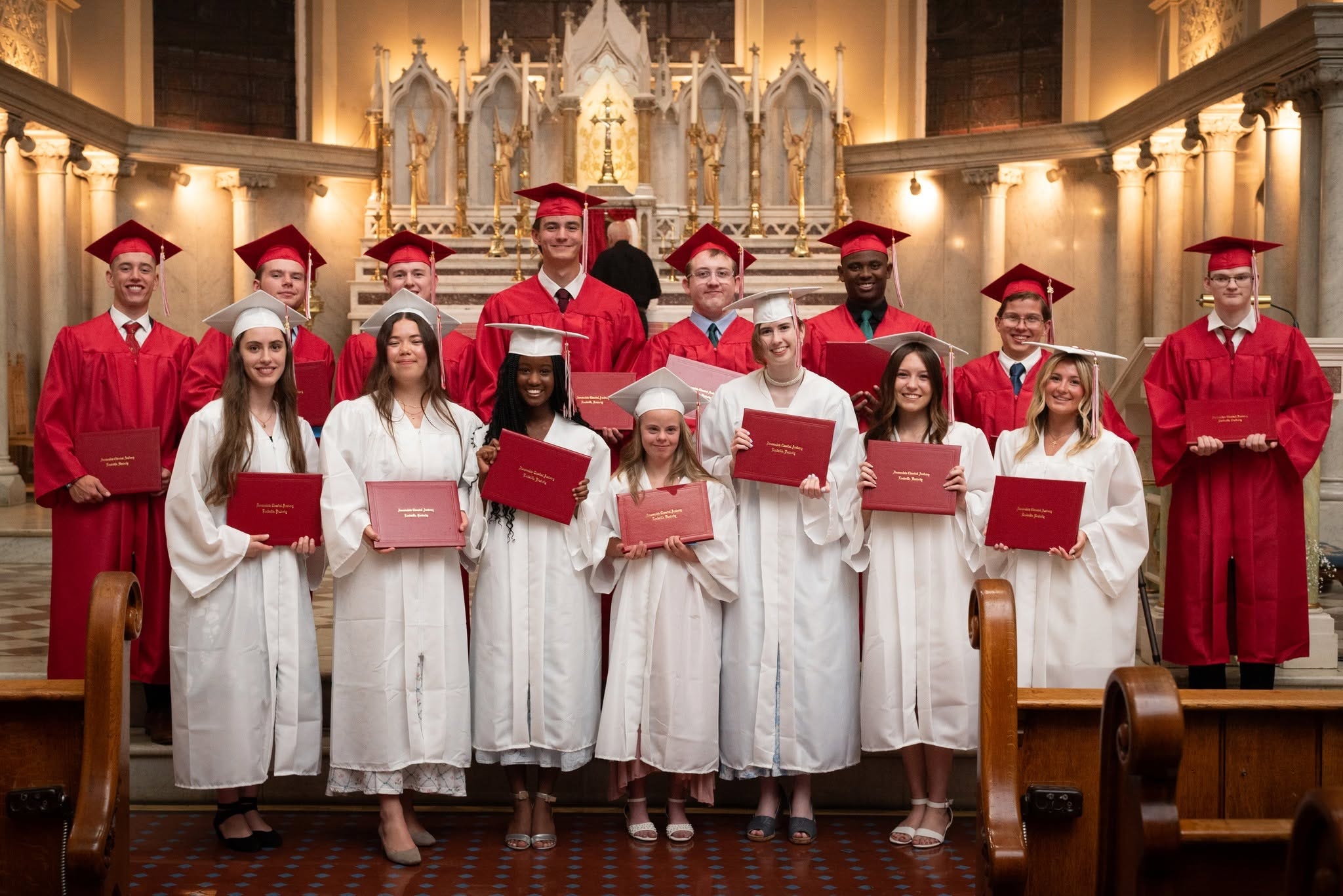
It’s a great accomplishment for Angela.
But here’s what you need to know. Immaculata Classical Academy is not a tony school with excess cash to drop on whatever suits its fancy. I’ve been there. I think it’s fair to say Immaculata had hardly two pennies to rub together, and is reliant on people of good will making real sacrifices, and on the dictates of Divine Providence.
And Angela is not unique there. Immaculata might have one of the highest concentrations of students with profound disabilities at any Catholic school in America. They’re in most classrooms, learning alongside their typically developing peers. I’ve observed them instructed in the liberal arts, in sacred music and art, in history and literature. I’ve seen them make meaningful friendships. I’ve seen them play kickball pretty damn well.
The news this week is that the world is hostile to people with disabilities, and the inconvenience they seem to represent. If such people have the dignity we say they do, the Church must make herself their home: Both because they are in need of a holy refuge, and to show the depth of Christ’s love.
—
Finally, whatever Pope Leo does on his ordination anniversary next week, I doubt he’ll go to an opening night showing of “Toy Story 5,” which convenient for him, hits theaters June 19.
No doubt, a great many people will hope publicly that the pontiff see the movie, whose franchise has taken on a weirdly crypto-mythic status in our culture, and whose predecessors are often hailed as “beautiful” works of art.
You’ll forgive me, reader, or maybe you won’t, if I dissent from the American orthodoxy on the Toy Story universe. Toy Stories are neither masterpieces of storytelling nor film-making; they’re two trick ponies, dependent on cheap nostalgia and our looming fear of death.
“JD,” you’re saying, “stop being a curmudgeon. Toy Story is about friendship, and growing up, and Learning. Life. Lessons.”
Maybe the first one. Maybe even the second one.