
Paid Pillar subscribers can listen to JD read this Pillar Post here: The Pillar TL;DR
Hey everybody,
He is risen!
At our house, that means Kate and I are still basking in the graces of the Easter Vigil, while our children stagger around in near-constant sugar comas, leaving little piles of Reese’s wrappers or unwanted jelly beans wherever they happen to sit.
Christ is risen, and we are in full celebration mode: I even took most of a day off yesterday, and Kate and the kids have a full week of daily excursions planned during their Easter break.
Christ is risen.
And right now we are witness to the humanity so beloved by God he assumed it — witness to its full spectrum; to its extraordinary capacity for good, as astronauts slingshot around the moon and remind us to be moved by wonder; and to its dismaying capacity for violence, as the world’s powers charge us more deeply into war.
I have been this week astounded by the images of our own universe coming from Artemis II, moved to marvel at God’s own creation, and at the amazing gifts of creativity and capacity he has bestowed on us, his children.

I am at the same time, like a growing number of Catholics, disquieted by the president’s threats that “a whole civilization will die” if Iran does not acquiesce to our administration’s demands — which even if it is only blustery rhetoric, is a chilling method for geopolitical negotiation.
In light of the scope and scale of human achievement — for good or for ill — it is for me the most challenging aspect of faith to believe that one man, Jesus of Nazareth, can actually be the focal point of history, the protagonist of the entire human story.
And yet that’s what Easter is: The memory and experience of an event completely unparalleled, in which Jesus of Nazareth defeated the great certainty and singular foe over whom no other human could have mastery — death itself.
If the resurrection is not true, Christianity is nothing — a pointless faith, a collection of rituals and aphorisms. Christianity ties together only in the empty tomb; it makes sense only in his glorified body.
But if the resurrection is true, then we can believe with real certainty that there is nothing Christ can’t overcome, or transform, or set free.
And that gives meaning to prayer. We can pray earnestly for a change in the world because we know that by the resurrection of Christ, anything is possible. We can pray for peace, and hope for its coming. We can pray for a triumph of truth.
And we can believe in something which defies nearly all available evidence about human behavior: We can believe in a civilization of love.
The weirdest part for me is that because of the resurrection, we can believe that God has some unique, particular, and singular role for each one of us to play in the accomplishment of his will. We can ask him to use us for good, and trust he will. And right now, it seems to me, we certainly should ask that of him.
Happy Easter. He is risen.
The news
News broken by The Pillar this morning: The Archdiocese of Atlanta has asked the Vatican to consider it as a prospective host for the 2030 World Youth Day.
If selected, Atlanta would be the second U.S. city to host World Youth Day, and would almost certainly host a papal visit too during the global youth gathering.
The bishops’ conference did not disclose publicly its decision to cut initially suggested amounts for victims, which were slashed with cuts believed to be as large as 50 percent.
The Pillar’s investigative reporting broke Tuesday morning, and you’ll want to read it now, because it is sure to portend a firestorm among victims and advocates.
And there’s been a lot of talk about a surge of converts to Catholicism this year. But for all the anecdotal experience, it’s been hard to put numbers on what exactly is happening.
Enter Brendan Hodge: The best Catholic data analytics journalist we know.
Brendan’s run enough numbers to see the trend for what it appears to actually be — a major rebound in the number of Catholic conversions since Covid, but still mostly a decline since the year 2000.
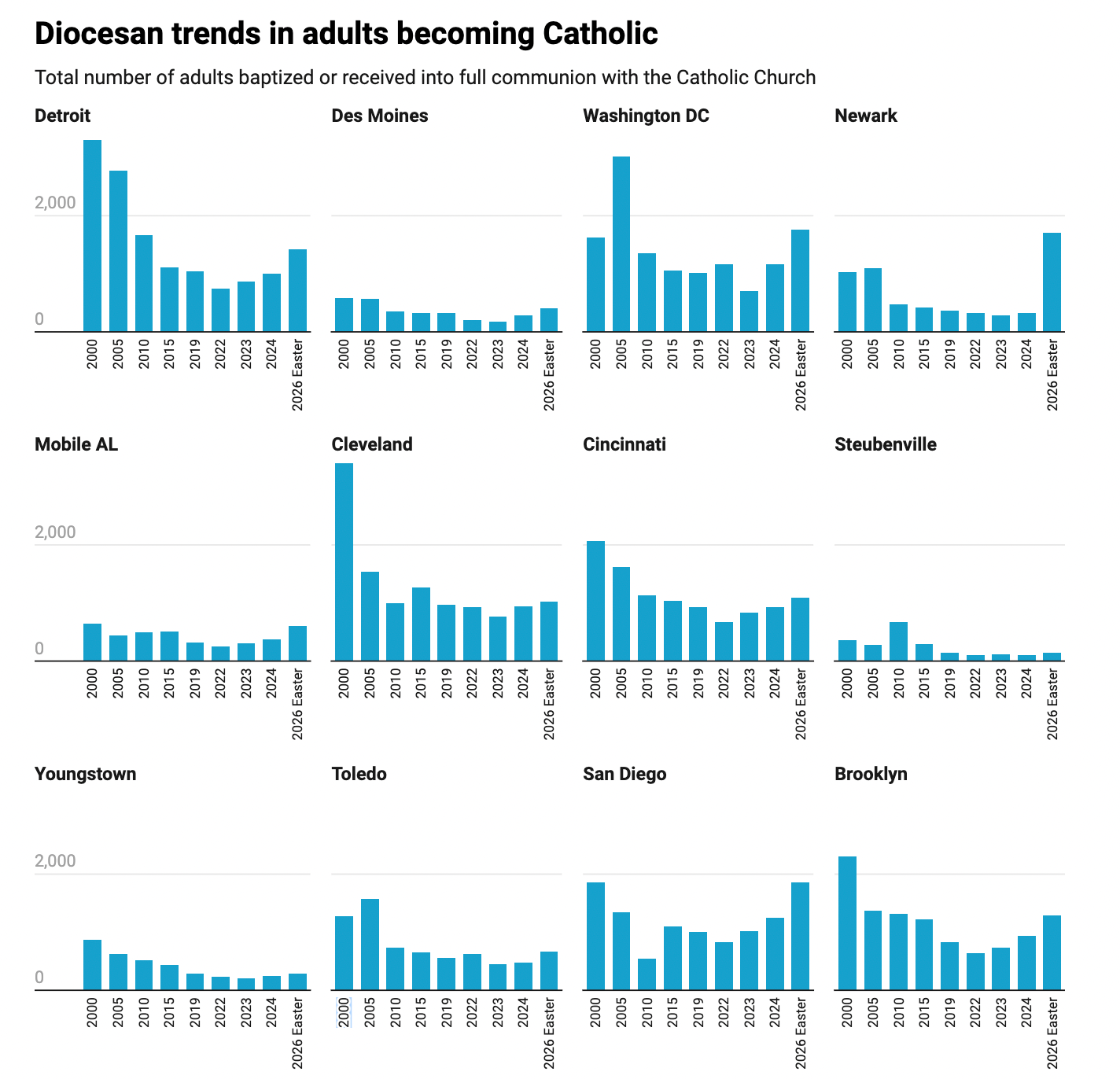
The real question is how high the rebound might bounce, and whether the Church can expect numbers of conversions to continue growing year-over-year. Further, it’s worth asking how the number of adults becoming Catholic will compare to the massively declining number of annual infant baptisms in the U.S.
The proposed legislation would grant the government powers to take control of foreign-funded assets when an NGO’s registration is canceled or lapses. It triggered alarms especially among Church leaders in Kerala, because the southern state has a large network of Christian schools, hospitals, and charities that depend on funds from outside of India.
En garde
Like a lot of 8-year-olds, my son Daniel is the sort who sees swords everywhere. Any broomstick, fence picket, pvc pipe, or fallen branch under about 4 feet long becomes in his hands either a broadsword or saber, depending on its length and thickness, and he runs off in search of dragons or villains to defeat in combat.
He started with lightsabers, of course, but decided at some point that lightsaber duels were just contrived bits of choreography, uninteresting because combatants seemed rarely to be trying to win so much as trying to pull off the coolest dance moves while clashing their blades with that of their opponents.
He moved from there to the great Spanish swordsman Inigo Montoya, and the dashing heroics of our swashbuckling relative, Errol Flynn.
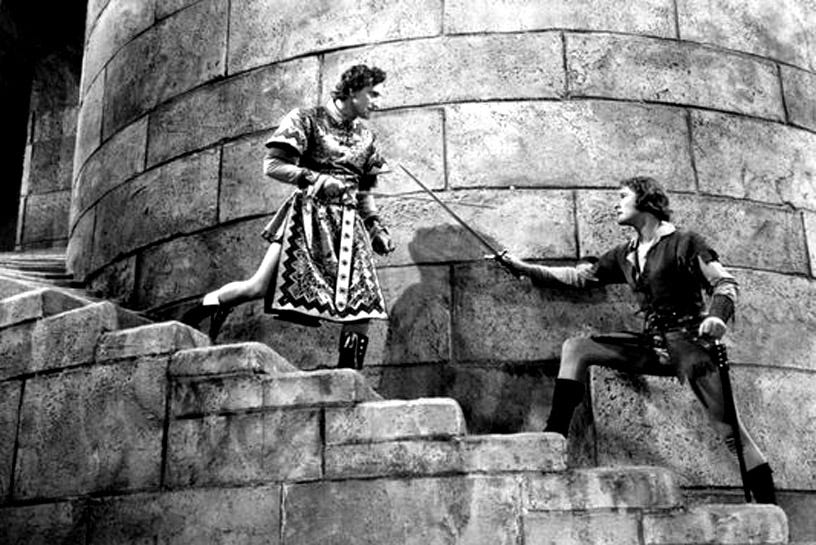
My son, being a bit extra, started about six months ago asking us for his own “real sword.”
I put him off at first by telling him he was too young to join the fourth degree of the Knights of Columbus. While that cracked me up every time I said it, he didn’t seem to get the joke.
So instead I eventually told him that he couldn’t have a real sword until he learned how to use it. Which is how he ended up registered for fencing lessons this summer, which he says will be “helpful” with giving him better footwork in baseball, and also in case the honor of our family should be challenged by some dastardly dueler.
In any case, I’m happy to have him fence, since organized swordplay probably keeps kids off the streets. Plus, I’m fascinated to learn what the subculture of fencing parents looks like, even if I’m not among the parents wealthy enough to bribe my kid onto an Ivy League team via sketchy real estate transactions.
If nothing else, it turns out Notre Dame is the national fencing champion, and I’m pretty sure I’d be ok with my kid studying under the Golden Dome, especially since things are cleared up now at the Liu Institute for Asian Studies.
But we’ve been watching fencing, my son and I, and we discovered something we didn’t expect at all.
The world’s most prominent armed martial art is terribly boring. I mean, for a game played with sharp swords, fencing is really, really dull.