
Pillar paid subscribers can listen to JD read this Pillar Post here: The Pillar TL;DR
Hey everybody,
Near the Lateran basilica in Rome there is a marble staircase, covered in wood, which pilgrims climb on their knees.
At the top is a small chapel dedicated to St. Lawrence, though that’s not why people come, and few people visit the little space for very long.
They come instead because of the historical legacy of those stairs, the scala sancta, which custom says are the stairs of Pilate’s praetorium in Jerusalem, climbed by Christ the Lord on his way to trial, shortly before he climbed Calvary.
The custom says, too, that the stairs were brought to Rome in the fourth century by St. Helena, the possibly-English princess who was the mother of Constantine, who went to Jerusalem in her 70s, and is said to have discovered the true cross of Christ, among many other relics.
That custom has made the stairs a place of deep devotion for Catholics on pilgrimage to Rome; a place that feels physically connected to the passion of the savior.
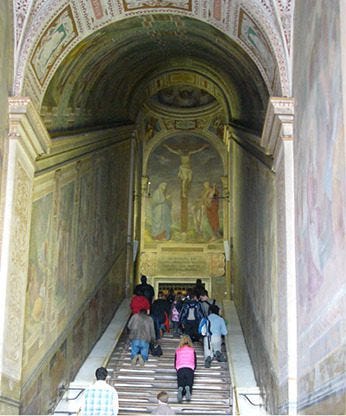
Tracing each step of the stairs’ provenance isn’t easy. The actual staircase seems to have been installed in the Lateran Palace for hundreds of years before they became in the Middle Ages — starting sometime in the 1000s — associated with the steps of the Lord’s passion.
In 1589, they were moved in a solemn procession to their current location, and reinstalled in reverse order — with the original bottom stair installed at the top of the current staircase — so that workers’ feet would not touch them, and they became thereafter the locus of Christian pilgrimage.
The marble itself does not say much about the stairs’ origin — it’s not especially uncommon stone, and doesn’t convey definitively where it was quarried and cut.
Do the stairs come from Jerusalem? Did Christ the Lord climb them to endure his trial before Pilate?
We don’t know. It’s certainly possible. And it’s enough for me, as with many relics of that era, to remember the centuries of pilgrims taking those stairs as a kind of sacramental, a place which calls to mind that Christ was really a man, who really came into this world, and who really climbed the long pilgrimage into Jerusalem, and then to Pilate, and then to the cross.
The stairs are a connection to Christ, and at the same time, a connection to generations of Christian pilgrims in a Christian city; they are a witness to most of Christian history, unfolding from the city in which they stand.
And I suspect that whether she brought the stairs to Rome or not, Helen intercedes for the pilgrims who climb the scala sancta.
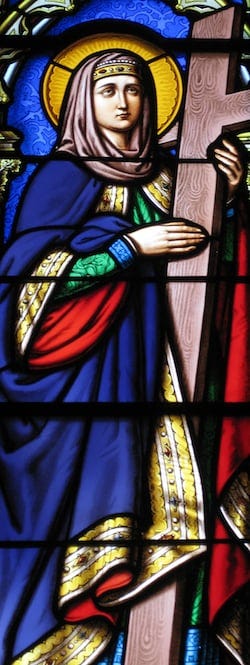
On St. Helen’s feast, let me recommend to you the Evelyn Waugh novel “Helena,” a fictionalized account of the queen’s great life.
It’s not typical Waugh — it’s not especially funny, it’s more earnest than ironic, it doesn’t even explore the pagan potentiality of male friendships between men, for that matter.
But Waugh thought it was his best novel, and in part because it was a love story to a woman he’d come to know across time.
And he said the takeaway from St. Helen’s life “is something about the workings of God, that He wants a different thing from each of us, laborious or easy, conspicuous or quite private, but something which only we can do and for which we were each created.”
May St. Helen intercede for us, as we — each one of us — search for Christ and his cross, and discover the work for which we were created.
The news
Lord David Frost, CMG, is a British politician and diplomat who is well known in the United Kingdom as the man who negotiated the terms of Brexit.
He has also recently become Catholic — and, surprisingly for one of Britain’s most well-known politicians, he came into the Church through the ordinary OCIA program at his local parish, with no special treatment, or VIP fast-track, or anything of the like.
Having entered the Church, Frost said recently that he’s “maybe only halfway down the road” of being formed to live and think and act like a Catholic.
He said that to our own Ed. Condon, who sat down with Frost recently for an absolutely scintillating conversation on the “consequences of Christianity.”
You can listen to that conversation right here.
—
And speaking of politicians, the advocacy group CatholicVote made headlines this week, by calling for the excommunication of the Massachusetts governor who signed into law a bill permitting doctors to perform late-term abortions when they judge them necessary.
In an open letter to the Massachusetts bishops, the group said that Governor Maura Healey should be judged an “accomplice” in abortions in the state, and thus declared excommunicated. And that open letter got a lot of attention.
I don’t think that’s going to happen, because the notion of being an “accomplice” is a strictly circumscribed thing, which must pertain to a particular canonical crime — in this case a particular abortion — and the canons governing that are required to be interpreted “strictly.”
And after that went to print, I was reminded by a canonist-friend of another possibility — that a politician like Healey, or any other enabling policy in grave defiance of Catholic morality, could face canonical sanction under the prescripts of canon 1368, which allows for a “just penalty” to be imposed when a Catholic in public “gravely harms public morals.”
Advocacy for doctor-regulated late term abortion would seem to fit the bill of grave harm to our public morality, and thus, in principle, a competent bishop could initiate canonical proceedings on that front. I’m not aware of any case in which a Catholic politician has been sanctioned with that norm — and indeed, setting the precedent might open a floodgate, because it’s hard to think of many Catholic politicians who don’t, on one front or another, bring some grave harm to public morality.
But the point is clear — while the CatholicVote approach doesn’t seem to fit with the law’s dictates, there are numerous canonical options available to the diocesan bishop who believes that sanctions and disciplinary measures might call a wayward Catholic pol to conversion, and address the public scandal of their conduct.
In recent years, Archbishop Salvatore Cordileone utilized one such option with Rep. Nancy Pelosi. His path is one of several possibilities made available to bishops — if they choose to use them.
It’s commonly said, by the way, that when bishops don’t so choose, it’s obviously because of some kind of cowardice, a desire not to make waves, or to put their heads above the parapet.
There’s something to that. And the issue of scandal — a grave moral offense going unacknowledged by bishops — is real.
But even very conscientious bishops have a discernment to make about how to balance the scandal question with a proper assessment of what pastoral methods will effect conversion in the actual people they’re dealing with. And, again, for good bishops of conscience, that’s more art than science, and more genuine Christian discernment than either.
How should the bishop respond? How does he consider both the salvation of the individual and the harm done to a community? There are cases in which the law is clear about what should be done, and there are cases which are left up to the pastoral judgment of the bishop. Those aren’t always as clear cut as “courageous-vs-cowardly.” So pray for the bishops called to make those discernments.
Anyway, I hope this explainer helps.
(And before we move on, please let me acknowledge the idiocy in the room. Ours. Our initially published version of this explainer indicated that the capital of Massachusetts is Springfield. It’s not, obviously. Massachusetts is one of the 17 U.S. states whose largest city is also its capital. But we were so confident in our initial error that we didn’t even fact check the mistake until we published the thing. And then you guys noticed.
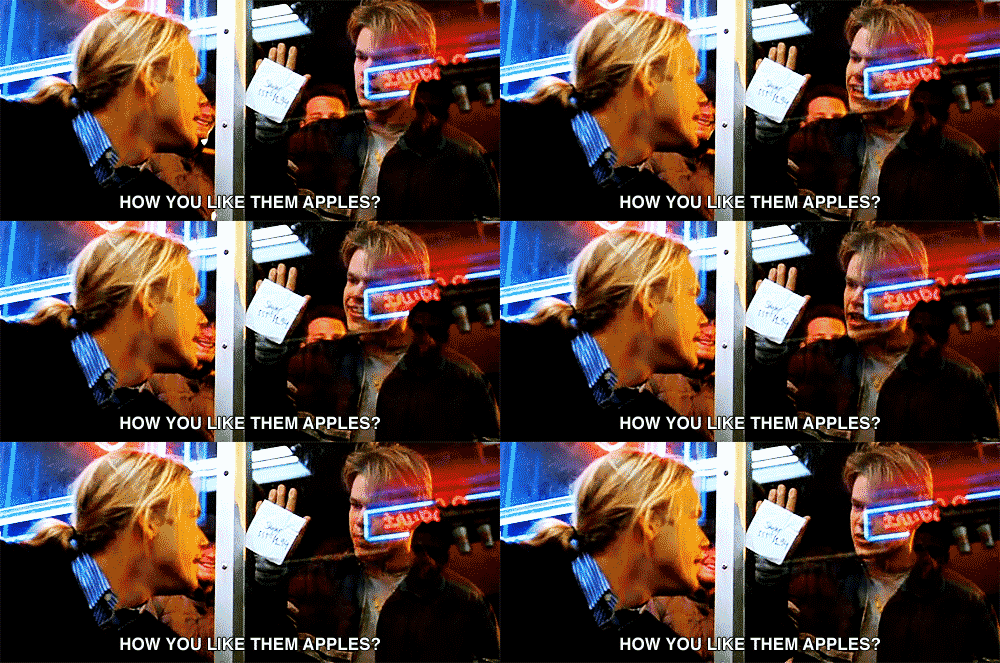
So, yes, that was probably the dumbest mistake we’ve made as journalists. But as they say in Boston, uh… well, what do they say in Boston, even? “How you like them apples?,” I guess.)
That’s not the sort of thing which should ordinarily attract your attention, except for this: Longo is a Freemason. And not just any kind of Freemason — he’s reportedly a member of the Ancient and Accepted Scottish Rite of Freemasonry, which is like one of the most O.G. and hardcore versions of Freemasonry — and can boast among its membership the guys who founded the Ku Klux Klan.
This is the kind of Masonry whose high-level initiation rite features a skull wearing a papal tiara.
So with a guy who reportedly belongs to that club appointed to a Vatican committee, you’ve gotta ask whether the Church actually cares anymore what its law and history says about Freemasonry.
And if someone’s going to ask that, it’s going to be Ed. Condon, our resident Mason expert.

Are you looking for a flexible, online degree to deepen your faith and advance your career? The University of Mary offers Pillar subscribers scholarships of up to $10,000 toward qualifying programs, including the MBA, Master of Organizational Leadership, MBA/MA in Philosophy, and MA in Applied Catholic Theology. Learn more and apply at pillar.umary.edu.
Pope Leo XIV and Latin Patriarch Cardinal Pierbattista Pizzaballa drew attention this weekend to the plight of civilians in the West Bank, the Palestinian territory west of the Jordan River.
They especially drew attention to the Christians in the West Bank village of Taybeh, which has faced a crisis in recent years, for a constellation of reasons.
Here’s a peek into what’s going on there.
—
And six weeks ago, an 80-year-old Nicaraguan bishop was taken into police custody, and more-or-less barricaded into a kind of de facto house arrest, without actually being accused of any crimes.
He appeared last week in an interview on a state-controlled TV station, claiming that he is being treated very well.
On the other hand, what else would you say during an interview on a regime-controlled TV station?
The troubles for Bishop Abelardo Mata began when he preached a homily critical of the state’s anti-Catholic persecutions. His treatment thereafter would seem to confirm the substance of the criticisms.
Pray for Bishop Mata, and read about his situation here.
—
Pope Leo last Friday urged Catholics to fidelity to liturgical rubrics, and a formative approach to worship aimed at ensuring that “through proper education and reverent worship, Catholics will be formed both for the liturgy and by the liturgy.”
The pope’s words came in a letter addressed to Cardinal Arthur Roche, the prefect of his liturgical office, and to those attending a liturgical conference at Mount Angel Abbey in Oregon.
The conference, formally held as a reflection on the 2022 apostolic letter Desiderio desideravi, was announced formally by Roche’s office, the Dicastery for Divine Worship and the Discipline of the Sacraments, as a period of “joint reflection with the aim of defining shared, concrete and practical proposals” for the liturgical formation of laity and clerics.
But with Roche widely expected to be on the verge of retirement, the conference raises questions — about how Leo will use the dicastery to address ongoing liturgical questions in the life of the Church, about Roche’s future in the dicastery, and about what exactly the cardinal is up to right now.