
Pillar paid subscribers can listen to JD read this Pillar Post here: The Pillar TL;DR
Hey everybody,
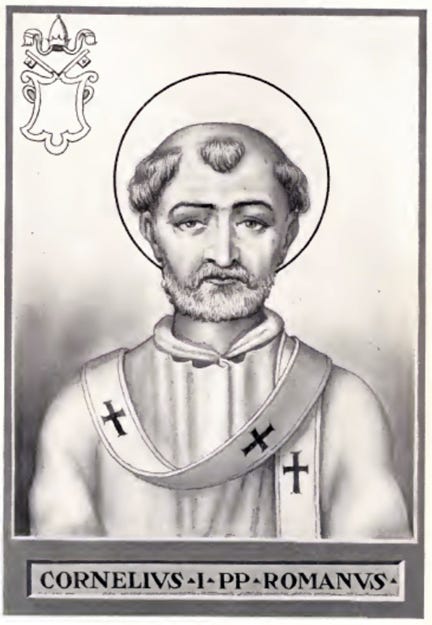
You’re reading The Tuesday Pillar Post, and today’s the feast of St. Cyprian and Pope St. Cornelius, martyrs both, and saints of mercy.
It was the third century. In the eyes of the emperor, Decius, Rome was floundering, the empire’s best days were behind it. Decius believed the empire was fracturing, that respect for Rome’s culture, her glory, and her emperor were fading. He aimed to restore Rome to its former greatness, and cement himself as the leader of a new golden age.
In 250, Decius ordered a supplicatio. The millions of Roman citizens across the empire would need to make a sacrifice to the Roman gods — burning a pinch of incense, pouring out a libation of wine, to the gods themselves, and for the emperor’s reign.
Following a long-standing Roman custom, Jews were exempted from the supplicatio. But Christians were not. (and if you’re thinking that Christians could have argued that they were grafted onto the tree of Jesse, forget it — Rome wasn’t gonna buy that, and Jerusalem wasn’t gonna support it.)
Thousands of Christians were martyred, including Pope Fabian, who was reportedly one of the first to refuse. Many more found ways to bribe officials, to get fake documents certifying that they had done the requisite sacrifice. Some fled as refugees from the empire’s reach. In some regions, there were Christians who were arrested, and tortured when they refused to make the sacrifice, but they were eventually freed.
But facing death, thousands of Christians did the thing, sacrificing to the Roman gods and for the emperor.
And that provoked a crisis for the Church.
Decius himself died soon after the persecution began, on a swampy battlefield where he fought the Goths.
That brought the persecution to an end, along with the requirement of the supplicatio, at least for five or six years.
But bishops had a problem. A lot of Christians had made the supplicatio, they had made a small sacrifice to the pagan gods of the Roman pantheon, and to the divinity of the emperor. And now they wanted to come back to Mass, and to the Eucharistic table.
Some bishops, led by the priest Novitian, said that apostates could not ever return to the full practice of the faith. He and his supporters believed that contrite apostates could make penance for the rest of their lives, and entrust themselves in death to God’s mercy, but could not return to the full communion of the Church.
Cornelius, elected pope amid the controversy, disagreed. With support from the Bishop of Carthage, St. Cyprian, Cornelius taught the inexhaustible mercy of God extended even those who had faltered at the moment of grave trial — and that by public penance, the apostate lapsi could return to the communion of the Church.
Together, they set in motion a deepened understanding of the deposit of faith, and especially the sacrament of penance.
But the Church fractured over the controversy, even as the pope brought clarity. In Carthage, Cyprian faced the opposition of laxity, where priests would reconcile apostates to the Church with no public penance at all. In Rome, Cornelius faced the Novitian heresy, which led eventually to the rise of Novitian as an antipope, a claimant to the see of Peter.
Eventually, Cyprian, the legitimate bishop of Carthage, faced opposition from both sides, with both the Novitianists and laxist group of priests electing their own bishops to his see.
And yet both Cyprian and Cornelius remained faithful to the truth: That God is merciful, and that his mercy is mediated through the ministry of his Church.
Both were eventually martyred themselves. In their fidelity, despite the fractures and schism and pain they doubtless experienced, they glorified God. They trusted in the truth, as error persisted around them.
May they intercede for us.
The news
Those agreements come after the Heydar Aliyev Foundation has reportedly given more than 1 million euros for restorations at the Basilica of St. Paul Outside the Walls, St. Peter’s Basilica, the Vatican Museums, and elsewhere.
So what’s the problem?
Azerbaijan is persistently accused of violating human rights — the U.S. State Department has accused the country’s government of torture and illegal and arbitrary killings, while the UN has accused the country of "severe and grave human rights violations” committed especially against ethnic Armenians.
Watchdog groups call that pattern of conduct “ethnic cleansing.”
So why is the Vatican such a frequent partner of Azerbaijan? Signs point to the longstanding involvement of Cardinal Claudio Gugerotti and Cardinal Gianfranco Ravasi in the relationship. And the country, along with its government-affiliated foundation, has money to spend, while the Apostolic See is increasingly broke.
But for their part, human rights advocates are crying foul.
—
She is also running for President of Ireland.
At least, she’s trying to. Steen, not the nominee of a major party, faces an uphill battle for ballot access, despite her name recognition.
But in many corners, her candidacy is being taken as a litmus test on a key question: In heavily secularized Ireland, can a practicing Catholic still find a place in national politics?
That remains to be seen. But the answer matters.
—
The resignation has gotten widespread public attention, because it threatens to test the fragile peace which has emerged in recent weeks in a long-standing controversy of the Syro-Malabar liturgical rites.
But the question is this: Is this the last gasp of rebellion against the Church’s authority, or a sign of fomenting discontent with a Vatican-back compromise over a very deep liturgical disagreement?
That remains to be seen. But it ain’t all over quite yet.
—
The essay — a commentary on Diversity, Equity, and Inclusion policies — was seemingly drawn from a homily Campbell gave in February, but it was published without context on the USCCB website, leading some Catholics to ask what it was — what authority it had, whether it spoke for the conference or the subcommittee, and how it had come to be published.
So with Catholics asking questions, The Pillar looked into it — and according to a USCCB spokesperson, the essay was a draft “personal reflection” from Campbell, published by mistake.
—
Mozambique is a Portuguese-speaking East African nation of almost 35 million people, about 55% of whom are Christians.
There is a growing Muslim presence in the country’s north, and with it, a growing Islamist militia presence, which have in recent years taken to targeting Christian sites, destroying churches and missions, beheading Christians, and in 2022 executing an Italian Comboni missionary sister.
But Mozambique’s army has proven itself unable to find a military response to the jihadi terrorists, nor have Rwandan troops fighting the same problem.
Which is why Mozambique Archbishop Inácio Saure told The Pillar this week that he does not “believe in a military solution” to the problem, which he says brings only “more death.”
So what can be done? “We need to help all those involved, including the ones doing the fighting,” the archbishop said.
And he believes the country has a powerful intercessor — Sister Maria Coppi, executed by Islamist insurgents in Cabo Delgado in 2022.
“I presided at her funeral Mass,” the archbishop said. “I believe she is interceding for peace in Mozambique.”
—
Meanwhile, the vice-president of Brazil’s bishops’ conference told The Pillar last week that he believes Trump administration tariffs on his country were aimed to interfere in the criminal trial of the country’s former president Jair Bolsonaro.
That interference, he said, is “unacceptable.”
In fact, the bishop had very strong words about politics in his country, and in the USA.
We report, you decide, so read up.
—
And from our columnists:
Stephen White on the generational moment of Charlie Kirk’s assination.

For the past 28 years, Logos has brought together scholarly authors and eager readers to engage with the beauty, truth, and vitality of Christianity as it is rooted in and shaped by Catholicism. Published by the Center for Catholic Studies, University of St. Thomas (MN). Read/subscribe via Project Muse or PDC.
Mining the moon
Back in June, I told you guys about the U.S. decision to sell off the federal Strategic Helium Reserve, and the broader U.S. concerns about a helium shortage that threatens MRI machines, and the coolant used in our biggest supercomputers.
While we’re running low on helium, China, Russia, and Iran have a lot, but they’re not keen to sell it to us.
Which is why a Finnish tech firm signed recently a $300 million contract to buy moon-mined helium from U.S. commercial space company Interlune.
That’s right. Helium mined from the moon. There’s a purchase order out there to buy it, and a company planning to mine it.