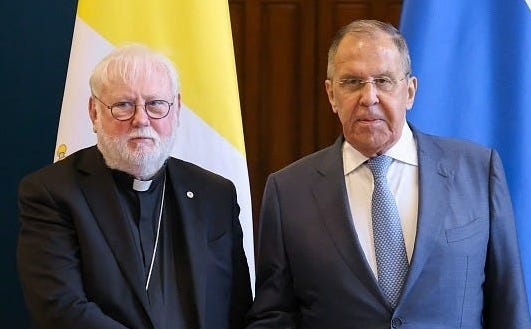
The Holy See’s chief diplomat has been in Moscow this week, meeting the Russian foreign minister. Both men offered sober but broadly positive sounding statements following the meeting, as the Vatican continues to push for peace in Eastern Europe.
But even as the Russian minister was praising the Holy See for its diplomatic efforts, government propaganda efforts were pushing out conspiracy theories about Vatican finances, and spinning the Holy See’s peace efforts as a bid to curry Western political influence and funding.
The stark duality of output from the Russian regime would seem to illustrate several things at once – the unreliability of the Russian government as a diplomatic party and the amount of moral credibility the Holy See has staked on trying to engage with it, the most obvious among them.
But, ultimately, the dissemination of anti-Vatican conspiracy theories by Moscow’s proxies could be proof that the Holy See has achieved one of its most obvious but unspoken diplomatic priorities — to be taken seriously.
—
Archbishop Paul Gallagher, head of the Vatican secretariat for relations with states, told press after meeting with Sergei Lavrov that, four years after the invasion of Ukraine, the Vatican continued to “offer our good offices in any way that can help, in the hope that the much-desired peace can be achieved as soon as possible.” Lavrov, in turn, characterized the diplomatic dialogue with the Holy See as one of “trust, friendship, and pragmatism.”
Since the beginning of the Russian invasion, the Vatican has gone out of its way to become not just a leading voice for peace, but a diplomatic player in trying to broker an end to violence.
In 2023, Pope Francis made a series of sometimes cryptic public statements about discreet negotiations and tentative peace plans, coupled with sometimes dramatic public announcements, like the appointment of Cardinal Matteo Zuppi as a roving personal papal envoy.
Alongside this kind of traditional dialogue, the previous pope used his public appearances and private meetings to attempt to place the Vatican in a unique position to serve as a broker for peace, avoiding clear denunciations of Russia as the obvious aggressor and emphasizing the suffering inflicted by the conflict on all concerned.
This balancing act was not always successful and occasionally left the Vatican looking as though it was being universally antagonistic, rather than conciliatory, variously warning Russian Church officials about being “altar boys” to president Putin and provoking outrage among Ukrainians by seeming to equivocate between their suffering and those of Russian soldiers.
In his statements this week, the Russian foreign minister appeared to acknowledge the Vatican’s efforts to walk a thin line, and avoid appearing to take sides in the conflict, despite the clear role of Russia as aggressor, praising Rome’s “balanced position on the situation in and around Ukraine” and noting the Vatican’s diplomatic “pragmatism.”
“We reaffirmed our high assessment of the Vatican’s active involvement in resolving a number of acute humanitarian issues arising from the conflict in Ukraine, as well as our mutual commitment to continuing bilateral cooperation in this area, including on the extremely sensitive ‘children’s dossier,’” he said, referring to the thousands of Ukrainian children forcibly relocated to Russia after the full-scale invasion in February 2022.
However, while Lavrov was stressing the effective working relationship he has with the Vatican’s diplomatic department and praising its “humanitarian” priorities, Russian propagandists were pushing out an alternative view of the Holy See.
The website Russia’s Pivot to Asia purports to be “a politically neutral news and statistical portal” which claims to be “written by academics and experienced regional businessmen from across Eurasia,” who write “on an anonymous basis as a result of previous harassment from Western mainstream and social media and government.” In reality, the website is a reliable amplifier and apologist for Kremlin economic and diplomatic policy, as well as providing content on avoiding Western economic trade restrictions and sanctions on Russia.
On Wednesday, the day after Lavrov and Gallagher’s exchange in Moscow, the site published an “analysis” of the Vatican-Russian diplomatic dynamic, concluding that “the discussions between Moscow and the Vatican illustrate there is a great deal of common ground if they are able to work together.” However, that conclusion is based on a bizarre series of motivations ascribed to the Church’s diplomatic work.
Foremost among these is the allegation that “financial issues” are the “primary reason why it wishes to potentially involve itself in negotiations between Russia and Ukraine.” The site states that internal Vatican financial reforms undertaken by Pope Leo have sought to roll back Francis-era reforms which “had the effect of suspending the influx of capital from Catholic Churches in developing countries and delayed the provision of multi-billion-dollar donations.”
The site claims that “the Vatican had placed itself under the jurisdiction of the United States and European Union’s financial regulatory systems – and potentially at risk of being sanctioned or having its (considerable) assets frozen or confiscated if it operated in ways unacceptable to US or EU politicians. Pope Leo XIV has seen that as undermining the Vatican’s own financial operations and political independence.”
The site goes on to theorize that the Vatican is bidding for diplomatic status as a credible broker for peace as a means of insulating itself from Western diplomatic pressure and financial sanctions.
It is hard to know where to begin debunking what is, in effect, a bizarre word salad of conspiracy theory. Though it should be noted that similar themed accusations have been levelled at the Vatican by the Ukrainians in the past.
While it is true that Pope Leo opted to reverse an order by Pope Francis related to the management of Vatican departmental investments and assets, there is no basis for asserting that order made any Vatican assets more or less liable to seizure or freezing by international financial authorities.
Nor did its repeal have any bearing on the Holy See’s political or financial independence — on the contrary, the Leonine repeal increased internal autonomy among Vatican departments to seek outside and offshore financial and investment opportunities and management. Critics of the repeal noted it could lower Holy See profitability and decrease internal transparency, but international pressure or regulatory concerns did not feature.
The idea that the Holy See is “largely subjected to European and American politics,” especially under an American pope, and fighting for independence from Washington would seem obviously nonsense to any reasonable observer, illustrated most recently by the unsuccessful attempts by the Trump administration to draw the pope into the American political frey.
Far more interesting, and perhaps informative, than the contours of the Russian propagandist content, is the fact of it at all, and the timing.
Targeting the Holy See for absurdist conspiracy theories even while the Russian state is engaged in formal diplomatic dialogue is, in reality, a kind of acknowledgement of credibility from the Putin regime, alongside or even more so than formal words of recognition from the foreign ministry.
What it suggests is that Rome has with years of effort, albeit with some notable missteps of tone along the way, successfully inserted itself into the geopolitics of Russia, Ukraine, the EU, and the United States as an equal status player diplomatically, if not economically or militarily.
In some respects, the Russian propagandist effort could even be said to mirror the kind of “frank exchange of ideas” the previous papal nuncio was treated to by the Pentagon earlier this year.
Increasingly, it seems like powers on both sides of the East/West divide seem to view the Holy See as a serious diplomatic player. One serious enough to merit briefing against, from time to time. While that isn’t a tangible achievement towards peace or humanitarian ends, that is a kind of victory for the Vatican’s state department.
