Pope Leo XIV accepted Wednesday another early resignation of a German diocesan bishop, who cited the toll of office as a reason for stepping down.
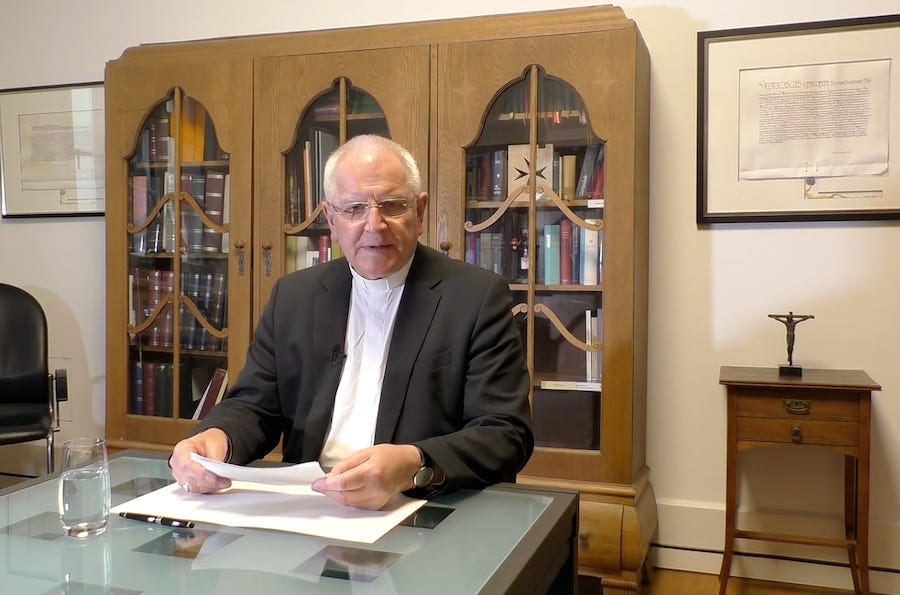
The Holy See press office announced Sept. 2 that the pope had accepted the resignation of Bishop Heinrich Timmerevers of Dresden-Meissen, eastern Germany, almost a year before the bishop reached the typical retirement age of 75.
Timmerevers’ departure came exactly two weeks after the Aug. 19 resignation of 66-year-old Bishop Karl-Heinz Wiesemann of Speyer. Wiesemann cited “psychological strain” to explain why he resigned almost 10 years early.
Timmerevers, a supporter of Germany’s controversial synodal way, said he had submitted his resignation to Rome months earlier and discussed the matter at a private audience with Leo XIV.
In a video announcing his resignation, Timmerevers said the pope asked him a few questions and noted he would submit the request to the Dicastery for Bishops for consultation before informing him of his decision.
Timmerevers said that at a June 23 meeting in Berlin, Archbishop Hubertus van Megen, the new apostolic nuncio for Germany, gave him a letter confirming that the pope had accepted his request.
“I feel that the many challenges and responsibilities of this office have taken an enormous toll on me,” Timmerevers commented.
“That is why I have decided to hand over the leadership of our Diocese of Dresden-Meissen — which has become very dear to me during my 10 years in office — to younger hands.”
He added: “I have wrestled intensely in prayer over this decision, for which there is no external cause or urgent health-related reason. This diocese continues to need leadership with boundless energy.”
“At the same time, I feel that age and my numerous responsibilities have left their mark on me as well. I extend my heartfelt thanks to everyone with whom I have had the privilege of working during this time.”
Timmerevers and Wiesemann are not the only German diocesan bishops to have stepped down early citing the strains of leadership.
In June 2025, Bishop Gregor Maria Hanke resigned as the Bishop of Eichstätt at the age of 70. Hanke, a critic of the synodal way, said he had asked to retire five years before the customary resignation age of 75 because of “inner fatigue” caused by “the many challenges, scandals, and unresolved conflicts” that marked his term in office.
Other German diocesan bishops have sought to retire early in recent years, but were asked to remain in office.
Archbishop Stefan Heße tendered his resignation as Archbishop of Hamburg in March 2021, after an independent report accused him of mishandling abuse cases. But Pope Francis requested that the 54-year-old continue in the role.
Cardinal Reinhard Marx submitted his resignation as Archbishop of Munich and Freising in May 2021, at the age of 67. But Pope Francis declined the offer a month later.
Cardinal Rainer Maria Woelki offered his resignation as Archbishop of Cologne in March 2022, at the age of 65, amid criticism of his handling of abuse cases. He also remains in office.
Timmerevers was born on Aug. 25, 1952, and was ordained a priest of the Diocese of Münster in 1980. He was appointed an auxiliary bishop of Münster in 2001. He moved from western to eastern Germany in 2016, after he was named Bishop of Dresden-Meissen.
The Dresden-Meissen diocese traces its history back to 968. It serves 124,700 Catholics in a territory with a total population of 4 million, in one of the most secular regions of Germany. It has a Mass attendance rate of 12.5% — one of the highest among the country’s 27 dioceses.
Timmerevers oversaw a reduction in parishes from 97 to 37. He also instituted an austerity drive intended to save the diocese millions of euros in expenditure each year. The financial restructuring process required the diocese to give up the Bildungsgut Schmochtitz St. Benno, a Catholic education center. The diocese described the decision as “painful.”
The diocese said that Timmerevers was “committed to further addressing the issue of abuse in the diocese, though he occasionally encountered fierce resistance from critics.”
Years before the Vatican issued Fiducia supplicans, its declaration on blessings, Timmerevers publicly called for blessings for same-sex couples to be permitted. In 2020, he appointed a lay worker and a priest to provide pastoral care for Catholics who identify as LGBT.
Before his resignation was announced, Timmerevers was preparing to celebrate the 25th anniversary of his episcopal ordination at a Sept. 5 Mass at Dresden Cathedral, followed by a reception. The diocese said the occasion would instead mark Timmerevers’ departure as Bishop of Dresden-Meissen. German bishops’ conference chairman Bishop Heiner Wilmer is expected to preach at the Mass.
In a letter, Wilmer paid tribute to Timmerevers, saying his departure was “a great loss” and highlighting the bishop’s commitment to ecumenism.
“This included prayers and church services, but also political stances — especially in eastern Germany, which has not only been shaken by the recent successes of right-wing populists but was also confronted early on with the Pegida demonstrations in Dresden,” Wilmer recalled, referring to a political movement opposing “the Islamization of the West” that was founded in Dresden in 2014.
Timmerevers said he would live in a rented apartment in Dresden and continue to serve the diocese as a pastor whenever needed.
The appointment of Timmerevers’ successor will follow the provisions of the Baden Concordat.
The Vatican reviews lists of candidates submitted annually by the bishop, as well as a list drawn up after the see falls vacant by the cathedral chapter. The chapter consults lay representatives in the course of preparing its candidate list.
From the candidate lists, the Vatican creates a shortlist of three candidates, which must include at least one candidate from the Diocese of Dresden-Meissen.
The cathedral chapter elects one of the three candidates in a free and secret ballot.
The chapter communicates the election result to the state governments of Saxony and Thuringia, parts of whose territory are covered by the diocese. The governments can express political concerns about a candidate but do not have a veto.
In the final step, the pope appoints the candidate as the new Bishop of Dresden-Meissen.
Following Timmerevers’ and Wiesemann’s resignations, three of Germany’s dioceses are now vacant. The Diocese of Hildesheim also requires a new bishop after Pope Leo XIV named Bishop Wilmer as Bishop of Münster.
Bishop Gerhard Feige of Magdeburg, which neighbors the Dresden-Meissen diocese, has offered his resignation to the pope ahead of his 75th birthday on Nov. 19.

Please Pope Leo, appoint an orthodox Catholic bishop to replace Bishop Timmerevers. You can help fix so much wrong with the German Church with this simple move of just picking an orthodox replacement (who also is a good administrator since that seems to be one of your main priorities in picking various positions so far). Help yourself hit a reset with the Catholic Church in Germany's heretical synodal way. Replacing all these retiring German bishops with orthodox ones would send the message to the rest to get back in the barque of Peter and stop their pursuit and infatuation with the modern world.