
Pillar paid subscribers can listen to JD read this Pillar Post here: The Pillar TL;DR
Hey everybody,
Today’s the feast of St. Cillian, and you’re reading The Tuesday Pillar Post.
It’s also the customary feast of my favorite Biblical couple, Priscilla and Aquila, but I’ve got a godson named Cillian, so I should probably write about him.
The saint was born in Ireland’s north around 640, and became a monk. As happened to Irish monks in those days, Cillian was commissioned by his abbot to become a missionary, and the pope sent him with 11 other monks to Franconia, then paganland in Bavaria, home to dark enchanted forests, filled with terrible wraiths and phantasms — at least according to the people who lived there.
Cillian arrived near Würzburg Castle in late 686, and set up shop, monastery-wise, with a few of his traveling companions. He was by then a bishop, though it’s not clear whether he was consecrated in Ireland or in Rome, by the pope personally.
In either case, Cillian and companions did as Irish monks do, draining some swamp and chopping down trees and building a little monastery, offering Holy Mass and converting people by powerful preaching.
Soon after they arrived, they converted the local Herzog Gozbert, who ruled the Würzburg region. With the duke a Christian, the local minor nobility and hundreds of families followed suit.
Cillian, and his companions — Fr. Colmán and Deacon Totnan — baptized thousands of people in just a few years.
But then things went wrong.
See, Gozbert attempted to marry his brother’s widow — then in violation of canon law, and thus invalid. Gozbert wanted to be a faithful Christian, so when Cillian told him to separate, he accepted it.
But Geilana, his consort, had not converted, and she had no wish to be exiled in the name of Gozbert’s new religion.
Perhaps Cilian should have taken a more accompanying tone to his exhortation to the couple, I don’t know.
But whatever the case, Geilana decided to solve her own problems with the local meddlesome priest.
When Gozbert was traveling — July 8, 689 — Geilana had soldiers find Cillian, Colmán, and Totnan, and dispatch their heads.
It’s not clear whether that worked on Gozbert himself, and whether he stayed with Geilana, but after the monks were killed, Christianity actually did recede in the region, for at least a half century.
The few Christians who remained, though, managed to hang on to the martyrs’ heads, and keep them as relics. When the place was converted again, and a cathedral was eventually built in Würzburg, the skulls were covered in jewels, and placed in the church’s high altar.
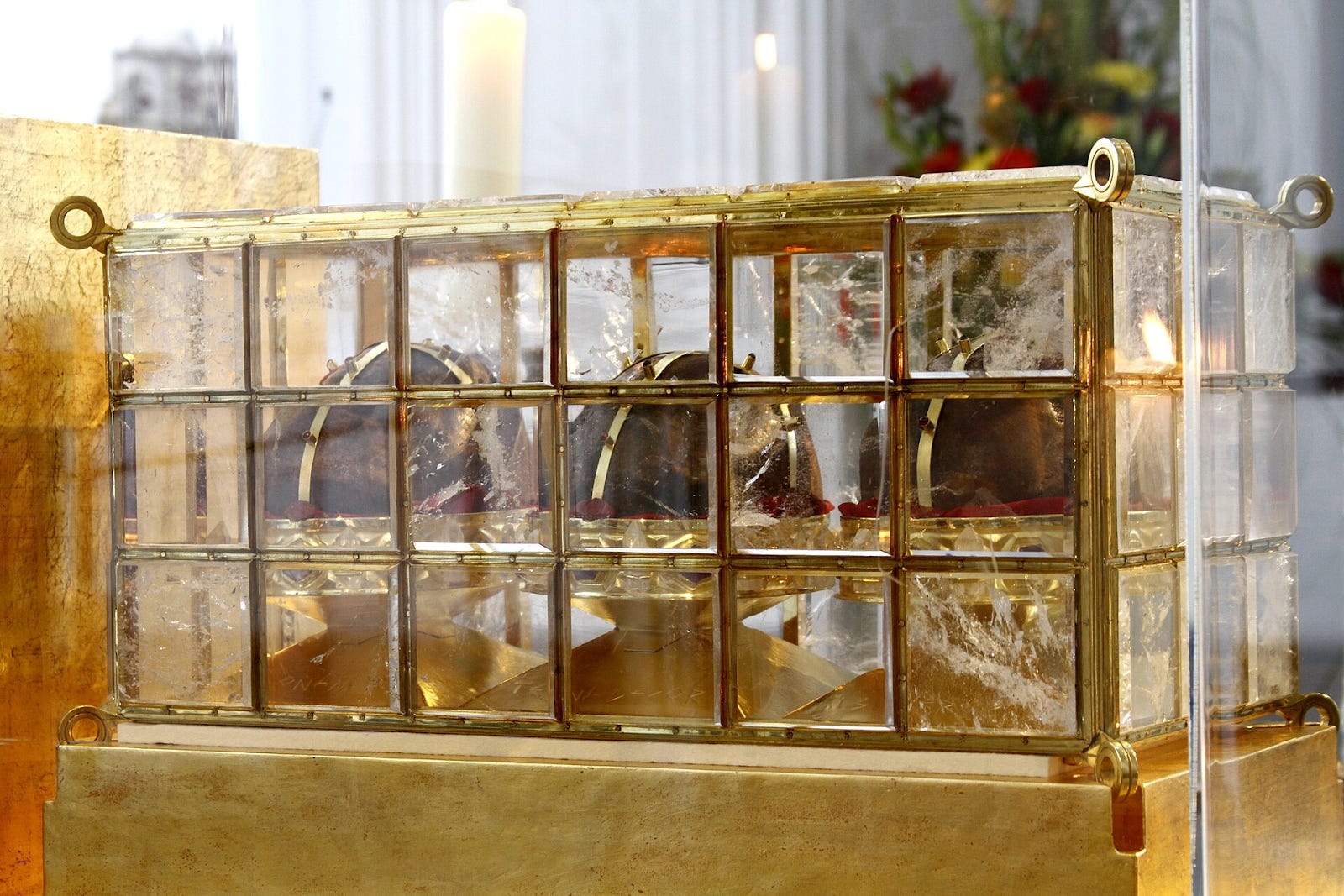
On July 8, every year, the skulls are processed through the city.
And that’s almost what I wanted to tell you about.
But when I was reading about St. Cillian, I came across another fact about Wurzbürg Cathedral that seems worth mentioning.
Well after Cillian, the region was eventually governed by prince-bishops. For almost 1,000 years, they governed their little corner of Franconia as both secular and ecclesiastical ruler, under the aegis of the Holy Roman Emperor.
For about 400 years, those prince-bishops had an unusual burial custom — unusual both for our time, and for theirs.
Starting in the late 1300s, the prince-bishops of Wurzbürg were buried in three places.
— Their bodies were buried in Wurzbürg Cathedral — named after St. Cillian himself.
— Their hearts were buried at nearby Ebrach Abbey.
— But their entrails — their intestines — were buried in the Marian chapel, inside the fortress where the prince-bishops made their residence.
Again: Bodies at the cathedral. Hearts at the monastery. Guts at home.
And the guts of prince-bishops were buried at the Marian chapel all the way until the late 1700s.
While separate “heart burial” was practiced elsewhere, the triple burial practice of Würzburg was — as I said — unusual even in the time when it was practiced.
So why were the intestines buried separately? I do not know. I have a theory that disembowelment allowed the bodies of prince-bishops to keep a little bit longer. But I could be wrong.
And I’m not sure I have the guts to find out more.
Anyway, may St. Cillian and his martyred companions intercede for us.
The news
Friday was the 4th of July, so we’re a bit lighter on news stories as we mostly took the day off, but here’s what we got:
While Germany is known to be one of the Church’s wealthiest corners — largely because of the nation’s “Church tax” set-up — a declining number of Catholics in the country means an anticipated major drop-off in revenue in the years to come.
Right now, because of rising German wages, Church tax revenue is rising, with 27 dioceses receiving 6.62 billion euros last year, up from 6.5 billion the year before.
But also last year, 321,611 Catholics formally disenrolled from the faith with the government, meaning they will no longer contribute to the church tax.
And the decline in members is eventually going to catch up with the rise in revenues, officials believe, leading to a sharp reduction in Church income.
To handle this, the Germans are planning to make “hard cuts” in the expenditures of the common fund which supports the bishops’ conference, and the country’s synodal path. It is not clear whether synodal path staffers will be laid off, but that could be coming.
Father Héctor Alejandro Pérez underwent two surgeries, and will now face a long process of recovery.
Here’s the story.
—
To date, roughly 75,000 people in Canada have died through the country’s physician assisted suicide programs, including many Catholics.
The pervasiveness of “medical assistance in dying” causes new and unique pastoral problems for clergy who minister to the dying, and navigating them isn’t easy.
Deacon Larry Worthen is no stranger to these complex situations. He talked with The Pillar about the thorny pastoral challenges Canada’s MAiD laws present.
Read the interview, it’s very good.

Tired of partisan media cheerleading for one team? Jonah Goldberg and Steve Hayes launched The Dispatch in 2019 to build an enduring presence for original reporting and thoughtful analysis that cuts through the partisan spin to deliver the facts. No insulting clickbait, no false outrage, no annoying auto-play videos—just reliable journalism that prioritizes context, depth, and understanding. Claim your exclusive 30-day, all-access FREE trial today.
But how does it actually work? What does it actually entail? And what technicality prevents it from being approved as a catechetical program at the USCCB?
Mary Farrow heads into the atrium — for a great report you won’t want to miss.
The allegation is not the subject of a police investigation, but according to the Sydney archdiocese, “Bishop Umbers has agreed to stand aside from public ministry while this allegation is investigated” — ostensibly in an ecclesiastical process.
Two weeks ago, I wrote about the value in transparency during investigations of bishops, and of dioceses being forthcoming about their existence, in order to better ensure justice across the Church. At the same time, I wrote about the responsibility of Catholics to concede that an investigation does not, in itself, connote guilt.
Here we have a living example of that. An allegation is raised, a bishop maintains his innocence, the diocese transparently announces the investigation, and we’ll await the results as they become available.
To my way of thinking, that’s how it’s supposed to work.
Here’s where things stand.
Alligator Alcatraz
You’ve read about “Alligator Alcatraz,” the immigration detention center built in the Florida Everglades, and expected to be a kind of ICE-administered way station for people being deported from the United States.
I was surprised to learn this week that Alligator Alcatraz is the ACTUAL name of the place, not a media or administration conferred nickname.
And according to Bishop Frank Dewane of Venice, Florida — bishop of the Alligator Alcatraz territory — the name is just one problem with a facility that he told The Pillar is inconsistent with human dignity.
In an interview this week, Dewane told The Pillar that he has concerns that Alligator Alcatraz is an inhumane facility, and part of a much bigger problem with immigration policy in the U.S.
And the bishop said, the Diocese of Venice has not been able to set up pastoral and sacramental ministry for detainees at Alligator Alcatraz — seeing their phone calls on the subject basically going unanswered.
You can read that interview here.
Let me note the criticism I’ve seen Dewane take for an interview on the presidential administration’s immigration and deportation policy — most of which centers around the USCCB’s participating in federally funded refugee resettlement programs, and the receipt of federal funds by Catholic Charities engaged in refugee resettlement and various kinds of migration work.
That participation has led to online pushback of Dewane, with comments saying basically that bishops criticizing deportation practices are being disingenuous, because they’re really concerned about the loss of federal bucks.
I’ve said before that I think this fundamentally misunderstands the motivations of bishops, who don’t get to keep any immigration-related federal funding for the financial problems that actually keep them up at night — chancery operations, unfunded priest pension liabilities, seminary tuition, or keeping Catholic schools open.
There’s solid analysis which suggests that the USCCB lost money by its participation in federal refugee resettlement programs. But even if that weren’t true — and I think it demonstrably was true — the refugee resettlement wing of the USCCB was somewhat walled off from most of the other program areas of the conference, especially in bishops’ minds, and the local money passed through — which went to Catholic Charities, is not foremost in bishops’ minds.
Now, you might say that money is fungible, and money bishops get from the federal government means money they don’t put into migrations programs themselves — which is to say, more money for other things. But that’s only true if bishops are putting money into migration programs locally when federal funds aren’t available, and that’s demonstrably not the case in most places.
It’s rare for Catholic Charities agencies to receive much, if anything, from central curial funds, and if federal funds on resettlement programs dry up, those Catholic Charities agencies are more likely just to shutter the programs, and layoff staff — as they’ve done across the country — than they are to expect more subsidies from the bishop’s office.
In short, the fluctuation of migration federal funding is just not a high-ranking consideration for most bishops on its face: They don’t benefit from it, most don’t see Catholic Charities migration funding as a core component of their diocese, or feel directly responsible for maintaining it, and many who have seen reduced revenue in the current federal administration see it as a badge of honor, a kind of persecution for religious convictions, rather than an actual inconvenience.
I’ve written most of that before.
And despite the common argument to this effect, I also am skeptical that bishops support massive migration to the U.S. as a way of “propping up” declining religious practice numbers among their flocks.
Bishops just don’t think this way about numbers, and few would see declining religious practice among Catholics as something for which they have responsibility to “paper over,” because — for better or worse— few bishops would measure themselves by the metric of declining religious practice.
There are a few numbers bishops gravitate toward. A bishop with an uptick in seminarians for the year will waste little time in telling you that — while he’s beaming, of course, and explaining what steps he implemented to get there.
But a bishop facing declining Mass attendance is not likely to feel pressure to “make up the numbers.” With notable exceptions, he is most likely to shake his head about “the culture” and then possibly change the subject to the German synodal way.
Still, the question keeps being raised, and bishops continue to be accused of “chasing the money” when they talk about immigration.
So why do I think they talk so much about immigration, and in the way they do?
Here are four reasons, ranging from my least to my most cynical takes: