
This Pillar Post is available entirely for free to all readers through a sponsorship from Catholic International University.
Hey everybody,
My son Daniel will be confirmed on Saturday, and I’d appreciate your prayers for him.
For his confirmation saint, he picked Blessed Solanus Casey — we just call him Fr. Solanus at our house — so we’ve been talking about our favorite Capuchin a lot lately.
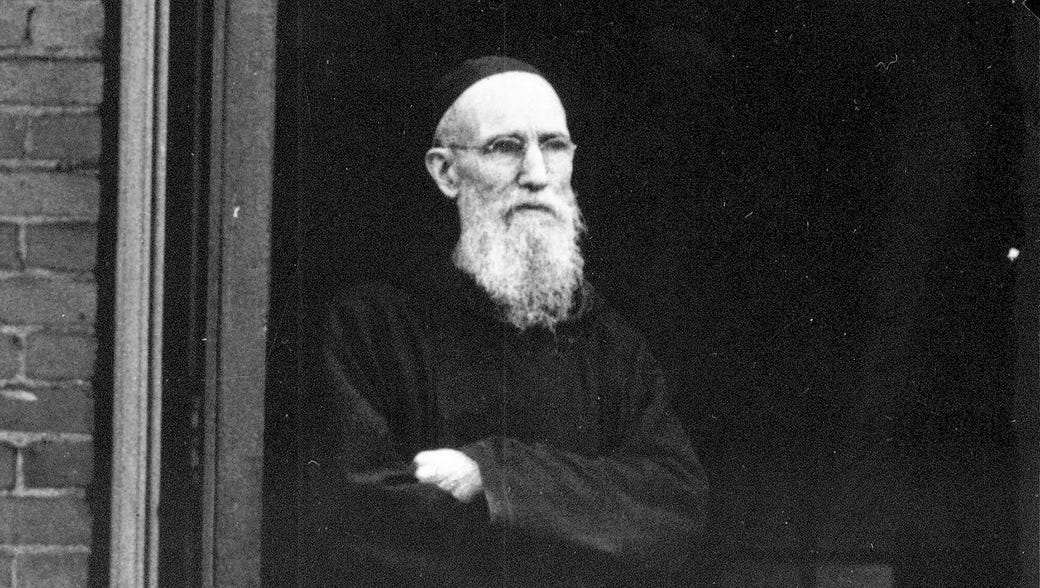
Fr. Solanus is funny.
He sang badly, all the time, to the annoyance of everyone in the house.
He poured all his breakfast foods, including coffee, into the same bowl, and ate them as a penitential morning mash-up.
He had a way with bees, handling them without harm.
And he did the thing with the ice cream. On a hot summer day in 1941, a lady stopped by one morning to give Fr. Solanus some ice cream cones, to thank him for helping her with a problem. Solanus wanted the ice cream, but he was busy enough that morning that he put the cones in a desk drawer, without thinking at all about the mess he might have later — no air conditioning and all, it being 1941.
Then almost an hour later, a Capuchin novice stopped by the desk, to thank Fr. Solanus for praying for him about a dentist appointment he’d been nervous about. The novice was excited because he thought he was going to lose a tooth, and the dentist (maybe through Solanus’ intercession) found it had no problems at all.
Well, Father wanted to celebrate with the novice, and he remembered about the cones. So he reached into the drawer, and, amazingly, found them still frozen, as cold as if they’d been in the freezer.
There are some cool miracles in Solanus’ life, but if you ask me, the little ice cream miracle is among the most impressive, because it’s the sign of a God who cares enough to console, in even the little things.
But Fr. Solanus isn’t a sort of cartoon character of holiness, playing his fiddle and working fun miracles. He was a man of flesh and blood, and he dealt with disappointments, in family life and in the Church. Two of his siblings died in childhood, of the same diphtheria which left him frail. He proposed to a girl, and her mom was so appalled she sent the girl to boarding school. He might have witnessed a traumatic murder (accounts vary, and he didn’t talk about it much).
He was a high school seminarian, but was basically pushed out, because he didn’t have the Latin and German required for class lectures; formators thought he was incapable, when it was really a language issue. The stigma followed him into the Capuchins, where bad grades — and perhaps a genuine inability to “play the game” — saw him ordained a simplex priest, with no faculties to preach or hear confessions. He was a priest of Jesus Christ, and given the work of novices and lay brothers.
You could take those things, and let them add up to a life of bitterness. You could harbor resentments or grudges. It’d be easy. Solanus just made other choices, cooperating with grace, and living a fulfilled life in circumstances he didn’t predict.
At our house, we’ve been talking about a particular spiritual discipline of Fr. Solanus.
During his life as a Capuchin, he got into the habit of “thanking God first.”
When he needed something, Fr. Solanus made an act of the will, to thank God for it even before it arrived. He encouraged other people to do the same.
It’s a little thing, but it strikes me as remarkable, for a few reasons:
First, thanking God first disposes us to see Providence, when we’re tempted to see only our own efforts. Second, thanking God first inclines us to gratitude, when we’re often inclined to grumble or resentment about what we don’t have yet. Third, thanking God first purifies our intentions — no one would have the audacity, I hope, to thank almighty God for providing something he wanted for the wrong reasons.
Thank God first.
It’s simple. But I’m impressed that a man whose life might have gone otherwise found a way to live in joy and satisfaction, and I suspect this is a key component.
The news
Twenty-seven-year-old Brother Grzegorz Gaweł was detained last September, when Belarussian authorities said he was carrying a sensitive military document documenting a Belarussian exercise conducted jointly with Russia.
The Polish government insisted the brother was not a spy. While he has not been tried, he was released Tuesday as part of a prisoner exchange.
—
A Belgian diocese confirmed this week that the Vatican imposed confidential disciplinary measures on its former bishop in 2021.
The Diocese of Namur said April 21 that retired Bishop Rémy Vancottem was informed five years ago that he could no longer celebrate Mass in public or participate in bishops’ conference bodies due to his mishandling of an abuse case.

Apostolate leaders—clergy and laity alike—are often well formed in theology, yet underprepared for budgeting, fundraising, and team management. Catholic International University’s fully online MA and Graduate Certificate in Ecclesial Administration & Management provide practical, mission-driven training you can apply immediately. Study anytime, in fidelity to the Magisterium: www.catholiciu.edu/pillar
Readers of The Pillar know that the Nagorno-Karabakh region is populated by ethnic Armenians, but claimed by Azerbaijan, in a dispute that has left more than 100,000 people displaced from their homes and hundreds dead.
Armenian human rights leaders say the situation is a kind of ethnic cleansing, part of a long history of ethnic persecution by Azerbaijanis.
Now, for the Holy See, this situation points to Vatican-Azerbaijani ties which have been criticized in recent years. A non-profit foundation connected to the Azeri government has invested a lot of money in Rome, helping to restore St. Paul Outside the Walls basilica and other important works of art and history in Rome — along with giving support to a Vatican-affiliated pediatric hospital.
Observers suggest links between the Vatican and the former Soviet republic were strengthened thanks to Cardinal Claudio Gugerotti, who is now prefect of the Dicastery for Eastern Churches and was the apostolic nuncio to Azerbaijan, Armenia, and Georgia from 2001 to 2011.
During Gugerotti’s service as nuncio, Azeri authorities signed a bilateral agreement with the Holy See in 2011, appointing an ambassador the same year, and began to have frequent meetings, both in Azerbaijan and the Vatican, with Holy See officials.
How long can that situation last? Will Leo give it another look? I’ve been wondering that myself.
—
Leading German Church figures have defended the country’s guidelines on the blessing of same-sex couples in response to critical comments made by Pope Leo XIV on an airplane last week.
Bishop Georg Bätzing, who oversaw the guidelines’ introduction in April 2025 when serving as chairman of the German bishops’ conference, insisted that they posed no threat to Church unity.
That insistence comes after the pope said the Apostolic See has intervened already to make its views known with the German bishops, about “guidelines” that would seem to allow for liturgy-like blessings of same-sex couples.
—
A Swiss diocese has announced that three people who shared the Eucharist with their dogs have not been excommunicated because they “did not act with sacrilegious intent.”
Yes. You read that right.
Last October, at a Mass connected to a pet blessing, three people fed the sacred host, or parts of it, to their dogs. The Diocese of Chur investigated, and has announced that the people involved did not have sacrilegious intent, and thus, did not incur an excommunication.
On the law, I find this a bit interesting. The relevant canon prohibits taking the Eucharist for a “sacrilegious purpose” — and I think taking the Eucharist to feed it to your dog is an objectively sacrilegious purpose. In that sense, I’m not sure how germane the intent actually is.
It is true that a person can’t incur a canonical penalty if they were absolutely ignorant of the law in question — but it’s also true that “crass or supine” ignorance does not suffice — in other words, you can be culpably ignorant of some law, and still legally culpable of breaking it.
I haven’t read the acts of the case, but I’m surprised the bishop has hung his reasoning on the idea of sacrilegious intent — not exactly a strong legal argument, instead of some question about their ignorance of the law and the nature of that ignorance.
On the other hand, we’re working from a press statement now, and I’d really prefer to work from the decrees and acta of the preliminary investigation in this case. So if you work in the Diocese of Chur, well, you know how to get a hold of me — and I think this case merits just a bit more scrutiny, if we can muster it.
You can read our reporting here.
And by the way, I heard in my inbox from a few of you, who thought our headline — referencing the Chur Catholics as “out of the doghouse” — was a bit flippant, given the gravity of the situation.
I’ve also heard from a few who really liked it.
I wrote the headline, and I take ownership for it, and I appreciate hearing views on both sides. In truth, the headline is intended to convey the surreality — the absurdity, if you will — of a situation stranger than fiction. That’s all. It’s not meant to disrespect the situational gravity.
Some of you agree with our reasoning there, and some of you don’t, and I’m glad you told me either way. The Pillar actually is a community, your views actually are relevant to our deliberations, and I like thinking about stuff like this from more than one angle.
In other words, thanks for being engaged, Pillar readers, and for having the chutzpah to tell us what you think.
I don’t want to bark on about this all day, but your views, perspectives, and considerations are always in my mind, and they’ll be on this too. So thanks.
And thanks for, you know, supporting a community like this, where we can talk about these things sanely, by subscribing to The Pillar. If you haven’t yet, do it now:
—
The Brazilian bishops’ conference last week approved the creation of a national data center, which will aim to make information sharing between the country’s dioceses easier, while making available to both Church officials and the public information about the status of the nation’s clerics.
U.S. Catholics — especially clergy — have called for a system like this for quite some time.
But in my estimation, we’re probably not getting one.
The study is interesting, because it conveys schools which believe they can enroll more children with disabilities, schools which have had success, and that some schools say they are “not interested” in serving children with significant special education needs.
I am not unbiased on this front. I have spent the past decade, at least, working with schools to help them enroll children with disabilities — my own children with Down syndrome, and others.
Here’s what I’ve learned: When administrators decide that enrolling parishioners with disabilities is a core element of Catholic school identity — when they say “yes” to life, in other words, financial and practical obstacles are almost always easily overcome.
It’s just true — enrolling children with disabilities can so positively transform school culture, pedagogy, instruction, etc, that doing so leads to more success, more viability, and more resources.
But if administrators view that kind of thing as an “extra” — if they’re not firmly committed to making their school work for their parishioners, no amount of money will make a difference.
The biggest obstacle is not financial, it’s dispositional.
And that’s a shame, because, in my view, schools which open their doors to children with disabilities actually witness to the dignity of the human person.
In short, if you want to create a culture of life, you have to do so tangibly. And when you do, the “Catholic” in “Catholic education” becomes all the more rich, and all the more real.
If you’re a pastor or a school administrator, and you don’t believe me, just reach out. I’ll help. We can do this.
—
Ok, so there was on Saturday an assasination attempt on President Trump, during the White House Correspondents’ Dinner.
It is not the first attempt on Trump’s life, and I’ll bet it won’t be the last.
America has fallen into its predictable patterns: A swath of Americans say this proves Trump’s heroism, a swath say the attempt was staged, and a swath, like this woman, have taken to social media to lament that the president wasn’t killed.
I’m not surprised that woman was fired, by the way — she worked for United Healthcare, whose CEO was killed in December 2024 by Luigi Mangione, who has been turned into a folk hero in some circles, and — all the more bizarrely — is celebrated in some corners of the internet as a basically a heartthrob sex symbol. (Our country is in a really, really weird and troubling place, guys).
For a while Trump will probably appear behind bulletproof glass in public, though, as usual, the security cordon around him will gradually return to the status quo.
The status quo, by the way, is still a pretty tight perimeter of security — The U.S. president is one of the most protected men on earth, which is evidenced when the Secret Service periodically finds and arrests someone hiding out on a golf course or pretending to be part of his security detail.
It’s reasonable that a nation would take its leader’s security as seriously as possible, given that an assination on any political leader has the potential to throw a country — or the world — into chaos.
Which is why I’ve been thinking about the dispositional openness of the Roman pontiff.
I have spent, in my life, a great deal of time in the Vatican City State, much of it behind the scenes. I can assure you that the pope’s security matrix is more sophisticated than the visible presence of Swiss guardsmen wielding halberds in his presence.
But for a global leader of his stature, the pope’s security team is not what you might expect — and I’ve often looked around at papal events, thinking just how much at risk the pontiff puts himself.
Of course, canon 1370 assures an excommunication for the Catholic who uses violence against the pontiff, but I suspect that has less deterrent effect than we canon lawyers hope it will.
In short, as the 1981 shooting of John Paul II proved, the pope is often exposed, and vulnerable to the prospect of assassins, whether motivated by politics, religion, or garden variety nuttery.
I don’t think that’s just because the Apostolic See isn’t sophisticated enough for better security.
I think it’s instead because the nature of the Petrine office is to be willing to die for the faith and for the Church.
When popes were martyred, that meant they were as likely as anyone to be arrested by Roman authorities, and killed for professing faith in Jesus Christ.
For Pius IX and his immediate successors, it meant accepting to be a “prisoner of the Vatican,” because of the political situation in Italy.
Today, it means that the pope, as the vicar of Christ, chooses to be among the people to whom he professes the Gospel, for whom he witnesses to Jesus Christ — even if he puts himself at real risk to do so.
I expect that 1981 won’t be the last time someone gets close to killing the pope. I suspect eventually in the modern era it will happen. And I suspect that a man like Leo knows he could be safer if he chose, in countries around the world and at home, to be just a little bit more removed from the thronging crowds wanting a piece of him.
He wades into the crowd anyway. Safety is not the paramount concern of the Christian. We place our hope in something greater.
Gotta be the shoes
Ok, a couple of last things.
Humans have been running the marathon distance since 490 BC, when a guy named Pheidippides ran 26.2 miles to Athens from the Battle of Marathon, to alert the Greeks that they’d repelled the Persians, and should not be tricked by a Persian ship in the Athens harbor.
No one knows how long the run took old Pheidippides (especially since the whole thing is a legend), but we’re pretty sure it was longer than two hours.
In fact, since 490 BC, no one had ever run an official marathon race in fewer than two hours.
Until this weekend, when two men did it.
At the London Marathon, Kenyan Sabastian Sawe beat a once-unbreakable record with a 1:59:30 marathon time.
Eleven seconds later, Ethiopian Yomif Kejelcha took second place with 1:59:41.
Nobody did it, and then they did.
This is an incredible moment of human achievement. It is a triumph of athletic virtue, an extraordinary moment in athletics, and we’re lucky to be alive when it happened.
I told this to some friends on Monday, who hadn’t known about the race, and their response was deflating. “Big deal,” one friend said. “It’s the shoes.”

Of course it’s the shoes. These guys ran on precision engineered sneakers, each pair weighing less than a deck of cards, with u-shaped carbon lips replacing the carbon plates that had ushered in the supershoe era.
These shoes are ugly, expensive, and engineered by some of the brightest minds on the planet, for one purpose: To take a well-trained and talented East African distance runner across a finish line in under two hours.

And they did it. The shoes worked as well as the runners did. That’s half the excitement.
When people went back around the moon this month on Artemis II, no one said, “big deal, it’s the computers.”
Instead, we celebrated the minds that made the technology, and the astronauts who made use of it.
We should do the same here: It’s cool that we live in a time when Adizeo Adios Pro Evo 3, worn on the right pair of feet, can contribute to a marathon raced in under two hours.
Less than 120 years ago, when Johnny Hayes set the first 26.2 world record, at two hours and 55 minutes, he did it wearing footwear he endorsed: The O’Sullivan’s Live Rubber Heels, attached to his racing flats.
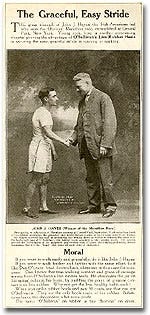
They were the best gear that engineers could offer, and Johnny jumped right into ‘em. Same for Sebastian Sawe. Who wouldn’t, actually?
And now, the same shoes can be yours for the low price of $500. If you think it’s just the shoes that propelled Sebastian Sawe into history, pick up a pair.
Maybe you’ll hit a sub-2 marathon, too? If you do, I’ll bet you’ll think it’s a big deal.
—
Next, reports emerged yesterday that a Minnesota lawyer and activist named Will Stancil had inside information on the plans of ICE agents in Minnesota this winter because the federal agents couldn’t resist bragging: They’d reportedly meet local girls on Tinder, and brag to them about what they were doing all day, and what their plans were. According to reports, those girls would share those plans with anti-ICE protestors and activists.
Now, whatever you think of the political players, their causes, and their methods, the point I want to make is different: Take seriously that strangers you meet on the internet are not a repository for the casual conferral of confidential information.
In fact, take seriously that your phone, and the apps inside it, and the people inside those apps, are all more or less aimin to spy on you.
Recall that last month, a French sailor’s use of a location-based exercise app allowed journalists to find the precise location of his ship, the aircraft carrier Charles de Gaulle. Recall that troop movements around the world have been frequently discovered by soldiers’ use of hookup apps — and that both Ukrainian and Russian intelligence agencies have set up blackmail and extortion operations using the apps, to trick or force soldiers into giving out even more information.
And recall that we’ve been warning about the security threat to the Vatican posed by location-based hookup apps since 2021.
But there is another lesson here, and it’s a personal one: Fellas, be faithful to your wives for at least two reasons. The first is that you owe it to her, yourself, and to Almighty God to be faithful.
The second is that if some other lady is interested in you on the internet, there’s a decent chance it’s a clandestine intel operation, or at least a bot farm blackmail ring. Be honest with yourself: You are not Brad Pitt or Timothee Chalamet, but you probably know some trade secret, or have a few bucks worth extorting.
Don’t be immoral, and don’t be so dumb, so vain, or so craven as to flatter yourself. If you’re tempted along those lines, just go for a run — I can recommend a good pair of sneakers.
—
Finally, next year is the 200th anniversary of Beethoven’s death. For classical music fans, this is the year of Ludwig.
So enjoy this classic take on his Sonata #14:
Please be assured of our prayers, and please pray for us. We need it.
And thank God in advance.
Yours in Christ,
JD Flynn
editor-in-chief
The Pillar

Even with super shoes, breaking two hours in the marathon is incredible. That is 4:33/mile pace. That means he could beat 99.9% of people in a mile race, then finish the remaining 25.2 miles at the same pace. Even the fastest person you know more than likely couldn't keep up for even just that mile. It's just mind-blowing how fast that is.
Back in my 40's I ran a lot of distance races. This was in the early 2000's and the best shoe I could find at the time was lightweight with a good amount of cushion but had little in the way of energy conservation. My personal goal was to look up at the finish line and see 2 in the hour indicator, but, alas, the best I could do was 3:08 in the Austin Marathon. A few years ago I was preparing for a 5 miler in Brooklyn and my wife bought me the first of the carbon plated shoes, the Nike VaporFly (which were the shoes Nike developed to get someone under 2 hours in a marathon). Immediately my times got better by about 5%. Too late for my goal: my speed is gone...fast twitch muscle gives way to slow twitch muscle as the years go by. But I am pretty sure they would have gotten me to a tick under 3 hours had they been invented at the time. In any case, they give a spring to your stride that makes you feel like a kid again. Awesome technology.