
Hey everybody,
I apologize this newsletter is so late. Please let me explain.
It started with a spot on the carpet, quite in the center of our living room.
The spot was a ring nearly the size of a frisbee, and of unknown provenance. It wouldn’t come out. Not with chemicals, nor with steam cleaning, nor even with the secret chemicals which can be only sold to you by the steam cleaners.
Year after year, we lived with the spot, a bit embarrassed by it when company was over. I developed a habit of standing right atop the spot when talking with guests, hoping it’d be concealed by my feet, and not quite so noticeable.
It started quite pronounced, but in recent years the spot had seemed to fade; we saw it less and less. Except eventually we realized that the spot wasn’t fading. The rest of the carpet, ravaged by children and pets and time, was taking on the same color as the spot, and settling into a level of disintegration which no steam wand would repair.
So we decided, Kate and I, that our Christmas gift to one another would be new flooring in the living and dining room, the places where the carpet had lain for decades. We thought we’d run into those rooms the very same laminate flooring already in our kitchen and foyer.
But that laminate, it turned out, has been discontinued. Just as well, since that, too, was in our house well past its lifespan. Of course, that meant a bigger project — new floors for most of the ground level.
We did some figuring, and so long as the kids won’t need braces, we could make it work. A contractor was hired, flooring was purchased, the demolition completed.
That revealed a problem. The subfloors were uneven, by more than negligible measure. In some rooms they’d need to be replaced or raised. More time, and a little more money we don’t quite have.
Yesterday, it became clear that the cheap fixtures in our powder room would not withstand removal for reflooring.
With the aid of America’s cheap consumer credit, I dutifully ventured last night to the Big Orange Depot, to purchase the newly-required bathroom vanity, and with it various plumbing accouterments. Of course, changing those out will require a better matching light fixture and towel rack, and with it a coat of paint for the bathroom, as it’s been a while.
What began with a spot on the carpet is now a bathroom remodel, readers, plus the flooring job, and of course that means new trim, and spot-painting and a few more surprises, I have no doubt.
The newsletter’s late because I’m living in a construction zone, much to my surprise. I am happy the spot is gone, of course, but I didn’t expect to be so coated in dust, and so devoid of cash.
If anyone should be happy, it’s our contractor, who came for a little job, and is now adding tasks to the bill every quarter-hour, it seems. He just muttered something about trimming down doors and, whatever that means, it’s gonna cost me.
As I say, he should be happy. But instead, over the din of the sander and the circular saw, I hear him cursing up a storm in our kitchen, banging away at something with a mallet.
I must admit, I understand the sentiment.
The news
The conference will be free, it will include several hundred young people, and to the organizers, it’s taught a valuable lesson about the Christian life:
Here’s Johnson: “If we really want to make something happen, we can do it. It might be hard at times, but it can definitely still happen, especially something that you think the Lord really wants you to do and is calling you to do.”
Sources in the Vatican told The Pillar that the policy was inconsistently applied before Leo’s Feb. 1 decision to rescind it — and in fact, may have been applied retroactively in only one case, that of Cardinal Raymond Burke.
Sources also said that the policy posed a challenge to staffing open positions in the Vatican, because of the high cost of living in Rome.
But “Leo has returned to the earlier situation, without requiring additional payments required by Francis,” one curial official told The Pillar.

This Lent, join Catholics across the country as we gather again for Bible Across America—the nation’s biggest Catholic Bible study. During our Lenten Bible study, Shane Owens and guests will blend biblical expertise with lived experience, unpacking the Bible’s practical relevance as we prepare to celebrate the Lord’s resurrection.
The Indian caste system is complex, and I don’t pretend to understand it entirely. But it is clear that almost two-thirds of India’s Catholics are Dalits, while far fewer priests and bishops are. And the bishops’ conference has been clear that caste discrimination is a problem in the Church, with some Dalit Indian Catholics saying they experience discrimination in the parish from members of upper castes.
In that context, the election of a Dalit cardinal to lead the bishops’ conference is noteworthy.
And while you’re reading about it, read a bit about how the Indian bishops balance leadership between the Latin, Syro-Malabar, and Syro-Malankara hierarchies of their country.
—
In a decree from the Dicastery for Clergy obtained by The Pillar, the Vatican dismissed the former parish employee’s appeal against his dismissal based on his political affiliation as “legally and factually unfounded.”
The case is seen as a litmus test for the German Church’s position that support for “extremist” political stances is incompatible with voluntary professional or voluntary service in the Church.
Want to understand more? Read all about it.
—
The Pillar talked yesterday with his daughter Claire, who said the sentence was “ridiculous” —but that her father has already spent years of incarceration committed to intercessory prayer, as a kind of spiritual evangelization.
“It’s extremely important to him that he evangelizes as many people as he can [by example], and prays for others,” said Lai. “He’s spending his time in prison praying for other people.”
Read the latest on Jimmy Lai — and why his case isn’t finished yet.
—
If that sounds familiar to you, it’s because The Pillar reported a few weeks ago that this announcement would be coming — and indeed, now it has.
It’s worth noting the Sheen sequence of events is a little bit unusual — Sheen’s beatification was approved seven years ago, scheduled, and then delayed, because of questions raised amid the fallout from the 2018 sexual abuse crisis.
Since then, we’ve known that certain things, like Rochester’s bankruptcy proceedings, would likely be resolved ahead of an announced second date for the beatification Mass.
But I was nonetheless surprised that the announcement Monday from Bishop Tylka told us that the beatification Mass could be scheduled, but came ahead of resolution with the Holy See on when and where the actual Mass will take place.
As with every part of the Sheen saga — beginning with the long legal fight between two dioceses over his body — I suspect there is a little bit more going on behind the scenes, with regard to working out the Sheen Mass between all the players.
But I’ve been talking with people close to the process for the past few days, and for my money, I expect it will take place in September or October, and I’m betting it takes place in St. Louis, which — unlike in the Diocese of Peoria — can offer both a very large space for a liturgy, and some conference/convention center space for the events which will inevitably crop up around the beatification Mass itself.
I’ll tell you this — wherever it is, and whenever, The Pillar will be there. And in addition to covering news on the ground, we’ll find a good dive bar, and have a live episode of The Pillar Podcast. I think soon-to-be Blessed Venerable Fulton Sheen would want us to do that.
‘Fascinated by Jesus’
I came to the Archdiocese of Denver in 2006 or 2007, newly married and with a new canon law degree in hand, to work for the bishop who had become in the years prior my hero — Archbishop Charles Chaput, now retired of Philadelphia.
Working for Chaput was among the most formative professional and personal experiences of my life, and the man himself became something much more important than a hero. He became a friend, a person of flesh and blood, with strengths and weakness — not an orator I placed on a pedestal, but a fellow Christian, running the same race I wanted to run, and in that sense, an important figure in my life.
Along the way, the Archdiocese of Denver became my home. I took a brief and blessed foray into Nebraska, to live The Good Life™ for a couple of years, but returned home to the mountains, where my parents and sister and nieces and nephews live now, too.
I worked for Chaput, and before journalism I worked for his successor, Archbishop Samuel Aquila, about whom I’ve written previously.
The Archdiocese of Denver has a history of significance in the United States. 1993’s World Youth Day, and its visit from Pope St. John Paul II, set off a period of renewal for the Church in the United States, and a lot of that renewal centered in the ministries and apostolates which grew up in Denver.
Of course, that renewal energy has spread to a lot of places since 1993, and Denver remains a center of renewal in the Church, but not singularly so. Still, the history reverberates here in good ways — like the extraordinary sense of apostolic initiative among Denver’s lay, clerical, and religious Catholics. And it echoes in bad ways — like the creeping vice of spiritual pride which can set in for any place with a storied history.
Denver has movements and religious and projects which have flocked here over time, and borne fruit, but which also require oversight. It also has a uniquely large class of professionalized lay Catholics, and some of them, like me for example, are fundamentally ungovernable, in an ecclesiastical sense — imagine the woes and sorrows and annoyances of being my parish pastor.
I mention all this because, like a lot of Denver Catholics, I have been praying for months for Denver’s successor — that we’d have a bishop prepared for what this archdiocese is, and for what it needs.
Please let me take off my journalist hat, and say something as a Denver Catholic: We learned this weekend that we may have gotten about as good as can be got.
From Friday night, my phone started buzzing with the name Golka, and indeed on Saturday Denver learned that Bishop James Golka of Colorado Springs — a priest of Grand Island, Nebraska — would be our next archbishop.
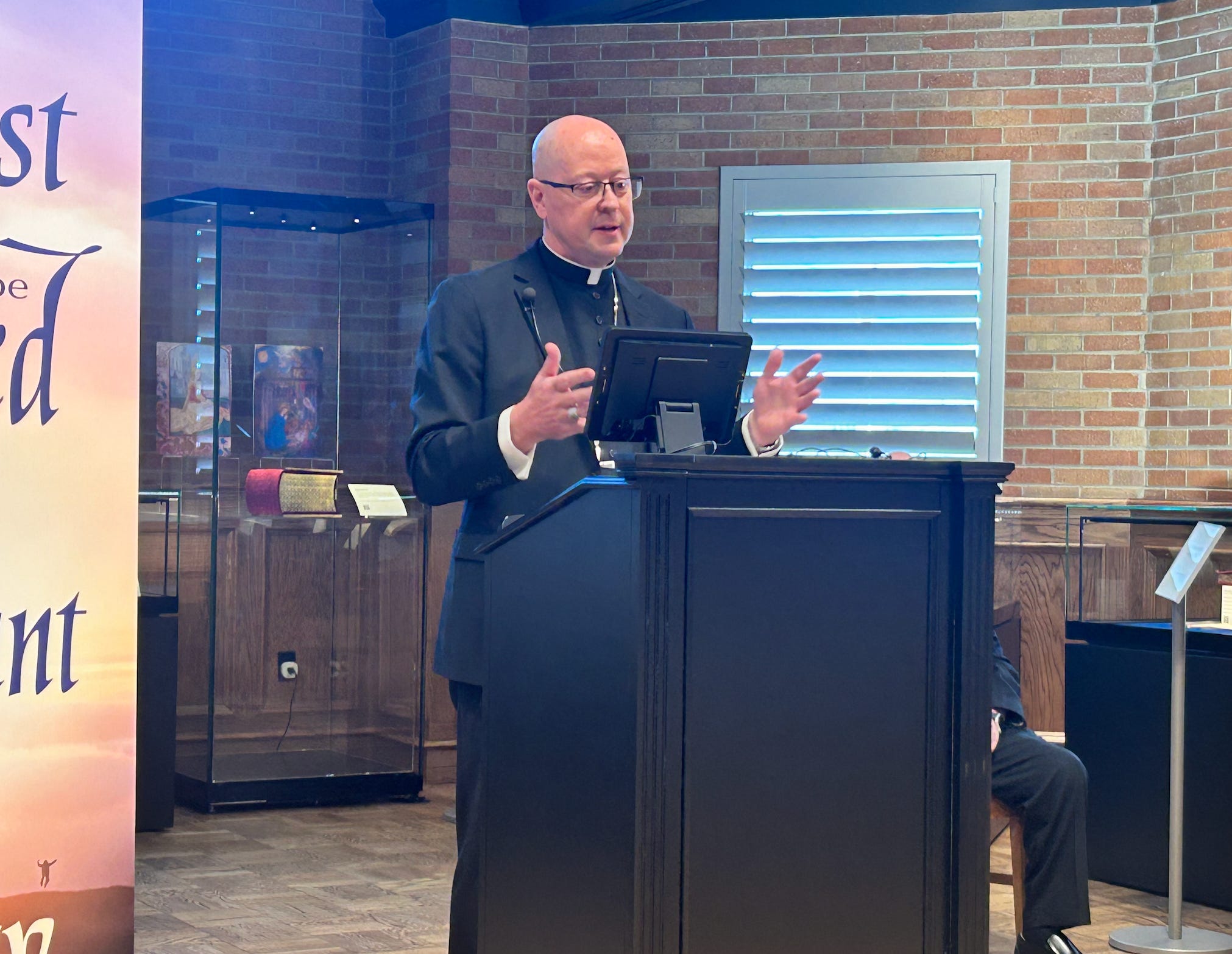
On Saturday morning, he spoke to a room full of priests and journalists directly. He said that since childhood, he has been “fascinated by Jesus.”
He made sure we knew he loves priesthood. That he loves sacramental ministry, and knowing people, and being their bishop. He spoke Spanish — and cried while doing so — as he expressed solidarity with the immigrant population of this city.
And he spoke to the 40% of Coloradans who say they have no religion. He told them that Jesus Christ loves them, and gives meaning to our lives, and he invited them to something concrete — to ask their Catholics friends or neighbors to pray with them.
In fact, prayer was the central theme of what he said. That every good work begins with prayer and must be immersed in it. That we should pray over one another — that spouses should bless each other, and bless their children. He told parishes to be open, and ready to receive people looking for meaning. He gave the sense that our mission will mean going out towards those people. He introduced his dad, and asked us to pray for his mom, who died just one month ago.
I’ll cover the man journalistically as I’m obliged to cover him, I’ll do my job. And a great first meeting is no guarantee of episcopal success. Five years ago, he was in a small rural parish, now he’s got a very big archdiocese looking to him. There will be a steep learning curve.
But what I took away most of all was that Pope Leo has appointed a man who sees himself first as a son of God, and as a priest of Jesus Christ. If that’s the criteria amid a great turnover in American metropolitan archbishops right now, it bodes well for our future.
—
And indulge me for one other Colorado-specific bit, please. I sit on the board of the FIRE Foundation of Denver, which gives grants to Catholic schools to enroll children with disabilities, who could otherwise not attend Catholic school. We have a very fun fundraiser planned for this Thursday night — and it’s not too late to buy tickets. If you live on the Front Range, do join us. There will be a full bar, I promise.
Varia
I’ve got a couple things I wanted to flag your attention this week, so the best way to do that seemed to be a round-up of quick hits. Here are some things I’m paying attention to right now — and they’re worth your attention too.
First, don’t miss this essay from my friend Tim Glemkowski, breaking down the fault lines of the American episcopate since Vatican Council II, and arguing for more arguing — that is to say, suggesting that “prudent and charitable argument, rather than a threat to communion and mission, is one of its necessary preconditions.”
In short, Tim suggests that genuine argument over genuine theological disagreement — beginning in shared first principles — is good for the Church, and is especially necessary in the “choppy waters of the post-conciliar period.”
I would add only that genuine argument is far better than the brand of power politics and tribal allyship which passes for most discussion in the Church today, but I wonder if we’re equipped for it. Too often in the Church, disagreement is perceived as personal — precisely because power politics is our predominant motif — and that leads people to shy away from saying they disagree and hashing it out. But the alternative is usually passive aggressive maneuvering, in place of honest deliberation.
I’m aware of chanceries in which bishops have encouraged a really healthy form of disagreement and discussion — over everything — and the friends who work in such places tell me it takes getting used to, because it’s different from a lot in ecclesial culture. So good substantive discussion — as opposed to disingenuous mutual agreement societies — takes unlearning some of the habits of deference and passive aggression which can be picked up in the immersive experience of ecclesial culture. That would be good, but it has to be named.
In any case, what Tim has to say is worth reading:
“Sixty years after the Council… are Catholics becoming more vital signs of the death and resurrection of Jesus Christ in such a way that those who have never known him come to? If we can recover that shared concern, then disagreement may once again become not a sign of division but a sign of the Church’s vital concern for the world and the Gospel.”
This is smart and insightful, and you should read it.
—
Next, if you’re a Pillar reader, you know that the Church opposes gestational surrogacy because it separates procreation from sex, and because it exploits women. But that can sound abstract. So here are some faces of commercial surrogacy. And things aren’t pretty.
—
I hope you’re watching the Winter Olympics, because they’re amazing. I don’t personally enjoy playing in the snow, but I’m glad other people do, because they make for great TV, and it’s fun to cheer for fairly obscure sports for a couple of days.
But a small scandal has been growing at the Olympic Games in Milano, into something semi-serious, at least. At every Olympics, scandals pop up, of course, and this one is inching its way into public view.