The SSPX’s unappealing canonical prospects for recourse
The group has filed an appeal against the Vatican’s declaration of excommunication
The Society of St. Pius X announced Monday that an appeal has been filed against the July 2 decree which declared six bishops to be excommunicated.
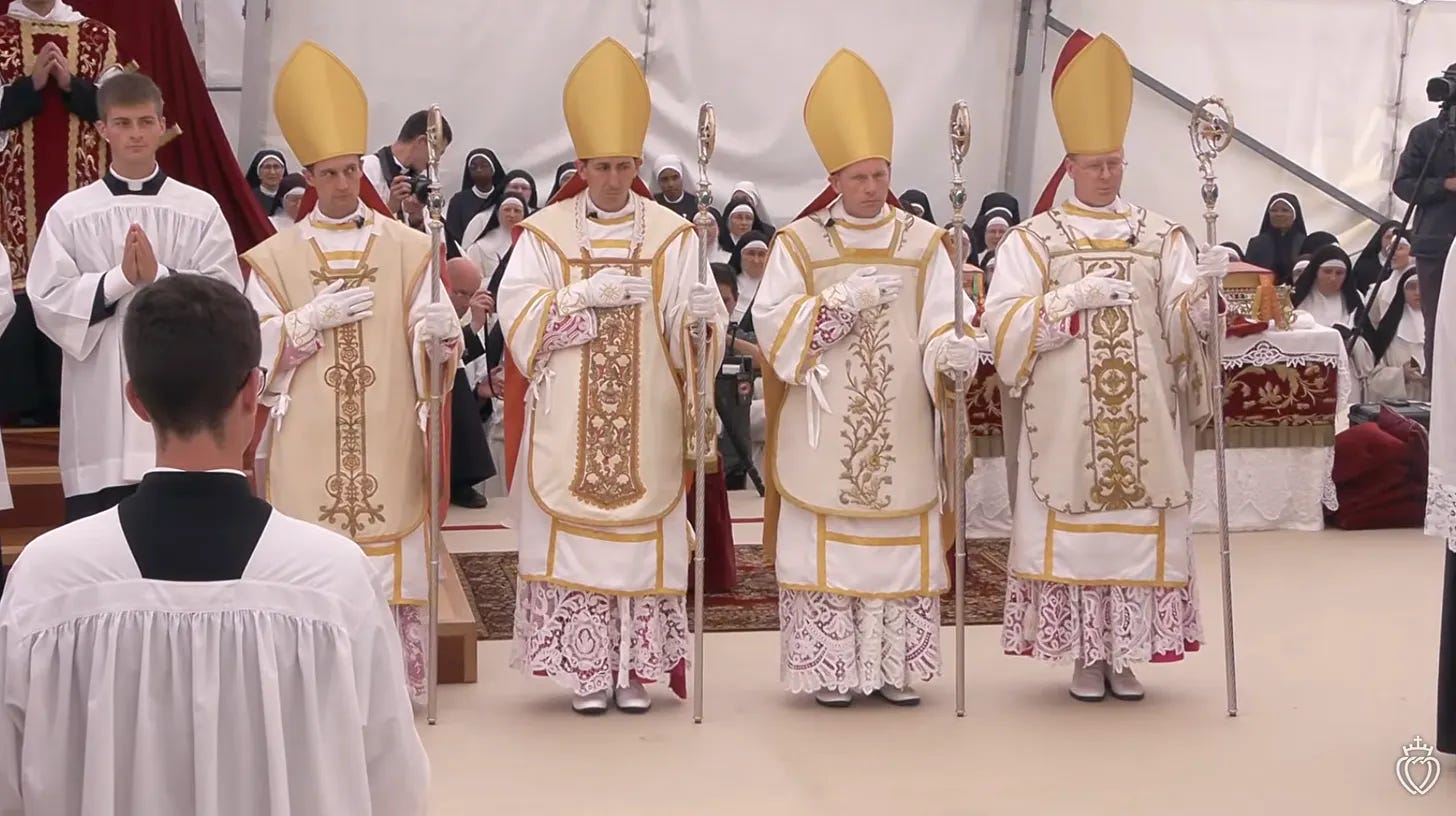
In an unsigned notice to media, released via the SSPX website, the society stated that “in response to the decree issued on 2 July 2026 by the Dicastery for the Doctrine of the Faith, [the society] submitted on 11 July a preliminary recourse to the same Dicastery, in accordance with canons 1734 and following of the Code of Canon Law.”
“This request, which constitutes the mandatory preliminary step before the possible introduction of a hierarchical recourse, has the effect of suspending the execution of the decree, in accordance with canon 1353 of the Code of Canon Law,” the statement said, adding that “the Society intends to exercise the right which the Church recognizes to any person who considers himself harmed by an administrative act to seek its correction, in a spirit of respect for ecclesiastical authority and of faithful attachment to justice, truth and the good of the Church.”
The society did not release the text of the submitted recourse. Absent that, the announcement of the society’s attempt to lodge canonical recourse leaves open a number of questions, which would likely bear upon how such an appeal is received within the Vatican, along with several related canonical questions.
—
Without the actual text submitted by the society to the Dicastery for the Doctrine of the Faith, much regarding the rationale for appeal remains open to conjecture. But the group’s press statement does contain enough information to suggest a few assumptions.
First, that the opening of the recourse process, as cited in the statement, is being undertaken in line with the norms of canon 1734, which deal with the Church’s procedural law for appeals against acts of governance.
Assuming the recourse is being made in line with that canon, the statement means that the society is not yet lodging a formal canonical appeal. Instead, the first necessary step of the process is the presentation of a petition to the relevant authority, in this case the DDF, for reconsideration of the act of governance — the decree declaring the excommunication of the six SSPX bishops who participated in the group’s illicit July 1 consecration.
Canonically, the first stage of appeal is a formal request for the disputed act to be withdrawn or amended, which can be made only within 10 ”useful days” of the act’s date— useful time being the canonical formulation for working days. The dicastery then has a period of 30 days to respond, either rejecting the petition — and clearing the way for legal appeal — or accommodating through the withdrawal or amendment of the act itself.
If no response is received within the 30 days, the petitioner can legally take the silence as a negative response and continue with the appeal process.
However, the society makes a particular claim in its communique about the process: “This request, which constitutes the mandatory preliminary step before the possible introduction of a hierarchical recourse, has the effect of suspending the execution of the decree, in accordance with canon 1353 of the Code of Canon Law.”
Legitimate canonical appeals against decrees involving penalties do have suspensive effect — the law states that “An appeal or a recourse against judgements of a court or against decrees which impose or declare any penalty has a suspensive effect.” And even if the petition for reconsideration did not explicitly request it, the procedural law of the Church provides that when the petition is presented, “by that very fact suspension of the execution of the decree is also understood to be requested.”
Of course, according to the SSPX’s statement, it is only the decree of the DDF dated July 2 which has been appealed, and the decree in question very narrowly pertains to the declaration of the excommunication of the six bishops as individuals. The petition for reconsideration and any subsequent recourse would not then, at least according to the SSPX’s own statement, apply to the other texts issued by the dicastery in the wake of the July consecrations.
Those other documents, an explanatory note from the dicastery outlining the status of the society as a schismatic group and providing a canonical rationale for the status of its priests, and a protocol for the reconciliation of former SSPX members into full communion with the Church, are not automatically included in the appeal against the decree, and so no automatic suspension of their contents would come into play.
However, several important questions remain regarding the appeal against the decree itself.
The first and most immediately relevant of these concerns by whom the petition for reconsideration was presented. According to the SSPX statement, this petition was made by the society itself. This is canonically problematic, if an accurate characterization.
The Society of St. Pius X is not recognized by the Church as an entity, properly constituted in canon law. In this sense, it does not legally exist at all canonically speaking. To the degree that the Vatican has conducted correspondence and negotiations with the society over the last several decades, it has done so recognizing the “members” of the society, most especially the priests ordained by or who have put themselves at the service of the SSPX, as a kind of self-identified group.
While the society could be said to have the status of a self-constituted group outside of the Church, this is not the same as it having legal personhood within the Church — and this is crucial since the society is, according to its statement, seeking to exercise certain legal rights within the Church’s canonical framework.
While the Vatican, and the DDF in particular, has been willing to engage with the society ad extra as a kind of convenient legal fiction for the purposes of communicating with a self-identified group of individuals, because it is not a recognized society in canon law, it does not have and therefore cannot exercise rights as a group as a group ad intra within the Church.
Simply put, it is entirely possible that the DDF will receive a petition from “the society” and respond that no such society exists in canon law, and therefore has no legal standing to make recourse.
That frame of thinking has a significant track record in Vatican jurisprudence. In the United States, over the past two decades, it has often happened that competent Vatican dicasteries receive recourse against the decisions of local bishops, presented by self-assembled groups of local Catholics — often parishioners of churches slated for closure.
In all such cases, the Vatican has upheld that those groups lack legal standing to make recourse, and absent such a group, only individuals directly impacted by the act of governance being appealed can be recognized in law.
As that relates to the July 2 decree, it seems likely that the DDF would only receive recourse from the six bishops directly named in the decree against whom the penalty of excommunication was declared. Those bishops would have to submit the petition for reconsideration either individually, or as a group of six individuals, each signing.
If, as the society’s statement says, the SSPX itself submitted the recourse as the society, and if the text was signed by anyone other than the six bishops directly impacted by the decree — including the superior of the society Fr. Davide Pagliarani — the petition is likely to be met with summary rejection, with an explanation of the reasons.
There would, in all likelihood, then follow a bid by the bishops to claim a legal exemption from the 10 useful days time limit to lodge a valid appeal, which the DDF might or might not choose to grant, depending on the substance of their arguments for an exemption and for presenting recourse at all.
All legal authorities in the Church have the option when considering an appeal to reject it on the summary grounds that it is “merely dilatory,” that is to say that the grounds and arguments offer no substantive points to be considered and are merely a stalling tactic to draw out the canonical process and stall an inevitable result.
If, as some statements emanating from the SSPX’s social media feeds indicate, the society — or more specifically the bishops directly concerned — is appealing on the grounds that its schismatic acts are justified because the hierarchy of the Church is in doctrinal error, including and especially the papal magisterium, this would likely strike the DDF as a mere repetition of the schism, not an argument against it having happened.
—
It is possible, though, that the six bishops could appeal on the grounds that they were not given a formal opportunity to defend themselves prior to the DDF decree — however often they were warned prior to the July 1 consecrations, including by the pope personally, about the consequences, and however explicit they were in their understanding and intent in the act itself.
That argument could meet with a number of possible outcomes at the dicastery. The DDF might conclude that it is a legitimate ground for appeal, and offer the six bishops the opportunity to present some summary of their defense.
However, in doing so, it would likely not be sufficient for them to merely rehearse the society’s argument that the Church is in moral and doctrinal error and therefore they are justified in what they did and immune to its consequences. Such an argument would essentially be seen as the SSPX bishops inviting the Church to declare itself in error to vindicate them, and that would almost certainly be termed a specious and “merely dilatory” appeal.
Of course, assuming for the sake of argument that the appeal is properly submitted by qualified persons with legal standing, and assuming it advances substantive grounds for appeal which are not deemed an obvious delaying tactic, and assuming the DDF recognizes both of these and declines to grant the reconsideration of its July 2 decree, there is still an open question of to whom the DDF’s decree would be appealed.
According to the norms of Sacromentorum sanctitatis tutela, the law on major crimes in the Church, the crime of schism is reserved to the competence of the DDF in all appellate cases. Since the July 2 decree was itself a text of the dicastery, signed by the prefect and the secretaries of both the doctrinal and disciplinary sections, it is unclear to whom their decision would be appealed.
Assuming it was processed and decided upon as an executive action undertaken by the prefect in consultation with the secretaries, and not on behalf of a wider internal decision by the dicastery, the ordinary route of appeal would seem to lead to a congresso of the dicastery, a kind of executive subcommittee of the dicastery’s full membership or to the entire membership at a plenary session.
In either event it would be an appeal of the DDF being heard within the DDF — a common occurrence in penal processes involving the most serious canonical crimes in the Church.
Another option is that either the DDF or the petitioning bishops could elevate matters directly to Pope Leo XIV. In the DDF’s case, this could be done quickest by asking the pope to reissue the July 2 decree with his own personal approval in forma specifica. This would have the legal effect of making the decree a personal act of papal authority and therefore legally unappealable by anyone to anyone.
Alternatively, Leo could be asked by either side — or assume for himself — the responsibility for judging the appeal, with any decision he were to make equally being beyond any further canonical recourse.
In almost any canonical permutation of the situation, however, the underlying facts would remain the same. On July 1, having previously been warned repeatedly and publicly by the Vatican that proceeding with the consecrations would be an act of schism and incur excommunication, the six bishops opted to proceed.
Assuming any appeal filed by the SSPX bishops is correctly formulated, and assuming the appeal process is deemed not merely a delaying tactic by the bishops, it seems hard to conceive of the process resulting in a different outcome.


The Church should respond to them: “from Vatican Council II up to the present day, men in the SSPX have been animated by a spirit that is contrary to that of the faith and have been acting against holy unity. They will no longer endure sound discipline.”
I can't wrap my head around why someone would want to be in communion with another when the former believes the latter has abandoned the faith. Either the representatives of the SSPX cannot reason properly or they have alternative motives in taking this course of action. Either is possible, and perhaps both.