What is the state of Catholicism in England and Wales?
As Bishop Moth steps into its most visible role, what is the state of the Church in England and Wales?
When Bishop Richard Moth is installed as the 12th Archbishop of Westminster Saturday he will become the most prominent Catholic leader in Britain.
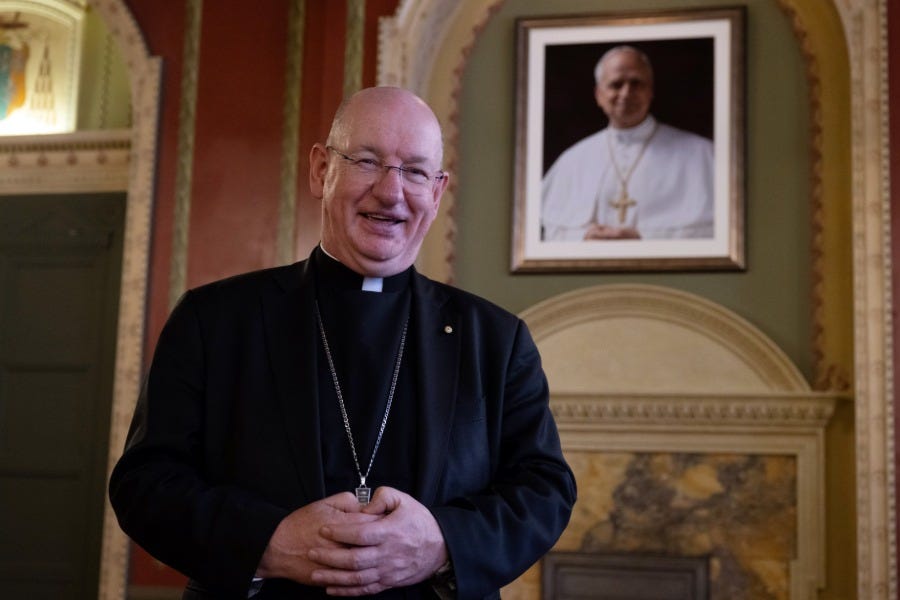
The secular media will likely describe Moth in the coming years as “the head of Britain’s Catholics.” While that’s understandable journalistic shorthand, strictly speaking his authority will extend only to the boundaries of the Westminster archdiocese.
Before long, though, he is likely to be elected president of the Bishops’ Conference of England and Wales. Scotland has its own bishops’ conference, so Moth will never be “Britain’s Catholic leader” in anything but the loosest sense.
But as he steps into its most visible role, what is the state of the Church in England and Wales on the eve of Moth’s installation? Here is a statistical snapshot, with the proviso that statistics cannot present the full picture.
How many weekly Massgoers are there?
Mass attendance has risen steadily in England and Wales since the COVID pandemic. The upward trend is visible in many parishes: pews that once lay empty at Sunday Masses are steadily filling up.
But while the recent rise is uplifting, it must be seen in context. The number of weekly Massgoers is still well below the pre-pandemic figure. In 2024, an average of 575,453 people attended Sunday Mass. In 2019, there were 701,902.
If the current trend of recovery continues, Mass attendance should return to pre-pandemic levels by around 2030. That is by no means guaranteed.
How many new Catholics are there?
New Catholics enter the Church in three different ways. Children are baptized. Adults who enter through baptism are known as catechumens. Adults who have already been baptized in a different Christian community are received into the Church via the sacraments of confirmation and the Eucharist. Let’s consider each group in turn.
In the past few years, child baptisms have continued their long downward trend in England and Wales. This phenomenon, seen in other Western countries, is a mark of secularization, with Catholics tending to marry later and have fewer children than in previous generations. This is a worrisome trend for the Church, but there is a tendency to ignore it because it appears to be an ineluctable process.
There is, however, good news in the other two categories. Both the number of catechumens and candidates seeking reception in the Church are growing.
Again, this is a trend seen elsewhere in Europe, including France, Belgium, and the Netherlands, and also in Australia and the U.S.
Moth commented on this development — dubbed “the quiet revival” by U.K. researchers — at his introductory press conference on Dec. 19, 2025.
He said he was “quietly cautious” about whether the growing interest in Catholicism amounted to a genuine revival.
“A statistician would say: ‘Let’s see it happen for 10 years,’” he commented.
But he noted that in the Diocese of Arundel and Brighton, which he has led since 2015, there were more than 100 adult baptisms in 2025 compared to the year before. In 2026, there will be two rites of election, where catechumens and candidates signal their commitment, because the diocesan cathedral is too small to host them all at once.
“It is true that a number of people are looking to faith and to the Gospel in a new way,” Moth said at the press conference.
“I rejoice in that. I am quite certain that the Diocese of Westminster has been open to this new movement in the life of the Church in the country, and the welcome is there.”
What’s happening with other sacraments?
First Communions are another good measure of the health of a Catholic community. In England and Wales, they have fallen steadily, for similar reasons to baptisms.
Catholic marriages too are in seemingly relentless decline — likely indicating further drops in the number of children raised in the faith.
Confirmations, however, have been rising since the pandemic. This is interesting, because there has been a trend in recent years to stress that the sacrament should be the fruit of a mature personal decision, rather than parental pressure. At least one English bishop asks confirmation candidates to write to him, explaining why they wish to receive the sacrament.
The recent decline in deaths, meanwhile, suggests fewer families are opting for funeral Masses for their loved ones.
How many new priests are there?
Some argue that England and Wales have historically enjoyed an unusually favorable priests-to-people ratio, but this has eroded in recent decades.
The decline in the number of new priests over the past 30 years has profound consequences for the local Church. The combination of falling Mass attendance and ordinations has forced most dioceses to amalgamate or close parishes.
Worryingly for Moth, the Archdiocese of Westminster has struggled to nurture new priests in recent years, despite being one of the most populous dioceses.
Two new Westminster priests were ordained in 2025. The diocese is forecast to have just one priestly ordination in 2026 and one in 2027.
In Moth’s previous Diocese of Arundel and Brighton, there were two priestly ordinations in 2024 and two more in 2025. But the diocese is projected to have none in 2026 and 2027.
Moth will also have the challenge of raising the morale of Westminster’s overstretched priests, while possibly considering some kind of reorganization of dioceses — an inevitably unpopular move among the laity.
What’s happening to religious life?
Over the past 30 years, the number of male and female religious in England and Wales has declined significantly.
Among the bodies hit hard is the English Benedictine Congregation, which for generations exercised a powerful influence on English Catholicism through its abbeys and affiliated schools. Due to shrinking numbers, the Benedictines have been forced to close once celebrated communities such as Downside Abbey.
At the same time, there have been pockets of growth in religious life. The English Dominican Province is making a notable pastoral and intellectual contribution, especially in London and Oxford. Despite its relatively small size, it has produced renowned figures such as Fr. Aidan Nichols and Cardinal Timothy Radcliffe.
Lively female religious communities include the Dominican Sisters of St. Joseph in Lymington, Hampshire.
Moth seems to have a deep affinity for religious life. He is an oblate of Pluscarden Abbey, a Benedictine foundation in Scotland, where he makes annual retreats.
He is likely to draw on monastic spirituality during his tenure at Westminster. He previously promoted lectio divina — the prayerful reading of Sacred Scripture — in schools in the Arundel and Brighton diocese. Look out for similar initiatives in the years to come.

What happened to diocesan ordinations in 2000?
In Damian Thompson’s reporting, he has suggested a lack of “enthusiasm” among the presbyterate to Moth’s appointment, and he has described the appointment as more or less “unimaginative.”
Any thoughts on the what the reception on the ground has really been like?
Ultimately, I suppose, we’ll see what fruit there is in ten years.