
Pillar paid subscribers can listen to JD read this Pillar Post here: The Pillar TL;DR
Good morning Ladies and Germs,
Well, later this month is the feast of St. Christina Mirabilis — Christina the Astonishing, they call her — and today seems like a good day to tell you all about her.
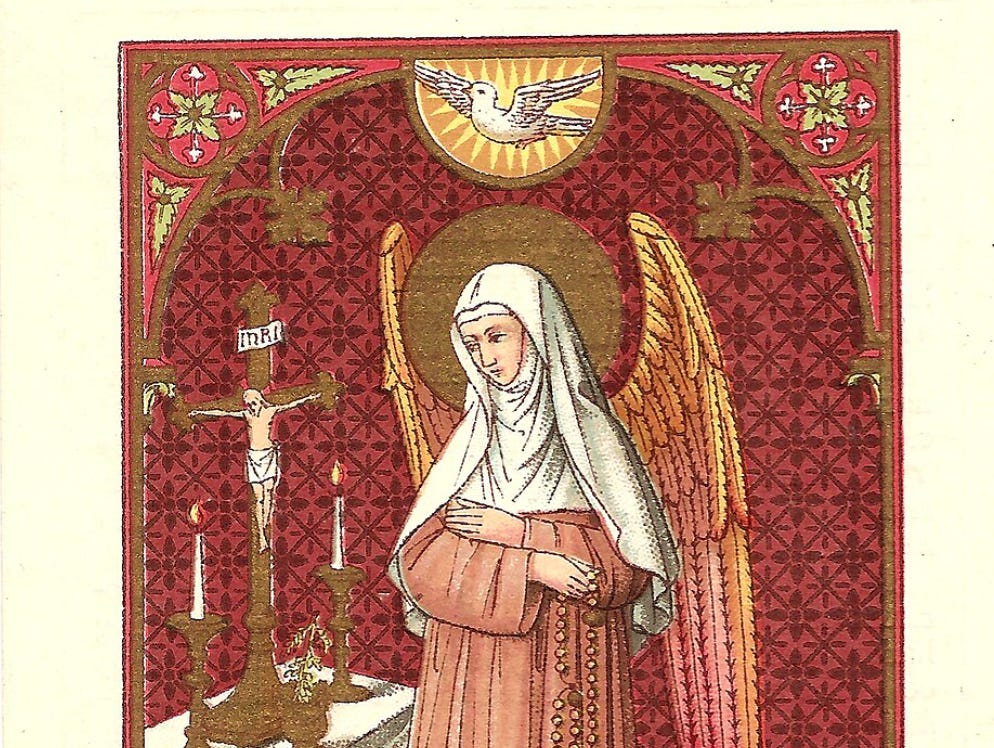
Christina the Astonishing wasn’t a magician, though I hope that out there somewhere is a woman working birthday parties and doing card tricks, who has taken the moniker as a kind of quiet homage to the great lady.
And Christina was a great lady.
She lived almost 900 years ago in the city of Liege, in what is now Belgium. We don’t know much about her early life. Her parents died when was 15; she lived by tending sheep.
But she had epilepsy, and she had a seizure when she was 21 or 22. She was comatose after, and presumed dead. Her open casket was carried into her parish church for a requiem Mass.
But at the Agnus Dei, Christina sat straight up from the coffin. The congregation was surprised, as you’d also be.
They were also quite terrified — near everyone fled the church, save for Christina’s sister, and for the priest, who was resolved to finish the Mass.
We don’t know quite what happened, but the stories of her day say that Christina levitated to the Church rafters, and stayed there until the end of Mass — when the priest convinced her to come down.
When her feet were firmly on the floor, Christina apparently said two things:
First, that she had levitated to the rafters because she could smell the sin of the assembled congregation, and the stench was odious to her.
Second, that she actually had died. That she had seen Hell, and friends suffering there, and then seen Purgatory, with more friends, and Heaven — presumably with far fewer. Christina said she had begged God to allow her to return to earth, in the hope of saving souls.
That was a lot to claim. And a lot for people to take in.
After that, Christina became somewhat … singularly focused on salvation. She lived often in the streets, and usually as a beggar. She was attacked by dogs. She insisted she could smell sin, and she frequently ran and hid from people who offended her sense of smell, and thus her conscience.
She acted strange.
She liked to curl herself into a ball in the church where she prayed. She liked to spin. She hurled herself into icy rivers, she would plunge her hands into fire — all to convince people, she said, of the reality of sin.
She was at least twice arrested.
Christina was unwell. There’s no other way to say it. There is a reason she is a patroness for people with mental illness.
She was also recklessly generous. She gave away what she had, even if she had just begged for it. When people gave her food, she usually knew someone who needed it more than her. She dressed in rags, but she’d give them away in the icy winds of winter.
As time went on, and the years wore on her body, Christina agreed to live in a convent, amid sisters who’d come to love her. There, things changed. She found some peace. And people came to see her, every day, because they wanted to talk with her. She didn’t say much to them — but she pointed them toward the merciful Christ.
When she died — on July 24, 1224 — the community’s prioress explained to a local bishop that Christina was, at all hours, in the chapel, talking — sometimes almost indecipherably — with the Lord.
And that when she came to the monastery, Christina had asked to live under a kind of obedience. That she listened to whatever the superior asked of her, no matter how hard or how trivial. That obedience, it seemed, in the stable routine of the monastery, had begun to give Christina real peace.
In her life, no one could agree whether she was insane, or a prophet. Was she putting her hands into fire as a courageous witness of sin, or because she had no power to reason? Was she generous, or just unable to care for herself, to see even past the moment?
After her death, the debate continued. But people came forward to testify to her virtue. They said they’d been converted by her witness of faith. And a cardinal named Jacques de Vitry said he was convinced she was a holy woman, who saw God where few others did.
A few years later, when her body had to be moved, her coffin was said to emit the strongest and most beautiful aroma of holiness — one which would have been pleasing even to her.
She was remembered soon after as a saint by popular acclamation and, inscribed in the Church’s rolls of holy men and women, remembered at the altar.
Somehow, in the mystery of grace and Providence, I don’t think the questions about her sanity and her holiness are properly ‘either-or” propositions. She was mentally unwell, that’s obvious. And I think God worked through that — not by healing her, but by letting her life become a witness to faith, hope, and charity, even in ways that were disturbing, or distressing, and sometimes astonishing.
When I tell her story, Christina has the advantage of being long dead. That means her rough edges can be viewed gauzily as “eccentricities,” and romanticized into markers of sanctity. It’s not so easy to do that with mental illness in the people we love, or in ourselves. There the messy reality of life — which is smoothed down in the pages of hagiography for Christina — can be more visceral, and often more painful.
But Christ may be no less present. In people doing strange things — things even which cause pain, or frustration, or something close to despair — the witness of grace might still be there too. Christina is an invitation to look for Christ, and the resonance of his grace, in people carrying the torment of crosses borne mostly in their own minds. This all a mystery, and one we hardly plumb in the short period of our lives. But somewhere in the mix of that mystery is the haunting and inscrutable presence of God.
I hope she’ll intercede for us. I need, in my own life, the lessons Christina can offer. Perhaps you do, too.
The news
That’s not surprising: cardinals meet with the pope, it’s in the job description. But Cardinal Nzapalainga’s situation is unusual: He is just 59 years old, not sick, and was given a coadjutor bishop — a man appointed to eventually replace him — just two months ago.
The reason is not entirely clear. But in the CAR, his nation, there have been rumors about an allegedly wide-ranging ecclesial fiscal management crisis, and reports that Cardinal Nzapalainga’s resignation has been requested by the pontiff.
Now, those reports might be easily dismissed, if the pope hadn’t just a few months ago shaken up the entire structure of the Central African Republic’s dioceses, in a way that significantly reduced Nzapalainga’s areas of oversight.
Something is going on. And, with meticulous care, The Pillar’s Luke Coppen lays out everything that’s known, and the open questions still unresolved.
(This seems like a decent time to mention that about 12 years ago, my dad survived a plane crash in the Central African Republic. He was there for work. A cargo plane in which he was a passenger took off from a red earth runway, struggled to gain altitude, and crashed into the bush at the edge of the strip. He got no scars but some very cool photos, which I’m fairly certain I’m not allowed to publish here. The point is that my dad is a pretty bad-ass guy.)
—
The Holy See published on Monday the topics and preparatory document for an October meeting of presidents of bishops’ conferences and heads of Eastern Churches, who will gather at the pope’s request to discuss Amoris Laetitia.
The meeting — which will also involve several families sharing their experiences — has been widely taken as a sign of Pope Leo’s ongoing intention to consult broadly among bishops on topics that have been in recent years controversial in the Church.

Prepare your diocese for 2027’s Education Freedom Tax Credits with the Catholic Education Fund. Our turnkey SGO solution provides shared infrastructure, compliance, fundraising, and distribution at scale—delivering national reach with local impact. Don’t navigate this alone. Join our national network of dioceses as a Partner. Let’s grow Catholic education, together.
But the pope also appointed to the Dicastery for Promoting Integral Human Development, Sister Smerilli’s department, a “pro-prefect,” a kind of collaborator for the prefect, who happens to be a cardinal. That appointment raises some questions about when a Vatican department needs to be led by someone ordained, and when that isn’t required.
It also raises questions about whether Leo might eventually formalize a working list that seems to exist of dicasteries requiring a bishop in charge, and those which don’t.
Ed Condon asks some good questions about Leo and the Vatican’s ever-evolving governance structure.
The Catholic Standards Safeguarding Agency said Monday that for the Church in England and Wales, a survivor-centered approach to safeguarding policy is “exceptional rather than assured.”
This means that according to the bishops’ own monitoring agency, a person coming forward with a story of abuse might find support from the Church, but as likely won’t.
A plan for national standards on safe environment and victim support policies — first called for 25 years ago — is not yet realized, the agency said.
In sum, its report “paints a picture of the Catholic Church in England and Wales lamentably failing to adequately care for people abused within it.”
A bishops’ conference spokesman says the bishops have a plan, and a new “strategic council” aimed at addressing the issues identified by the report. Victims’ advocacy groups say they’re not holding their breath.
—
And you’ve been reading a lot lately about the excommunications of the Society of St. Pius X.
The story has gotten a lot of ink — and deservedly so, it represents a true schism in the body of Christ, and a major flex on Pope Leo’s part to address it.
But how many people does it actually impact?
Well, that’s a good question. And a lot depends, it turns out, on who’s doing the count. Here’s why.
—
The University of Notre Dame is facing a reckoning right now, over allegations and reports of sexual abuse and misconduct, both historic and current.
In May, the university announced that a third-party investigation had identified “instances of sexual abuse and a predatory pattern of behavior” by Fr. Thomas King, CSC, who served for 17 years in the ‘80s and ‘90s as rector in a male undergrad dorm. Another priest, Fr. David Porterfield, CSC, was also a dorm rector in the early ‘80s, and also faced allegations of sexual abuse, according to the report.
The report identified failures in Notre Dame’s historic record on communicating allegations internally and with the Congregation of Holy Cross, and recognized a pattern of spiritualized abuse that was manipulative of religious identity and authority.
Notre Dame is also facing now an allegation that a current dorm rector, Elizabeth Greenop, allegedly abused her position by giving an underage student alcohol and “groping” her while they had a vulnerable conversation, “sexually assaulting” another student, and requesting nude photos from a third undergraduate resident in her charge.
Greenop has not responded to media requests for comment, and the allegations are exactly that — allegations.
But the situation at Notre Dame — both historic and current — points to a reality of sexual misconduct in the Church which has not yet been fully addressed, either in law or practice: the sexual abuse of adults in ecclesial contexts, often wrapped up in spiritualized or vulnerable conversations, and perpetrated both by laity and by clerics.
Despite the efforts of recent years, victims’ advocates continue to insist that the problem of adults abused in vulnerable ecclesial situations is not fully appreciated, and not fully addressed.
These situations are harder to investigate, to address, and to resolve than are the clear cases of clerical child sexual abuse which intially prompted the Church’s modern efforts to build policy solutions to abuse.
From my point of view, that makes them harder to address by policy. Ecclesiastical leaders should try, to be sure, and should be committed to broad and expansive efforts on that front.
But they point, really, to something else.