
Paid Pillar subscribers can listen to JD read this Pillar Post here: The Pillar TL;DR
Hey everybody,
It’s the second Tuesday of Easter, and you’re reading The Tuesday Pillar Post.
Look, I know what you want me to write about. And I’ll get there. But we’re going to do first things first today, and maybe that’s all in God’s providence.
So let me tell you that today is the feast of Blessed Peter Gonzalez.
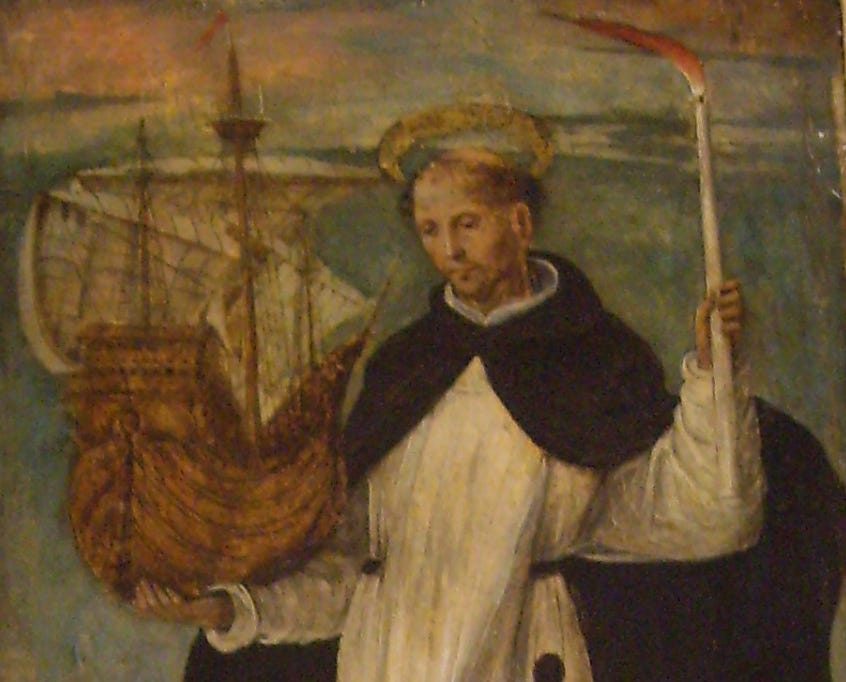
Peter — who is sometimes called Elmo — was born into a noble Spanish family in 1190, which means he was just nine years younger than St. Francis.
But Peter’s young life was even more privileged than that of Francis.
Peter was well-educated, raised for leadership, taught horsemanship and swordplay and culture and languages. He spent a couple of years sowing wild oats, as rich young men sometimes do. And then his uncle — a powerful and connected Spanish bishop — told Peter to settle down, get ordained, and become a canon in the cushy cathedral of Palencia.
He was too young to be a cathedral canon, but his uncle pulled some strings, aiming to set Peter up for a life of comfortable ecclesial nobility. His uncle hung benefices around his neck, and aimed to get him a gig in a royal or noble court.
Peter wasn’t a very good priest, but he didn’t seem especially to care about priesting, either.
He was confident, vain, and prideful. He lived for himself.
And then one day, Peter was riding into Palencia on a magnificent (expensive) horse. The horse stumbled in the street, and Peter — for all his vanity — fell right off that horse, into the mud of a medieval city street. Don’t forget, people emptied chamber pots into those streets. And there was Peter in the muck.
Here’s the worst part. Peter’s own people — the Palencia crowds who worshipped at the cathedral, where Peter was supposed to be their priest — laughed at him. Not one of them helped him up.
Peter got up alone, humiliated and dirty, and walked into the cathedral rectory.
And then for a reason I can’t give you — a reason that only was grace — Peter withdrew to a hermitage, a kind of retreat house outside the city. I think maybe he was just embarrassed at the public humiliation.
He was Peter freakin’ Gonzalez, and he’d been laughed at like a fool.
Somehow God worked through that. Whatever his plans were, Peter stayed away for a year. He learned to pray. I think he went to confession (though I have a lot of questions about how confession worked in 12th century Spain.)
He came back a different man. Like another rich young man was once advised to do, Peter sold everything he had. I’ll bet he gave the money to the poor. And to follow after Jesus, he became a Dominican friar.
Peter was a priest already, a nobleman, educated and accomplished, but he started in the novitiate, and he learned the contemplative and missionary patterns of religious life.
But becoming a Dominican then was not the kind of thing a noble family hoped for their son. And Peter’s family tried to convince him to leave. But as I read it, he turned that around for them: “If you love me,” he’d tell his kinsmen and family members, “follow me!”
I don’t think anybody did.
Providence has its own logic. I don’t know what might have become of Peter-the-rich-young-man, whose uncle wanted to find him a place at court. But Peter-the-friar found himself in exactly that place.
See, Peter became the confessor in the court of King Ferdinand III of Castile, who himself became a saint.
Peter reformed the court; he made regular Mass a thing, and he tried to enforce public morality among the decadent courtiers who spent time around the king. When King Ferdinand went to battle, Peter went with, and he advocated that the Castilian troops refrain from pillaging cities, and that they treat their prisoners-of-war humanely.
For Peter, the trouble was this: Ferdinand was impressed with Peter. The king liked Peter; he gave him honors and an easy life.
Peter realized that his old sins — pride and vanity, especially — were creeping in. He was tempted to flattery and worldy supplication. Peter didn’t want to stay that close to power, if it would cost him his soul.
So Peter left court to become a circuit rider, traveling between shepherd camps in the hills to offer Mass and hear confessions. He started going to see their family members living in port cities, and became a kind of chaplain to Spanish and Portuguese sailors and seamen.
He died in his 50s, on April 14, 1246, in a city near the sea, living a very different life than the one into which he had been born.
Take from Peter’s story what you will. But I’ll tell you this. He put a lot aside to follow Jesus Christ. And he was so appreciated by those sailors, they kept telling his story, about the man who came to their ships and heard their confessions, and taught them to pray. On the docks and on ship decks, they called him their saint, long before he was beatified in the 1740s.
And I suspect he’s interceding now for those of us tempted to pride, to vanity, to taking comfort in office, and power, and the trappings which go with it.
May he intercede for each of us in need of conversion.
The news
Last week, you’ll recall, a whole fracas emerged in the media about whether Cardinal Christophe Pierre had received some penumbra of a threat from U.S. Pentagon officials who were said to have made reference in the nuncio’s presence to the “Avignon papacy.”
If such reference occurred, reporting suggested, it could have been taken as a veiled suggestion that the U.S. would act coercively against the Holy See or the Roman Pontiff.
But catching all that requires some solid historical basis on why popes went to Avignon in the first place. So we here at The Pillar decided to fill you in.
If you’re wondering, here’s the info.
—
The Peruvian bishops’ conference announced last week that its secretary general, Bishop Antonio Santarsiero, has temporarily stepped down from his position while an investigation is conducted following the emergence of abuse allegations against him.
The bishop is accused of sexually abusing several victims, including a minor.
And given that all this is happening in Pope Leo’s adopted home country, how things proceed will say a lot about the pontiff’s plan for episcopal accountability and due process.

This Easter, transform how you accompany others on their journey to Christ. During the St. Paul Center’s Easter Challenge, receive weekly reflections from Dr. Jeff Morrow, Fr. Boniface Hicks, and the Mercedarian Sisters on how Jesus’ patient presence on the road to Emmaus shapes the way we accompany others today.
The Archdiocese of Chicago and the Chicago public school district are in a public disagreement over federal special education funds, which have been discontinued for Chicago Catholic schools for the remainder of the school year.
The archdiocese says that Catholic school students with learning differences — which can range from mild to quite significant —will see reading and math interventions cut in archdiocesan schools this year for as many as 800 students.
But there are very different accounts of how things got to this point. The archdiocese says that Catholic schools are being treated wrongly, that the situation could raise constitutional questions, and that it’s considering the prospect of litigation.
But the school district told us that Catholic school administrators were warned repeatedly they were spending their allocated funds too quickly, and that the pot would be empty before school was out for summer.
If you ask me, it’s part of the ordinary vocation of a Catholic school to provide necessary academic support for students with learning differences and disabilities. That’s not optional or an add-on, it’s a matter of justice, and it’s part of what it means for Catholics to be open to life.
So the discontinuation of services is a big deal — one which ruptures the covenant at the heart of Catholic education between students, parents, and educators.
In other words, this is a mission-critical issue for the Archdiocese of Chicago, and one which it likely aims to resolve as quickly as possible.
But is it a matter of administrative negligence, or is this a case of religious discrimination? Well, in Chicago, that depends on who you ask.
—
Ok, I’ll write about Trump et al a bit below, but we do have some coverage of the national situation for you.
First, Edgar Beltran brings you a round up of international Church and state reactions to the emerging tension between President Trump and Pope Leo.
Next, Ed Condon brings you his analysis of the president’s effort to engage the pontiff as political figure.
I’ll bring you my thoughts in a minute.
But first, news of a different kind of electoral politics.
The bishops of the Chaldean Catholic Church announced April 12 that Archbishop Emil Nona has been elected Patriarch of Baghdad, leader of the Chaldean Catholic Church, taking the regnal name Paul III.
I had hopes to attend Nona’s first regnal Masses in Baghdad soon, but Mrs. Flynn asked me to wait on visiting Iraq until things cool down with its neighbor Iran. That’s a fair request, I think.
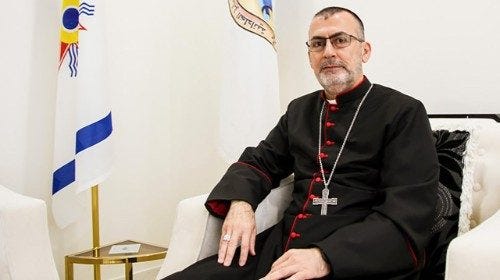
In any case, Nona — a close friend of prominent Chaldean Archbishop Bashar Warda — was among the most likely candidates if Warda himself was not elected or did not accept the patriarchal office.
But Nona is a significant figure in his own right. He was the Archeparch of Mosul in 2014, and forced in exile as ISIS took control of the area and Christians fled or were killed, leaving no flock in his archdiocese.
Nona said then that he had lost his archdiocese. He himself landed in Australia, and was appointed eventually to lead the Chaldean diaspora there. He is, by the account of Aussies who know him, a man of deep faith and good humor.
But he’s got a lot to deal with. The Chaldean Church is recovering from an extremely tumultuous period under the leadership of Cardinal Louis Sako, the prior patriarch, which culminated in Sako’s alleged cover-up of the financial and moral scandal involving Bishop Emmanual Shaleta, who is accused of taking hundreds of thousands from his own diocese.
Shaleta is now facing criminal charges. But Nona has some big decisions to make, which we’ll report on in the weeks to come.
In the meantime, his election is making waves for Chaldeans around the world.
One senior cleric put it this way: “It’s like we woke up, and the entire Church had changed.”
Stay tuned.
Matters of morality
This has been a month for American Catholics.
After the brouhaha last week over Cardinal Pierre’s January meeting at the Pentagon, we saw on Sunday night President Trump post on social media a tweetstorm attack of criticism against Pope Leo, and then double down in rather wide-ranging comments to a reporter, which centered around the idea that the president is “not a fan” of the pontiff.
Those comments have prompted a wide range of responses. Outrage. Confusion (over the thread of logic running through the president’s remarks). Frustration. Disappointment.
To me, they were unsurprising. President Trump has a tendency to call out figures with whom he disagrees, and he disagrees with Pope Leo on the justice of the Iran war.
Sure, the president articulated that while also calling Pope Leo “soft on crime,” and taking credit for his papal election, but the post and comments struck me as basically Trump being Trump.
This is the guy people picked to be the president. Now, some are asking questions about his mental capacity, while others call him heroic, and some point out that whatever you get with Trump is, to them, better than what we might have gotten if he hadn’t won the ‘24 election.
In America — and according to the Church, for that matter — everyone has the right to make his own prudential judgment on such matters. So here we are.
Now, more troubling for me is the AI-generated picture Trump posted online, the one that shows him as a kind of divine physician, clad in something he might lifted from the set of “The Chosen” and holding some kind of light beam, while placing his healing hand on the forehead of a guy who looks a lot like John Stewart.
The flag waved behind him, while a supplicant prayed, a nurse stood by, and Charlie Sheen looked on piously in a camouflage cap.
There was also a random guy with a white beard and a ball cap (perhaps Moses or Elijah? Should we build a star-spangled tent for him?).
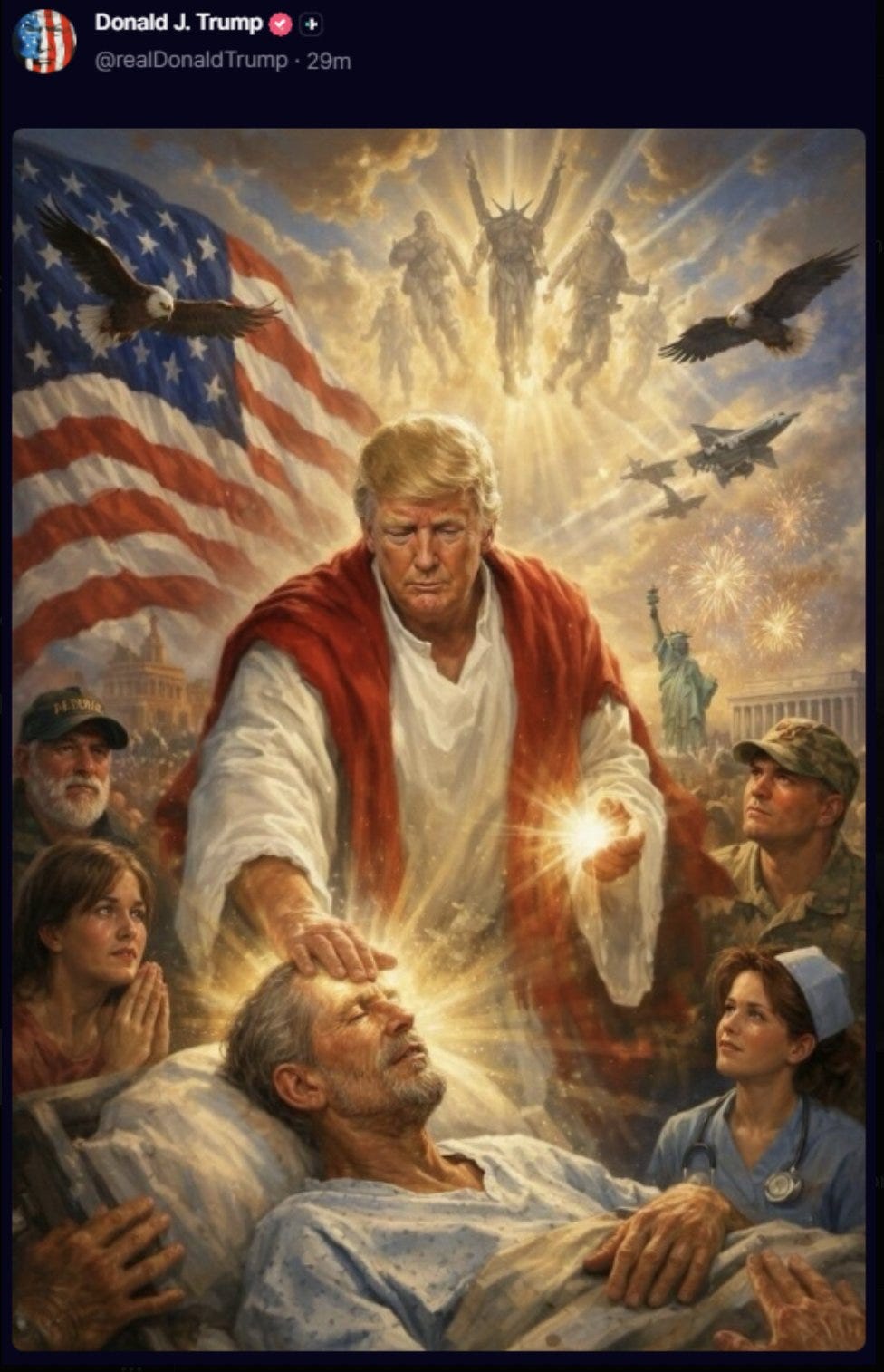
The picture struck most people, including me, as a Trumpish bit of blasphemy, in which POTUS shared some AI-created and trippy Trump/Christ mashup featuring a bald eagle, a Statue of Liberty/King Triton/St. Michael hybrid, and a couple of F-35s just for good measure.
After some pushback, Trump deleted the picture, and then asked us to believe that he had posted it because he thought it depicted him as a doctor — at which point Trump reminded the American public that he does actually “make people a lot better” by his largesse as president.
I read a great report the other day about how Kim Il Sung used some lessons from American Protestantism to create a three-generation religious cult of personality, and, well, suffice it to say, I think at least one necessary component is being willing to declaim your healing powers at every available opportunity, even when you’re supposed to be making excuses for a Jesus picture that your Jesus-loving supporters ain’t gonna like.
Anyway, all of that is what it is.
Trump is gonna Trump.
Trump is gonna Trump. You can no more expect otherwise than you can expect Italians to queue up politely and orderly for Holy Communion, or Ed Condon to accept the innovation of quartz watches, designated hitters, or the novelty of ballplayers wearing leather “mitts” on their catching hands.
And because Trump is gonna Trump, I’m also skeptical that this whole situation was some strategic play on the president’s part meant to achieve some particular political outcome, or that it will have a dramatic effect on the president’s electoral base, even the Catholics. Voters who support Trump have decided the benefits of the president outweigh his peculiarities, and they seem, to me at least, fairly resolute in that conclusion.
So because Trump is always gonna Trump, I’m far more interested in the situation of Vice President JD Vance.