
Reminder - The Pillar Podcast is having a live show this Wednesday, Sept. 23, in St. Louis for the beatification of Fulton Sheen! We’ll be at the Schlafly Taproom at 2100 Locust Street, starting the show at 9pm but come early if you want! See you there!
Hey everybody,
Today’s the feast of St. Thomas of Villanova, the Augustinian friar who was in the 1500s the Archbishop of Valencia, and who was a fiery preacher, an ecclesial reformer, and so committed to the margins of his diocese that he became known as the “father of the poor.”
If you’ve heard of him at all, you probably associate the saint most with his namesake university in Philadelphia, which means that until last year, you probably associated him with basketball, the most famous thing to come out of Villanova University before the election of Pope Leo XIV last year.
Would Thomas of Villanova have liked basketball? I don’t know. He didn’t like bullfighting, but bullfighting is different from basketball, because basketball players don’t get stabbed the entire game, and then roasted for public consumption immediately after a loss.
(Though in fairness, if the WNBA could figure out a way to put Caitlin Clark through that treatment on a nightly basis, I’m guessing they’d try it.)
But while Villanova himself was a cool guy, I thought I’d use his feast to tell you a little something about his university.
In 1796, an Augustinian friar named Fr. Matthew Carr arrived in the United States at the request of Bishop John Carroll, who had begged Irish religious missionaries to come to the new nation.
Almost by default, Carr became the provincial of newly established Augustinian province, and he started building a church with a spate of donations from America’s founding fathers, including 50 bucks from George Washington himself. The church was St. Augustine, and it opened in June 1801. From the parish sprung a school, St. Augustine’s Academy, the first educational foothold for the Augustinians in the U.S.
Forty years later, friars from the parish bought a big tract of land outside Philly to expand that school, and in 1842, they opened the Augustinian College of Villanova, which was both a religious novitiate and a college for the thousands of Irish immigrants who had begun pouring into Philadelphia.
Well, those immigrants weren’t too popular among the “heritage Americans” of the day. Philadelphia had become a hotbed of anti-immigrant sentiment; with a rising political movement of Protestants — many of whom claimed to trace their ancestry to the American Revolution — who opposed the presence of filthy Irish Catholics in their city, and especially the prospect that those Irish Catholics might become American voters, and an influential political force.
In Philadelphia, the tension was centered around a Bible — Catholic clergy opposed the use of the King James Bible for the education of Catholic children in public schools, and they wanted the Vulgate added to the curriculum — and the nativist Protestants opposed that prospect. “If you come to our country,” they reasoned, “you should use our Bible. Or, at least, the Bible from the country we used to belong to.”
1844 was an election year, and that led to a lot of anti-Catholic campaigning in the City of Brotherly Love, especially from folks running a nativist mayoral candidate. And in a move that can only be seen as trolling, the nativist political candidates and their supporters made it a point that spring to give speeches in Irish Catholic neighborhoods.
Well, that led to fights, and then gunfire. The fights led to marches. And the marches led to arson, with nativist gangs burning Catholic houses, and then Catholic fire stations, and then Catholic churches.
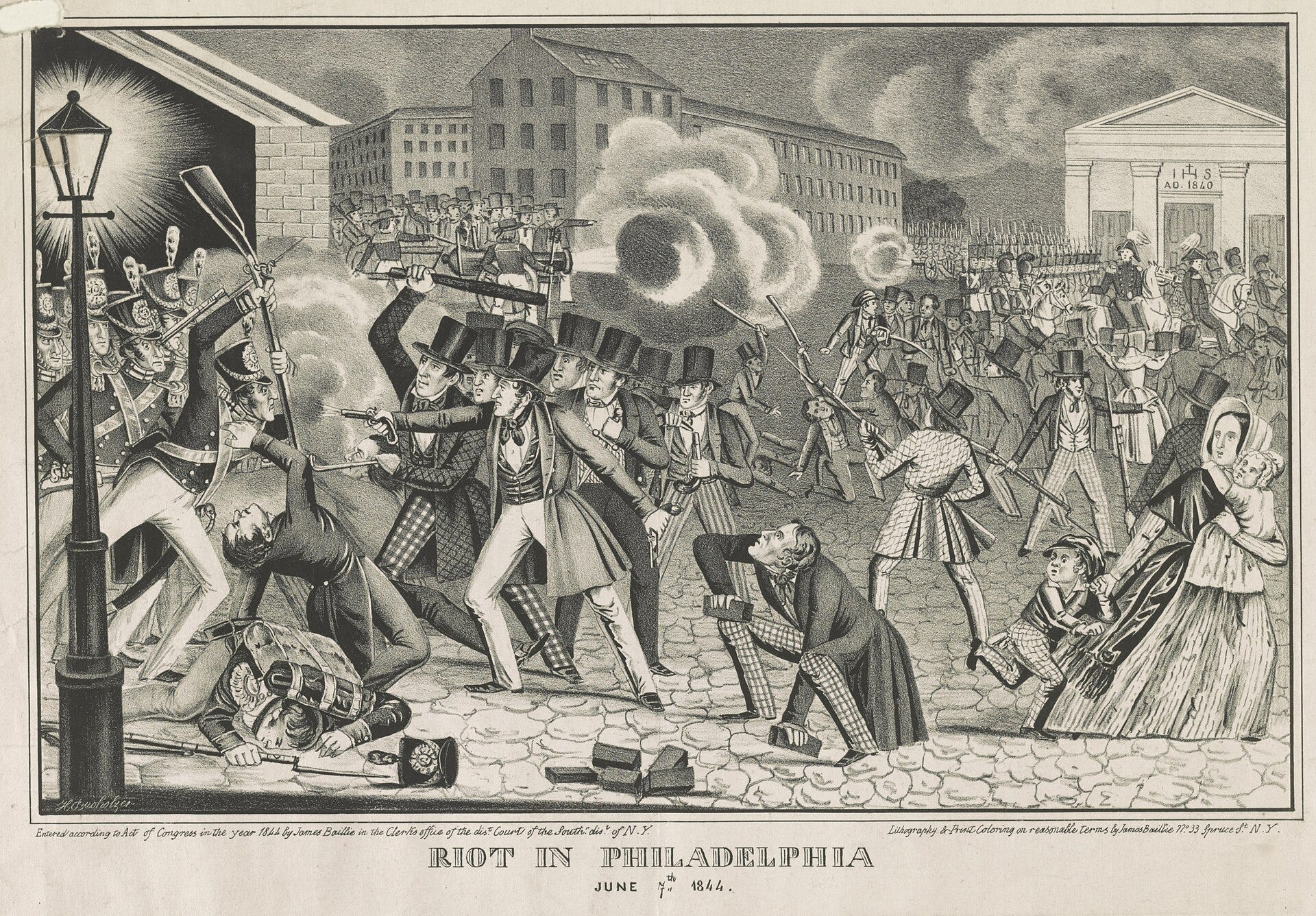
St. Augustine’s Church, which George Washington had helped pay for, was burned to the ground by gangs claiming to carry the mantle for Washington, and promoting a version of America he would not recognize.
The church fire put the Augustinians on their heels, and they had to close their fledgling college. They couldn’t reopen it for a year. They couldn’t graduate their first class until 1847. But they endured. And then they graduated another, and another.
Has the Catholic identity of Villanova wavered over the years? Yes. Has it been sometimes lost in the ra-ra of basketball, “elite” academics, and a false notion of academic freedom. Yes.
Villanova graduated a pope, but is it the model Catholic university? There are some very good things going on there, but ample problems, too.
But it’s worth remembering those early days, when the very existence of Villanova was a testament to the Catholics who endured extraordinary prejudice to be a part of this country. And to the Augustinian friars ready to form them, under the mantle of their patron, the “father of the poor.”
May St. Thomas of Villanova intercede for the complexities of the Church in this country. We surely need it.
A quick reminder that The Pillar runs on subscriptions. If you think our public accountability journalism, our podcasts, and our newsletter matter, please become a paying susbscriber. The only way we stay in business is you.
The news
First, if you’re tracking this at home, The Pillar learned yesterday that the Vos estis lux mundi investigation into Baton Rouge Bishop Michael Duca has been completed, and sent to the Dicastery for Bishops for a determination about what comes next.
We’ll continue to keep you updated on this important story.
—
An alleged victim of Fr. Marko Rupnik says that she has not been consulted about a decision in Fátima not to remove mosaics created by the disgraced artist, and that Rupnik’s style gives his work “a feeling… of invasiveness.”
Farbrizia Raguso spent two decades in the Rupnik-associated Loyola Community, where she says that Rupnik spiritually and psychologically abused her.
She told The Pillar that: “The experience of standing before [Rupnik] mosaics brings a feeling of inner invasion. Because of the insistent use of gold and harsh colors; the size of the figures; the unsettling feeling caused by their black, bottomless eyes; and also, in some cases, by their bodily postures. … We do not feel welcomed as we should, as we do before the authentic art of Byzantine icons, which allow us to enter into a spirit of deep prayer.”
Read more from Raguso, right here.

The St. Paul Center App | Bible Study On-The-Go
Read and understand the Bible with St. Paul Center’s new app! With today’s leading Catholic Scripture scholars as your guides, the St. Paul Center app empowers you to read the Bible from the heart of the Church. Download the app for free at either the Apple or the Google app stores. https://stpaulcenter.com/app
The patriarch says he might take legal action against “fabrications, lies, and vulgar verbal attacks” against him.
Younan seems resolved not to become the first Eastern Catholic patriarch removed under a Pope Leo policy that would let the Church’s bishops depose him.
At The Pillar, we’ll continue to bring you in-depth coverage of this fascinating story. Here’s the latest.
This is exactly the kind of thing which victims and their advocates called for in the wake of the 2018 ecclesial scandals — a serious-minded and spiritually sober effort to address sins against human dignity committed in the context of the Church.
From the sound of it, the focus of the task force will be to lobby Congress for AI safeguards and reforms. But in an analysis on the subject, I wonder if there isn’t an area of focus that would have decidedly more impact on the lives of Catholics. Read it here.
—
Finally, to Princeton University. Home to groundbreaking research, one of America’s first two college football teams, and the setting to Russell Crowe’s masterpiece, “A Beautiful Mind.”
Michelle La Rosa talked with Fr. Swantek about his mostly-homegrown approach to Catholic formation, the importance of beautiful liturgy, and the work of his pastoral ministry.
(And by the way, when I found out Michelle interviewed this guy, I was on a personal level delighted. About a million years ago I went to high school, and to some fantastic Supertones concerts, with Zach. Er, Fr. Swantek. Good dude, in my estimation.)
Here’s what he had to say about faithful formation in the Ivy League.
Bible songs
There is a debate on the internet right about director Greta Gerwig’s plans to cast Meryl Streep as Aslan in an upcoming film version of “The Magician’s Nephew.”
I can’t tell whether there is a substantial contingent of Christians who care about Greta Gerwig’s casting of a Narnia movie, or whether there is instead just a group of trolls hoping to meme some outrage into existence.
I don’t care at all who Greta Gerwig casts as Aslan in her Narnia movie. That’s not because I don’t care about the source material: I do. I care about the Chronicles of Narnia deeply. They’re formative in my life and worldview.
But they’re books. And I have a strong policy of not watching the film versions of books that matter to me. I have not seen Scorsese’s “Silence,” and, for that matter, I didn’t care for the 10 minutes of “The Chosen” I saw one time — a TV series based, somewhat loosely I gather, on my four favorite books.
My recommendation to you is the same. If you can read the book, don’t see the movie. It’s not good for your mind to rely on someone else’s vision of a place and a people you yourself were meant to take joy in imagining.
But what about a musical version of a book? Or, even more interesting, a musical version of The Book.
This morning, I got a press release for the recently launched app “Music Bible,” which has “transformed the complete Bible—word for word—into more than 30,000 songs spanning hip-hop, jazz, country and other genres.”
The long and short of it is this — an AI developer, and, according to the press release, 70 staff members “working around the clock” — turned every chapter of the Bible into songs sung by robots, in genres which include “workout,” “all female,” and “children.”

The press release took great pride in emphasizing that the AI did not change a single word of the Bible as it translated texts into lyrical flow. I have asked “Music Bible” about who was funding this round-the-clock effort, but I’ve not yet heard back on that.
I downloaded it, so you wouldn’t have to.
And I decided to test the limits of this wondrous idea with a verse designed almost providentially for exactly this moment.
Now, if you grew up Catholic, you might not know much about Deuteronomy 25:11-12. But let me assure you that every Evangelical kid in the land knows the passage by heart, and finds as many opportunities as he can to giggle through it at Sunday School.
It describes a frightful situation, which was apparently common enough in ancient Israel to merit a pair of verses entirely to itself.
And I’ve given it to you in the RSV, because homeschooled Evangelical kids seem to know that one by heart.
“If men get into a fight with one another, and the wife of one intervenes to rescue her husband from the grip of his opponent by reaching out and seizing his genitals, you shall cut off her hand; show no pity.”
Here it is as a country ballad. I was surprised, I must admit, that the AI chose a woman as the singer for this particular bit of Bible.
Here it is as a smooth bit of hip hop.
Listen, perhaps I’m being unfair to choose a funny verse. Perhaps I should get serious. And the most famous piece of Scripture-set-to-music is probably Bach’s “St. John Passion.”
And well, it’s pretty good and everything. But consider that you haven’t yet heard the Passion of Our Lord in the high-tempo, spin-class-energy genre of “workout,” sung by a robot with the quaver of earnest conviction in his voice.
The dictates of prudence won’t allow me to publish excerpts of that. Perhaps you’ll hear it at Mass soon enough.
—
Before you go, please keep in your prayers the Beltran family. Our intrepid Rome correspondent and his wife welcomed into the world yesterday Francisco Javier Mateo, their third beautiful child.
Please be assured of our prayers, and please do pray for us. We need it. See you in St. Louis.
Yours in Christ,
JD Flynn
editor-in-chief
The Pillar
The downloading of the Bible Song app is precisely why I pay for the good journalism of The Pillar.
See you all at the live show!
Congratulations to the Beltran family!