
Hey everybody,
The Roman Pontiff is so back.
He’s back from France, I mean.
Pope Leo just spent the weekend on a Franco-pilgrimage that’s making headlines around the world.
It was a pilgrimage of human dignity.
During his few days in France, Leo met with abuse victims. He told the world that life means more than avoiding suffering, and that euthanasia is not compassion. He welcomed altar servers with Down syndrome. He walked among ordinary people, many of them sick and suffering, in a candlelight vigil procession at Lourdes. He embraced people with disabilities.
To borrow a phrase from the late Irish journalist Peter Dunne, Leo in France comforted the afflicted and afflicted the comfortable. He came to both tell and show the people of France that they are more than the secular materialism of their culture (and ours) says they are, and that life can be more than the pursuit of comfort.
Will it bear fruit in France? That’s harder to say. The eldest daughter of the Church, as France is known, might be especially rocky soil these days. But no one can say that Leo didn’t try — that he didn’t give witness to the solidarity and compassion of those who live at the foot of the cross.
One moment became especially iconic.
As Leo traveled the Champs-Elysees Saturday, he stopped to bless Marie-Garance Noel, a child with profound disabilities, adopted by a Catholic family, which has adopted other children with disabilities along the way.
The pope took Marie-Garance in his arms; he traced the cross on her forehead. A photo of the moment unfolds as a Pieta, the pontiff embracing a suffering Christ in the sufferings of Marie-Garance.
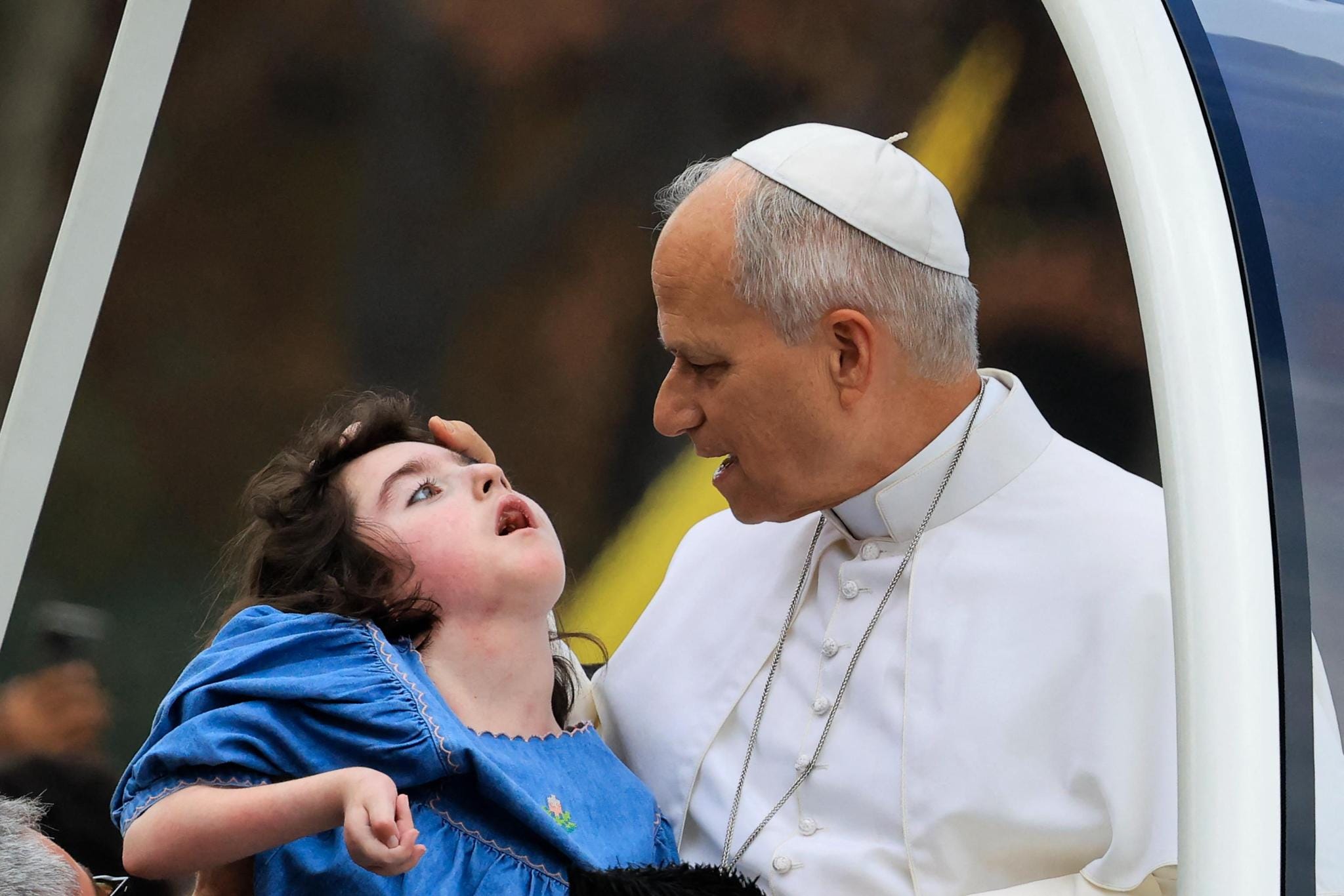
It may well become the most famous photo of the Leonine papacy, and deservedly so. When he embraced her, he seemed to embrace every sick and suffering person clinging to the heart of Jesus.
Friends sent me the picture over the weekend, of course. And I was moved by it. Kate and I have some common cause with Marie-Garance’s family — our own adopted children have significant disabilities, and Max, especially, carries a web of neurological complications that make life for him very difficult. We could imagine what their parents felt when their daughter was taken up as Christ by the bishop of Rome.
But I was struck all the more by another moment on the trip, one which has gone much more unnoticed. I’m not sure of the details, I’ve seen only the video clips a few times online.
As the pope processed along a corridor, he stopped to greet three adult men with profound disabilities. He talked with each for a few moments. He held their hands. He seemed to encounter them as brothers.
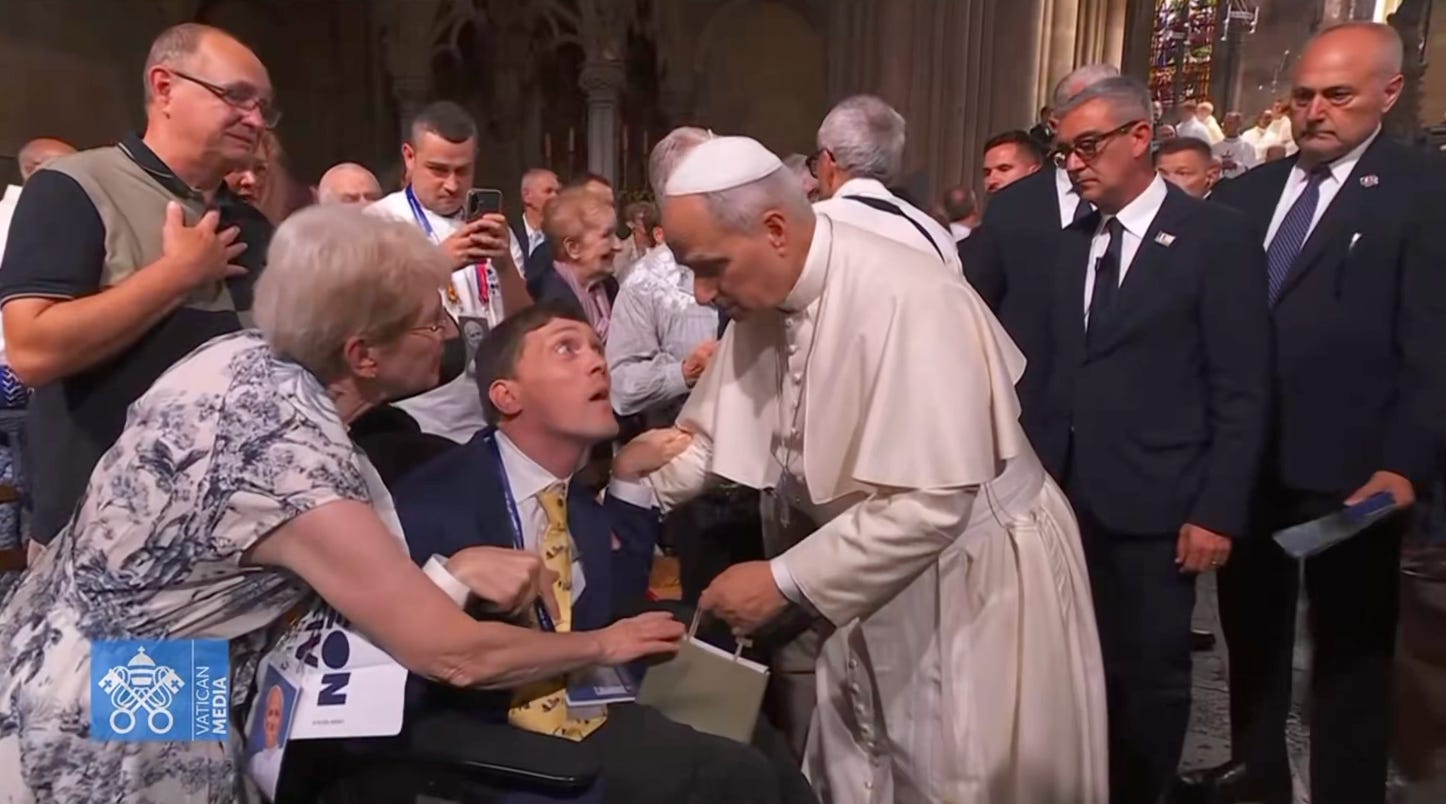
It was far less visible, far less public, and while the pope could have greeted these men perfunctorily, he instead lingered with them. He gave them the gift of himself, for as long as he could spare. In France, he pointedly offered them égalité — and a witness to what that really means.
And, well, there’s another reason it struck me as powerful. We’re hard-wired as a species to love children, and to have some natural sympathy, at least, for vulnerable children. Even people who would support the abortion of disabled children tend to have some natural sympathy when they see them in the flesh — some movement of the heart, however small.
Adults with profound disabilities are actually all the more vulnerable in some ways: They are not productive in the way we expect adults to be, they do not have control of their bodies, their medical equipment can be scary — and they’ve long aged past the cover of cute, which might help us to overlook our discomfort.
Adults with profound disabilities more often make us uncomfortable, and more often face the prospect of stigmatization or marginalization. Today, that goes to a dark place: the soft expectation that some of them will do the “decent thing,” pay a visit to the doctor, and spare us the inconvenience of their existence.
Those are the people for whom the pope made time. Those are the men with whom the pope talked fraternally. For them and their families, it no doubt said a great deal. And the rest of us ought to be listening.
Here’s the news.
The news
Here’s a snapshot of some highlights in Pope Leo’s trip to France. Check it out.
That’s right, “Rudy.”
—
A Zambian archbishop was in court Monday, pleading not guilty to charges of possessing a government-owned vehicle which he had no right to possess.
Archbishop Alick Banda appeared in court to answer a charge that he possessed a Toyota Hilux between 2021 and 2023 that was suspected of being taken unlawfully from the Zambia Revenue Authority.
If the bishop did possess property stolen from the government, it will have to be proven that he did so knowingly. In the meantime, he spent the night in jail Monday night, after a snafu with the country’s bail system — at least that’s the official explanation. Some on the ground are murmuring that the “mistake” was far from that, and meant to send a message to the archbishop.
—
Vatican delegates gave a clarification last week, confirming that Fr. Carlos Miguel Buela, the late founder of the Religious Family of the Incarnate Word, was found by Church tribunals with “moral certainty” to be responsible for abuse, amid ongoing denial from some members of the group.
The reason for the clarification is this: While the Vatican tries to reshape the religious institutes founded by Buela, some ranking leaders in those groups have insisted that Buela’s guilt was not “legal established” because the priest died in 2023 before the canonical proceedings had concluded.
On the whole, the Institute of the Incarnate Word and its female counterpart, the Servants of the Lord and the Virgin of Matará, have been accused of failing to reconcile with or accept the abusive behavior of their founder, and of continuing to promote his writings and hagiography. There is a lot of evidence that those accusations are true. And the Vatican’s latest step is to say, essentially, “no more. This man is guilty.”
This is a make or break moment for the religious orders formed in Buela’s image. Either they will accept the judgment of the Church, or they may face suppression — a move the Apostolic See has long taken pains to avoid.
—
Today is a very significant day in the Syriac Catholic Church.
Almost a month ago, bishops of that 160,000 member Syriac Catholic Church moved to depose their leader, Patriarch Ignatius Youssef III Younan. They were able to do so because of a recent law promulgated by Pope Leo, which gives the governing synods of Eastern Catholic Churches the power to oust their patriarchal leaders — with a papal confirmation — if the patriarch’s leadership has become detrimental to ecclesial communion.
Last week, Patriarch Youssef told me in an exclusive — and very frank — Pillar interview that the law came because of pressure from the prefect of the Dicastery for Eastern Catholic Churches, with whom the leaders of most Eastern Catholic Churches have grown frustrated, he said.
He also said that the move to oust him stems from a personality conflict with a Syriac Catholic bishop who’s been living in Rome too long. That bishop has not responded to my requests for comment.
But however it came about, the Syriac Catholic bishops are scheduled to meet near Beirut today and tomorrow to discuss their patriarch, and his possible removal from office. We don’t yet know how that meeting turned out. But we do know that yesterday the patriarch said the meeting is canonically unlawful.
I suspect that if there is a vote to oust him, Patriarch Youssef will appeal to the pope personally. But as of yesterday, he seemed to express hope that at least some Syriac bishops would skip the meeting, in deference to his authority and judgment.
Now, you might be tempted to see all of this as just position-jockeying infighting among Eastern Catholic prelates. But there’s a significant theological question at stake, about the nature of the relationship between the Roman pontiff, the patriarch of a sui iuris Eastern Catholic Church, and the governing synod of that Church. And many Eastern Catholics say that Leo’s prefect for their churches — Cardinal Claudio Gugerotti — is not attentive to theological issues at play, or to the traditions and customs of their churches.
At the end of the day, is being a sui iuris just living as an unusual flavor of ordinary Catholic ice cream, or is the status of a Church-in-communion-with-Rome supposed to afford more autonomy than the law promulgated by Leo seems to offer?
That’s at least how some Eastern Catholics see the question — with one prominent (non-Syriac) hierarch telling The Pillar recently that Leo’s law has “authorized coups.”
In short, Eastern Catholic Church leaders are watching very carefully what’s happening in the Syriac Catholic Church. And however the next few days unfold, Leo’s got some unhappiness brewing among the patriarchs and major archbishops of the Catholic East. If not handled soon, that issue will only ferment into fomenting patriarchal unrest.
In an influencer-tinged world, that’s an important lesson. Read about it here.
—
And at Fulton Sheen’s beatification last week, I found myself surprised by the sheer number of people to whom the beati seems really important. I’ve been trying to work out for myself why Sheen matters — why he’s more than a figure of sepia-tinged nostalgia.
For myself, I’ve really come around to an idea we discussed briefly on the The Pillar Podcast last week — that Sheen models a certain kind of masculinity which is confident without being domineering, which views his interlocutors as the prize, rather than the enemy. That Sheen, in other words, is confident enough in the veracity of his words that he doesn’t need to assert himself in a way that views “destroying” anybody as the objective of an apologetics or evangelical conversation.
This is needed now, when the atmosphere of the internet and our political climate rewards a certain kind of combativeness as the proper approach to every engagement — Sheen had little interest in being right as an expression of power or self-assertion, so much as he did in actually convincing his audience of the Gospel itself.
Sheen has been presented often as a man who embraced available new technology as a means of proclaiming the Gospel. And he did jump on TV just as soon as that was possible. But it seems to me he did it in a way that was meant to make the Gospel more human to his viewers — he jumped him into a technology which allowed him to convey his face, his voice, his mind, and his heart. His program was cor ad cor, straight through the television set.
This is a point that Benedict XVI made frequently about the evaluation of technology — does it allow us to foster more authentically human connections to each other, or does it create impediments to that human connection? I think Sheen would have been discerning about that question. And so should we.
Head-to-head combat
Finally, an update on Moby Dick.
Really.